Clark Ashton Smith – Averoigne: vol 3, excerpts

I can’t recommend highly enough this collection. Just look at those covers! Note the inclusion of CAS himself, from young to mature from book 1 to 4. Volume 3 has three Averoigne stories: The Holiness of Azédarac, The Makers of Gargoyles and the Colossus of Ylourgne. Those are less evocative than the previous ones in my opinion but in some ways they offer more background material for the Averoigne setting and, moreover, excellent gaming material.

The Holiness of Azédarac

  • […] I wisely thought to review my library; and I have found that the Book of Eibon, which contains the oldest incantations, and the secret, man-forgotten lore of Iog-Sotôt and Sodagui, is now missing.
  • In a chill flash of horror, his memory told him that the thin, pointed features behind the square beard were dubiously similar to those of Jehan Mauvaissoir, whom he had often seen in the household of Azédarac, and who, as he had reason to believe, was implicated in the Bishop’s sorceries.
  • « I am Moriamis, the enchantress, and the Druids fear my magic, which is more sovereign and more excellent than theirs, though I use it only for the welfare of men and not for their bale and bane. »
  • He [Azédarac] was the wisest and the mightiest of sorcerers, and the most secret withal ; for no one knew the time and the manner of his coming into Averoigne, or the fashion in which he had procured the immemorial Book of Eibon, whose runic writings were beyond the lore of all other wizards. He was a master of all enchantments and all demons, and likewise a compounder of mighty potions. Among these were certain philters, blended with potent spells and possessed of unique virtue, that would send the drinker backward or onward in time.

The Makers of Gargoyles

  • At that time, in the year of our Lord, 1138, Vyônes was the principal town of the province of Averoigne. On two sides the great, shadow-haunted forest, a place of equivocal legends, of loupsgarous and phantoms, approached to the very walls and flung its umbrage upon them at early forenoon and evening. On the other sides there lay cultivated fields, and gentle streams that meandered among willows or poplars, and roads that ran through an open plain to the high châteaux of nobles lords and to regions beyond Averoigne.
  • Of course, as in all medieval towns, there had been occasional instances of alleged sorcery or demoniacal possession; and, once or twice, the perilous temptations of succubi had made their inroads on the pious virtue of Vyônes. But this was nothing more than might be expected, in a world where the Devil and his works were always more or less rampant. No one could possibly have anticipated the reign of infernal horrors that was to make hideous the latter months of autumns, following the cathedral’s erection.
  • Armed with holy water and aspergillus, and accompanied by many of the towns-people carrying torches and staves and halberds, the priest was led by Maspier to the place of the horro; and there they had found the body of Mazzal, with fearfully mangled face, and the throat and bosom lined with bloody lacerations. The demoniac assailant had flown; and it was not seen or encountered again that night; but those who had beheld its work returned aghast to their homes, feeling that a creature of nethermost hell had come to visit the city, and perchance to abide therein.

The Colossus of Ylourgne

  • The thrice-infamous Nathaire, alchemist, astrologer and necromancer, with his ten devil-given pupils, had departed very suddenly and under circumstances of strict secrecy from the town of Vyônes. It was widely thought, among the people of that vicinage, that his departure had been prompted by a salutary fear of ecclessiastical thumbscrews and fagots. Other wizards, less notorious than he, had already gone to the stake during a year of unusual inquisitory zeal; and it was well-known that Nathaire had incurred the reprobation of the Church.
  • Among the people of the city, there was one man who took no part in the somber gossip and lurid speculation. This man was Gaspard du Nord, himself a student of the proscribed sciences, who had been numbered for a year among the pupils of Nathaire but had chosen to withdraw quietly from the master’s household after learning the enormities that would attend his further initiation. He had, however, taken with him much rare and peculiar knowledge, together with a certain insight into the baleful powers and night-dark motives of the necromancer.
  • Ylourgne, a great, craggy pile that had been built by a line of evil and marauding barons now extinct, was a place that even the goatherds preferred to shun. The wrathful specters of its bloody lords were said to move turbulently in its crumbling halls; and its châtelaines were the Undead. No one cared to dwell in the shadow of its cliff-founded walls; and the nearest abode of living men was a small Cistercian monastery, more than a mile away on the opposite slope of the valley.

Clark Ashton Smith – Averoigne: vol 2, excerpts

There’s only one Averoigne story in volume 2 but it’s a great one, very evocative:

(A Rendezvous in Averoigne)

« Somewhere in this wood, there was the ruinous and haunted Château des Fausseflammes; and , also, there was a double tomb within which the Sieur Hugh du Malinbois and his chatelaine, who were notorious for sorcery in their time, had lain unconsecrated for more than two hundred years. Of these, and their phantoms, there were grisly tales; and there were stories of loupgarous and goblins, of fays and devils and vampires that infested Averoigne.

[…]

Gérard surveyed his environment with a cautious eye; and the more he looked the less he liked it; for some new and disagreeable detail was manifest at every glance. There were moving lights in the wood that vanished if he eyed them intently; there were drowned faces in the tarn that came and went like bubbles before he could discern their features. And, peering across the lake, he wondered why he had not seen the many-turreted castle of hoary stone whose neared walls were based in the dead waters. It was so grey and still and vasty, that it seemed to have stood for incomputable ages between the stagnant tarn and the equally stagnant heavens. it was ancienter than the world, it was older than the light; it was coeval with fear and darkness; and a horror dwelt upon it and crept unseen but palpable along its bastions. »

[…]

« Raoul », said the troubadour a little sternly,  » you must gather all your strength and come with me. Amid the gloomy walls that surrond us, the somber ancient halls, the high towers, and the heavy bastions, there is but one thing that veritably exists; and all the rest is a fabric of illusion. We must find the reality whereof I speak, and deal with it like true and valiant Christians. Come, we will now search the castle ere the lord and chatelaine shall awaken from their vampire lethargy. »

He led the way along the devious corridors with a swiftness that betokened much forethought. He had reconstructed in his mind the hoary pile of battlements and turrets as he had seen them the previous day, and he felt that the great donjon, being the center and stronghold of the edifice, might well be the place which he sought. With the sharpened staff in his hand, with Raoul lagging bloodlessly at his heels, he passed the doors of many secret rooms, the many windows that gave on the blindness of an inner court, and came at last to the lower story of the donjon-keep. »

Clark Ashton Smith – Averoigne: vol 1, excerpts

As I’ve stated many times already on this blog, I’m a big fan of CAS. I’ve put Castle Xyntillan (of the eponymous adventure module) into Averoigne, CAS’ fictional France setting. I’m already using some of its characters and places in our rpg game and I’m planning to add a few other things inspired by those stories too. Can’t say too much at the moment but here’s some excerpts to help vindicate my choice:

(The End of the Story)

« [Gérard de Venteillon] found his way to the ruins of the Château des Faussesflammes, which stands on a hill opposite the Benedictine abbey of Périgon.

Now these ruins (said the manuscript) are very old, and have long been avoided by the people of the district; for a legendry of immemorial evil clings about them, and it is said that they are the dwelling-place of foul spirits, the rendezvous of sorcerers and succubi. But Gérard, as if oblivious or fearless of their ill renown, plunged like one who is devil-driven into the shadow of the crumbling walls, and went, with the careful groping of a man who follows some given direction, to the northern end of the courtyard. There, directly between and below the two centermost windows, which, it may be, looked forth from the chamber of forgotten chatelaines, he pressed with his right foot on a flagstone differing from those about it in being of a triangular form. And the flagstone moved and tilted beneath his foot, revealing a flight of granite steps that went down into the earth. Then, lighting a taper he had brought with him, Gérard descended the steps, and the flagstone swung into place behind him.

On the morrow, his betrothed, Eleanor des Lys, and all her bridal train, waited vainly for him at the cathedral of Vyônes, the principal town of Averoigne, where the wedding has been set. And from that time his face was beheld by no man, and no vaguest rumor of Gérard de Venteillon or of the fate that befell him has ever passed among the living… »

(The Satyr)

« The couple [Olivier du Montoir and Comtesse Adèle] had wandered beyond the limits of their customary stroll, and were nearing a portion of the forest of Averoigne where the trees were older and taller than all others. Here, some of the huge oaks were said to date back to pagan days. Few people ever passed beneath them; and queer beliefs and legends had been attached to them by the peasantry for ages. Things had been seen within these precincts whose very existence was an affront to science and a blasphemy to religion; and evil influences were said to attend those who dared to intrude upon the sullen umbrage of the immemorial glades and thickets. The beliefs varied, and the legends were far from explicit; but all agreed that the wood was haunted by some entity inimical to man, some primordial spirit of ill that was ancienter than Christ or Satan. Panic, madness, demoniac possession, or baleful, unreasoning passions that led them to doom, were the lot of all who had trodden the demesnes of this entity. There were those who whispered what the spirit was, who told the incredible tales regarding its true nature, and described its true aspect; but such tales were not meet for the ear of devout Christians. »

Gods Ghost and Men in Melanesia – extract IV

Here’s a ghost with gigantic testicles and a nature spirit with an extremely long leg that he uses to trip people. One could make an incredible bestiary from this book, I’m telling you.

Spells involving the name of the ghost to be called are recited as ginger is chewed. The ginger is next spat on to an object, and the spirit then comes and resides invisibly in this object. The invisible ghost is thus induced to inhabit a bracelet, knife, or a piece of ceremonial paraphernalia for an indefinite period.

___________

The names of some of these spirit forms are translatable or have obvious derivations. Thus the balepa (from a word meaning « wrapped bundle ») is a corpse which flies over the villages wrapped in burial mat. The tarogolo (from a verb meaning « to change form ») impersonates the living and kills human victims by various horrible methods including intercourse made lethal by obsidian blades in the genitals of the spirit. Only two types are limited to one sex. One of these is the bleeding women who have died in childbirth and are known as pigobara (pigo, « to give birth »; bara, « badly »). The other is the leader of the ghosts distinguished by his gigantic testicles and called putuperereko (putu, « scrotum »). The names of other special types have no known translations and appear to be simple class denominations. The visu flies at night, shines with a great light, and gouges out people’s eyes with long fingernails. The savei, which also lights up, and the tausogolo are wild, shy forms inhabiting the forest and seldom seen close at hand.

___________

A special category consist of disease-bearing spirits called taua-la-ilea (« taua of sickness »). These usually appear as gigantic, multi-coloured, four-footed animals like dogs or pigs, though they are also said to take human form. There is such a spirit which is afflicted with and spreads abroad each of a large variety of illnesses. They may appear in groups, coughing and groaning as they come, bringing epidemics to human villages.

___________

The most important powers which this god [Sumua] has exercised over human fortunes have been his control over the food supply and over the volcanic energy of Mt Pago. He has the ability to cause famine or plenty by controlling the growth of taro.

___________

As was the case with the specific forms of ghost outlined earlier, among the bush spirits some of the type names have more or less clear derivations, For example, two forms of mischievous long-haired dwarf, known as pii and tuu respectively, are said to be named for their vocal cries. The suguala (sugu-a, « to push forward, extend ») is a prankster which shoots one extremely long leg out across paths to trip people. The viri (viri-a, « to twist ») is a stunted being distinguished by twisted limbs which it owes to an arthritis-like illness. A form that eavesdrops on the plans of the living and then lures its victims by impersonating a friend or loved one is called the lolomaholi (lolo-a, « to hear, overhear »). The matea lights up at night but seldom injures men. The buata and a number of similar monsters are giant ogres or ogresses equipped with great tusks and renowned as man-eaters.

Several of the dwarfed forms are the least offensive or frightening of the bush spirits. Both the pii and another pygmy type called the patuki constitute exceptions to the general rule that men do not seek contact with such beings. There are several stories of people capturing these little spirits, taming them, training them to be useful workers, keeping them as playmates for human children, and sometimes becoming quite fond of them. It is one more instance of the incompatibility of human and spirit natures that these captivities always seem to end with the dwarfs escpaing to the bush once more.

(not) dying in the battlepits of Krarth-V

C’est un succès! Après 5 essais, c’est pas mal.

Arrivée à Kalugen’s Keep – Intro

À tous les ans, un prestigieux concours a lieu dans les plaines de Krarth. Les Magi se choisissent des champions qui s’affronteront dans le Labyrinthe sous la citadelle; ceux qui parviendront à en sortir vivant avec l’Emblème de la Victoire connaîtront gloire et fortune. Mais la plupart y trouveront la mort!

5ème essai

  1. Isaac – Trickster
  2. David – Enchanter

  • Nous choisissons l’étendard de Balthazar.
  • Au bal masqué, nous arrivons à trouver Balthazar par la toute puissante force de la déduction. Nous le défendons ensuite contre un assassin.
  • Une fois dans le labyrinthe, nous allons voir Larisha. Donne-nous des cadeaux. Allez, allez allez.
  • Nous passons par le miroir/porte secrète
  • Nous suivons les barbares à distance. Nous surprenons 2 d’entre eux dans une pièce, que nous éliminons juste avant que les 2 autres arrivent, qui rejoindront leurs compagnons dans l’au-delà
  • Dans cette pièce, nous trouvons des parchemins magiques très utiles
  • Nous gagnons une partie de Spirales:
« Alors le jeu consiste en… » QUATRE « Euh oh, vous avez gagné bravo… »
  • Nous envoyons des Dirges plonger dans la lave en leur lançant un Joyau de Glace
  • Nous traversons les ponts. Le Trickster se fait voler (cette fois) tout ce qu’il avait sauf son arme et armure. Il en est bien triste. L’Enchanteur ne passe pas par la cascade et se trouve confronté à Guillarme le Cauchemar (cool name), son ennemi d’antan, qu’il parvient à vaincre sans trop de problèmes
  • Nous prenons des potions de sorcières, les non-toxiques, merci
  • Nous prenons un portail de téléportation
  • Nous traversons une rivière de lave en nous servant d’une porte massive
  • Nous nous retrouvons cernés par des créatures de lave, ce qui aurait pu être notre perte si l’Enchanteur n’avait pas réussi un sort de Fuite Immédiate!
  • L’Enchanteur parvient à faire un sort de Enthrall sur l’Homme-Dirge, ce qui le force à nous obéir pour nous aider à traverser la crevasse
  • Nous affrontons Icon the Ungodly (cette fois en bon état), le Trickster est blessé au cours du combat et se met en mode esquive pour la suite, pendant que l’Enchanteur achève le warlock à coup de sort. Icon se sauve en se transformant en brume rouge.

(pro-tip: contre un ennemi unique puissant, un perso en mode defend, tandis que les autres attaquent à distance s’ils le peuvent)

  • Nous trouvons un Maillet de Bronze après le combat, nous nous en servons sur un gong géant ce qui nous téléporte sur un amas flottant en l’air, avec un sarcophage impressionnant dessus. Le Vrai Mage Zyn, désincarné, nous demande d’accomplir sa vengeance. Nous acceptons et il nous donne le coeur fossilisé du Géant Skrymyr. Merci. Mais yeuhk.
  • Nous trouvons les différentes parties disséminées du squelette du géant et nous l’assemblons dans un carcan de métal. Zyn lui insuffle à nouveau la vie
  • Nous soulignons à Skrymyr que nous l’avons aidé, sa façon de vouloir nous récompenser est de nous envoyer à la Mort. Le sacripan.
  • Le Trickster se met immédiatement en mode esquive tandis que l’Enchanter se concentre sur son sort d’attaque le plus puissant. Deux Nemesis Bolt plus tard et nous avons vaincu le géant fair and square!
  • Nous nous emparons de l’Emblème de la Victoire. Nous avons une récompense supplémentaire pour avoir éliminé Skrymyr
  • Victoire Alleluia!

Dying in the Battlepits of Krarth – III

Maman Ours a accepté de se joindre à nous! Nous allons donc jouer à 4, c’est Maman Ours qui prendra les décisions (avec quelques conseils d’Isaac).

Arrivée à Kalugen’s Keep – Intro

À tous les ans, un prestigieux concours a lieu dans les plaines de Krarth. Les Magi se choisissent des champions qui s’affronteront dans le Labyrinthe sous la citadelle; ceux qui parviendront en sortir vivant avec l’Emblème de la Victoire connaîtront gloire et fortune. Mais la plupart y trouveront la mort!

3ème essai

  1. Edmond – Warrior
  2. Julie – Sage
  3. David – Enchanter
  4. Isaac – Trickster

  • Nous choisissons l’étendard de Balthazar.
  • Au Bal masqué, le Sage lit les pensées des convives, tous sont protégés de cette intrusion mentale, sauf un. Nous l’attaquons…
  • Nous tuons l’Homme-en-Bleu, un assassin envoyé pour tuer Balthazar. Ce dernier nous récompense, il donne au Guerrier l’épée magique Buveuse-de-Sang. De plus, il accepte que nous le représentions et nous donne un Prisme Octogonal
  • Nous entrons dans le labyrinthe après avoir mangé copieusement.
  • Dans la première pièce, nous inspectons une alcôve et nous nous faisons téléporter dans un jardin féérique, en présence de Larisha Celle-qui-donne, qui nous offre de choisir entre plusieurs objets magiques. Le Trickster reçoit la Dague de Vislet, ayant appartenu au Prince des Voleurs. Puis nous revenons au labyrinthe, au même endroit.
  • Nous cheminons le long d’un corridor bordé de miroirs, le Sage détecte la présence d’une puissante entité de l’autre côté des portes de bronze ainsi que de pensées primales derrière les miroirs. Le Trickster tapote les miroirs et en trouve un seul derrière lequel ne semble pas se cacher quelque chose. Il trouve une porte secrète derrière celui-ci.
  • Dans un autre corridor nous voyons par une grille à nos pieds, un groupe de barbares passer en dessous. Nous attendons quelques minutes. Les barbares reviennent sur leurs pas, quelque peu blessés maintenant, ils ont combattus des assassins. C’est le moment pour nous de les attaquer par surprise. Nous triomphons, mais non sans quelques blessures aussi.
  • Nous arrivons dans une pièce avec de nombreuses alcôves, certaines contenant des statues. Celles-ci, étrangement font face au mur. Le Sage inspecte une alcôve vide et est instantanément pétrifié, le pauvre.

Maman Ours s’en voudra d’avoir fait ce choix, après coup! Elle jouera (brièvement) l’Enchanteur par la suite.

  • Nous continuons, un compagnon en moins. Nous arrivons à l’amphithéâtre, où nous remportons une partie de Spirales contre le Grand-maître Klef.
  • Nous sommes téléportés dans le profondeurs du labyrinthe. Nous passons l’épreuve des deux ponts et arrivons au temple des sorcières.
  • L’Enchanteur fait fi de la prudence et goûtent plusieurs concoctions des sorcières, jusuqu’à ce qu’ils succombe dans d’atroces souffrances, empoisonné…
  • Le Guerrier et le Trickster poursuivent à 2, et après plusieurs péripéties, finissent par perdre la vie à leur tour, face à Icon the Ungodly

Dying in the Battlepits of Krarth – II

Arrivée à Kalugen’s Keep – Intro

À tous les ans, un prestigieux concours a lieu dans les plaines de Krarth. Les Magi se choisissent des champions qui s’affronteront dans le Labyrinthe sous la citadelle; ceux qui parviendront en sortir vivant avec l’Emblème de la Victoire connaîtront gloire et fortune. Mais la plupart y trouveront la mort!

2ème essai

  1. Edmond – Warrior
  2. David – Enchanter
  3. Isaac – Trickster
  • Nous échouons à nouveau le test de Balthazar
  • Nous tuons l’importun Dominus Quel et prenons l’étendard de Kalugen
  • Nous gagnons contre lui au Jeu de Hasard, ce qui nous vaudra de garder nos armes cette fois!
  • Nous utilisons à nouveau les services du Gondolier et nous ignorons la bouée de l’Eidolon
  • En débarquant sur la terre ferme, nous sommes embusqués par des araignées géantes mais nous nous en débarrassons avec seulement des blessures légères
  • Nous entendons des barbares conversés entre eux, nous prenons nos jambes à notre cou comme des chiffes molles et parvenons à les semer
  • Nous parvenons à un vaste amphithéâtre, le maître des lieux propose une partie de Spirales (encore un jeu de hasard), nous gagnons et remportons un Joyau de Glace
  • Nous progressons le long d’un chemin escarpés, 6 dirges nous attaquent. Nous les trucidons mais non sans subir plusieurs blessures.
  • Nous arrivons devant 2 ponts côte-à-côte, avec une cascade s’écoulant d’un visage de pierre entre les 2, une puissante magie est à l’oeuvre
  • Le Trickster choisit le pont outre-cascade, vole un voleur invisible et se retrouve devant son ennemi d’antan, Hurondus the Blind, qu’il esquive habilement, ce dernier chute vers sa mort
  • Le Warrior choisit le premier pont et se retrouve dans un combat féroce contre son ennemi d’antan, Beorn Smith-hammer. Il triomphe mais est grièvement blessé.
  • L’Enchanter traverse la cascade et se retrouve en duel contre une magicienne plutôt incapable et triomphe rapidement
  • De l’autre côté il y a un temple. Devant, des sorcières tout ce qu’il y a de plus sorcières, affairées à leurs chaudrons
  • Nous buvons allègrement d’une élixir du chaos, nous procurant une variété d’avantages, et de désavantages, au combat
  • Nous entrons dans le temple et nous retrouvons devant la terrifiante Echnidae, elle nous force par l’esprit à donner de notre sang dans un vase, ce qui provoque une magie nous téléportant dans un second temple à proximité
  • Nous y trouvons un Talisman de la Flamme mais nous sommes aussitôt embusqués par des gargouilles, heureusement nous avons le temps de fuir (pro tip: fuir est souvent une bonne option dans ce livre)
  • Nous sortons du temple, continuons plus loin et peu de temps après, nous sommes confrontés à deux aventuriers/brigands qui nous disent: « la bourse et la vie »
  • le Warrior perd la vie, le Trickster et l’Enchanter fuient à nouveau
  • En contrebas d’où nous nous trouvons, une rivière de lave s’écoule, des êtres de magma se manifestent. Nous montrons le Talisman de la Flamme et ils acceptent de nous obéir. Nous envoyons les êtres de magma contre les deux aventuriers toujours à nos trousses. Ceux-ci sont brutalement incinérés. JUSTICE pour notre compagnon! Nous trouvons une Bride Dorée parmi les restes calcinés
  • Nous arrivons devant une crevasse impassable, un Homme-Dirge se moque de nous. Le Trickster utilise la ruse et la Bride Dorée pour obliger l’Homme-Dirge à nous faire traverser
Ne pas faire confiance aux inconnus
  • De l’autre côté, nous rencontrons Icon the Ungodly le warlock. Ils nous offrent une alliance, nous acceptons mais ce n’était qu’une ruse, il nous attaque par surprise, le scélérat! Le Trickster esquive habilement mais se fait finalement pourfendre, il était déjà dans un état critique. L’Enchanter avec un dernier sort d’Épée de Force parvient à occire le warlock, mais il ne continuera pas l’aventure sans ses deux compagnons…

Dying in the Battlepits of Krarth – I

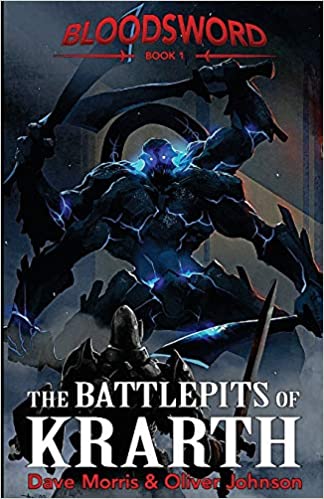
Battlepits of Krarth est un Livre dont vous êtes le Héros, le premier de la série Bloodsword par Dave Morris et Oliver Johnson. Je l’ai usé à la corde dans ma jeunesse mais toujours en solo, je ne l’ai jamais essayé auparavant en mode multi-joueurs. Donc cette fois-ci je joue avec mes garçons et c’est Isaac, 8 ans, qui prend les décisions, je ne m’en mêle pas!

Arrivée à Kalugen’s Keep – Intro

À tous les ans, un prestigieux concours a lieu dans les plaines de Krarth. Les Magi se choisissent des champions qui s’affronteront dans le Labyrinthe sous la citadelle; ceux qui parviendront en sortir vivant avec l’Emblème de la Victoire connaîtront gloire et fortune. Mais la plupart y trouveront la mort!

La première étape est de trouver un sponsor, un des Magi maîtres des lieux, mais nous arrivons tard sur place (par défaut) et il n’en reste que trois qui n’ont pas encore de champions à leurs noms.

1er essai

  1. Edmond – Warrior
  2. Isaac – Trickster
  3. David – Enchanter

  • Aussitôt arrivé, le Trickster vole une bourse à un marchand saoul
  • Avec ses nouveaux fonds mal-acquis il soudoie un délégué qui nous indique que le meilleur choix entre les mages restants est Balthazar
  • Nous choisissons donc l’étendard de Balthazar mais celui-ci fait passer un « test d’intelligence » à ceux qui voudraient être ses champions
  • Nous nous rendons au bal masqué où nous devons trouver Balthazar parmi les convives déguisés
  • Nous échouons, Balthazar refuse de nous endosser, et nous devons nous rabattre sur le seul étendard restant, celui de Kalugen, mais nous devons nous battre contre un magicien compétiteur, Dominus Quel, que nous tuons sans trop de difficultés
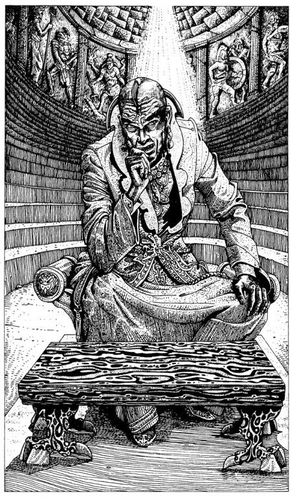
  • Le Magus Kalugen nous fait savoir qu’il est très peu intéressé par la compétition mais qu’il acceptera de nous faire participer si l’on fait un Jeu de Hasard contre lui
Ne jouez pas aux cartes contre un Mage
  • Kalugen est un sale tricheur et nous perdons
  • Après une nuit dans les geôles de Kalugen, nous sommes escortés jusqu’à l’entrée du Labyrinthe
  • Malheureusement nous sommes sans armes mais le bouffon de Kalugen nous a donné un mystérieux parchemin
  • Nous errons dans les corridors souterrains jusqu’à atteindre les berges d’une étendue d’eau
  • Nous payons les services d’un Gondolier sinistre
  • Nous inspectons une bouée étrange portant une inscription qui semble bien être une malédiction, oh que oui…
  • Qu’à cela ne tienne nous tirons sur la chaîne, ramenant une cage à la surface avec à l’intérieur un squelette
  • Il porte un médaillon-scarabée au cou, nous tentons de lui prendre mais à ce moment un Eidolon se matérialise et nous attaque!
  • Sans armes, le combat semble perdu d’avance, en désespoir de cause nous utilisons le parchemin mystérieux
  • Nous sommes téléportés dans une étendue brumeuse, que se passe-t-il?
  • Bonne nouvelle, nous avons échappé à l’Eidolon
  • Mauvaise nouvelle, nous sommes devant un démon de 4 mètres ayant un crâne de cerf en guise de tête et répondant au doux nom de Smeaborg the Fleshless
  • Nous mourrons rapidement, Fin du 1er essai

Herodotus, The Histories -Extract- Labyrinth of Egypt

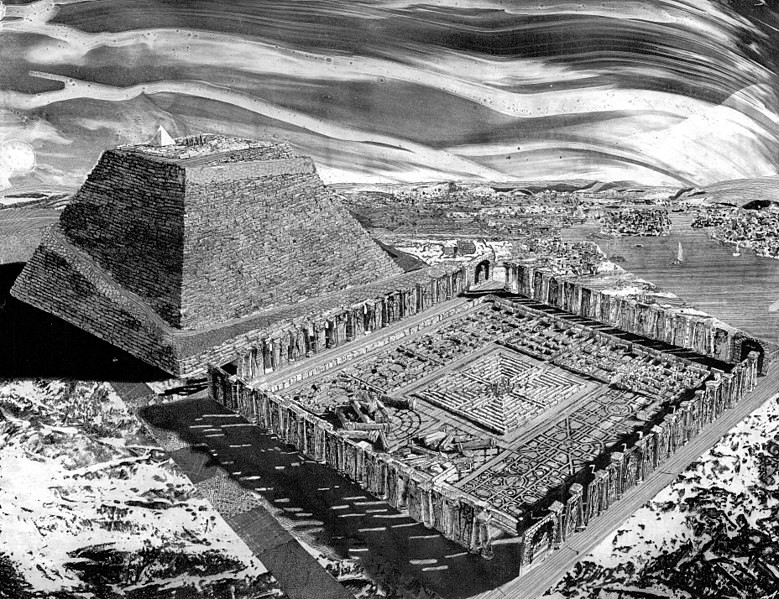
It has twelve courts covered in, with gates facing one another, six upon the North side and six upon the South, one after another. and the same wall surrounds them all outside; and there are in it two kinds of chambers, the one kind below the ground and the other above upon these, three thousand in number, of each kind fifteen hundred. The upper set of chambers we ourselves saw, going through them, and we tell of them having looked upon them with our own eyes. The chambers under ground we heard about only; for the Egyptians who had charge of them were not willing on any account to show them, saying that here were the sepulchres of the kings who had first built this labyrinth and of the sacred crocodiles. Accordingly we speak of the chambers below by what we received from hearsay, while those above we saw ourselves and found them to be the works beyond the human. For the passages through the chambers, and the goings this way and that way through the courts, which were admirably adorned, afforded endless matter for marvel, as we went through from a court to the chambers beyond it, and from the chambers to colonnades, and from the colonnades to other rooms, and then from the chambers again to other courts. Over the whole of these is a roof made of stone like the walls; and the walls are covered with figures carved upon them. each court being surrounded with pillars of white stone fitted together most perfectly; and at the end of the labyrinth, by the corner of it, there is a pyramid of 240 feet, upon which large figures are carved, and into this there is an underground way.

A labyrinth, with an underground level and an adjacent pyramid? That’s a megadungeon right here!

Herodotus, The Histories – Extract – The Gate of the Dead Queen

This same queen [Nitocris] also contrived a snare of the following kind: — Over that gate of the city through which the greatest number of people passed she set up for herself a tomb above the very gate itself. And on the tomb she engraved writing which said: « If any of the kings of Babylon who come after me shall be in want of wealth, let him open my tomb and take as much as he desires; but let him not open it for no other cause, if he be not in want; for that will not be the better way. » This tomb was undisturbed until the kingdom came to Dareios; but to Dareios it seemed that it was a monstrous thing not to make any use of this gate, and also, when there was money lying there, not to take it, considering the inscription itself invited him to do so. Now he would not make any use of this gate because the corpse would have been above his head as he drove through. He then, I say, opened the tomb and found not indeed money but the corpse, with writing which said: « If you had not been insatiable for wealth and basely covetous, you would not have opened the resting-place of the dead. »

This is neat. But I can’t help but think that in lieu of this mild disapproval it should have ended with a terrible world-shattering curse!