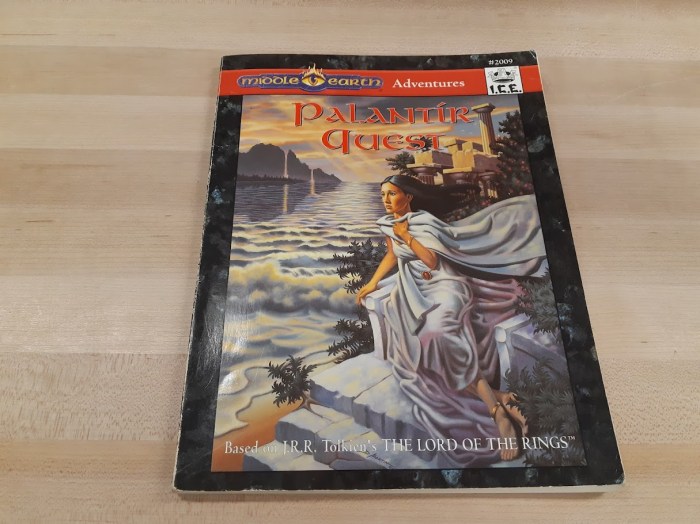
Just to be clear, I’ve never ran this adventure (nor played in it).This is a 3 decades late, external look at it we might say.
At page 14, after having informed the Game Master of relevant background information, the adventure begins with… extremely long read-alouds.
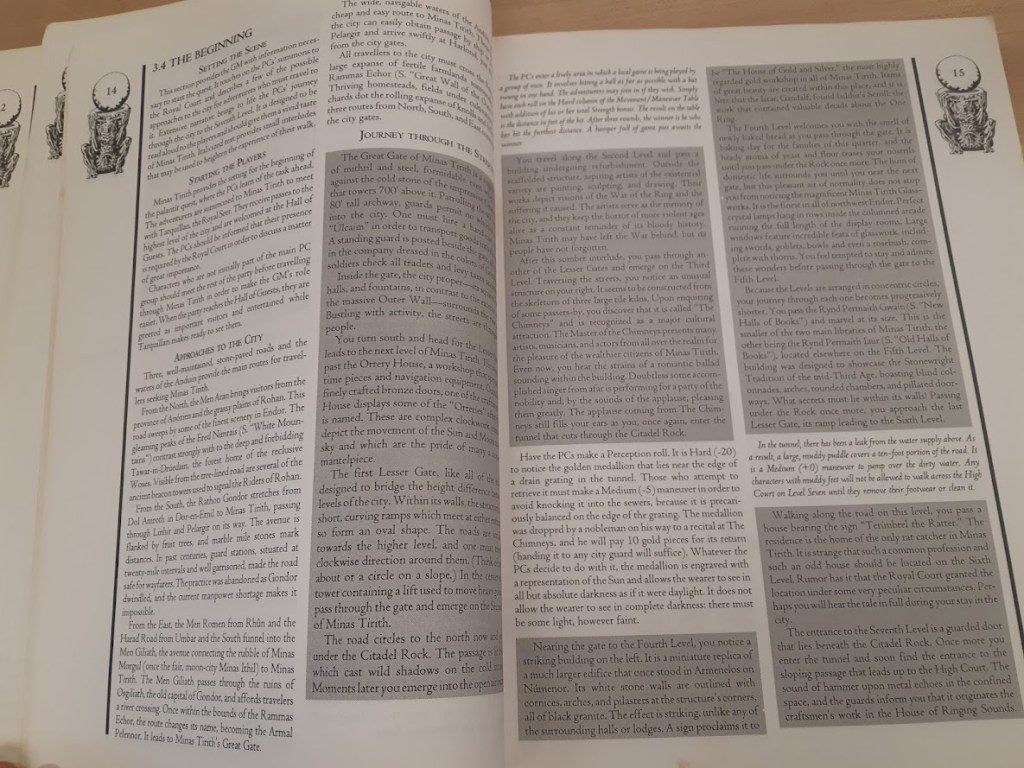
Well-written mind you, interesting for a true Tolkien aficionado perhaps, but boy if my mind would drift away as a player if I was read all this by someone!
But notice, between two grey boxes, a first challenge for the player characters! On how to deal with a « ten-foot portion » of muddy road. Yeah, well, small beginnings and all that…
Railroading into Middle-Earth’s 4th Age
(Side note: There’s a big hint on how the adventure will present itself on chapter 1.0 Guidelines: « Fantasy role playing (FRP) is akin to a living novel where the players are the main characters. Everyone combines to create a story which is never short of adventure. They help forge a new land and strange new tales in which the characters are forever immortalized. » (bold emphasis is mine)
After their mission briefing by the Royal Seer, the Player Characters (PCs) are ready to leave Minas Tirith.
The utlimate goal is to retrieve the lost palantir but in order to do that they first have to reach the Royal Library in ruined Annuminas in the north, to find a tome of spells that will help pinpoint its location. First stop is in Rohan in a place called The Juggler’s Hall.
It takes 10 days of travel to get there and somewhere in the middle we get this fixed event: upon arriving at the Inn of Greys the PCs see that it’s being attacked by bandits and the adventure just assumes that the PCs will intervene (and to be fair, why wouldn’t they?). Upon defeating the bandits the PCs meet Turibor the minstrel who’ll ask if he can accompany them on their journey north. This guy is a key NPC, I mean key as in unlocking another scene kind of thing. He’s the one who will bring the PCs to the Juggler’s Hall and if you had players that were expecting to go to Edoras and meet rohirrim riders they’d better forget about it, aside from taking new horses nothing happens in Edoras. No, instead you get the Thespian Intrigue in the Juggler’s Hall, involving the PCs in a theatre play (about the kin-strife that happened in Gondor, again. not really a nice fit for Rohan). The leader of the Wandering Conscience Company will offer 10 silver pieces and a choice of nice clothes to each character, for participating (acting) and help guard against sabotage from a rival company.
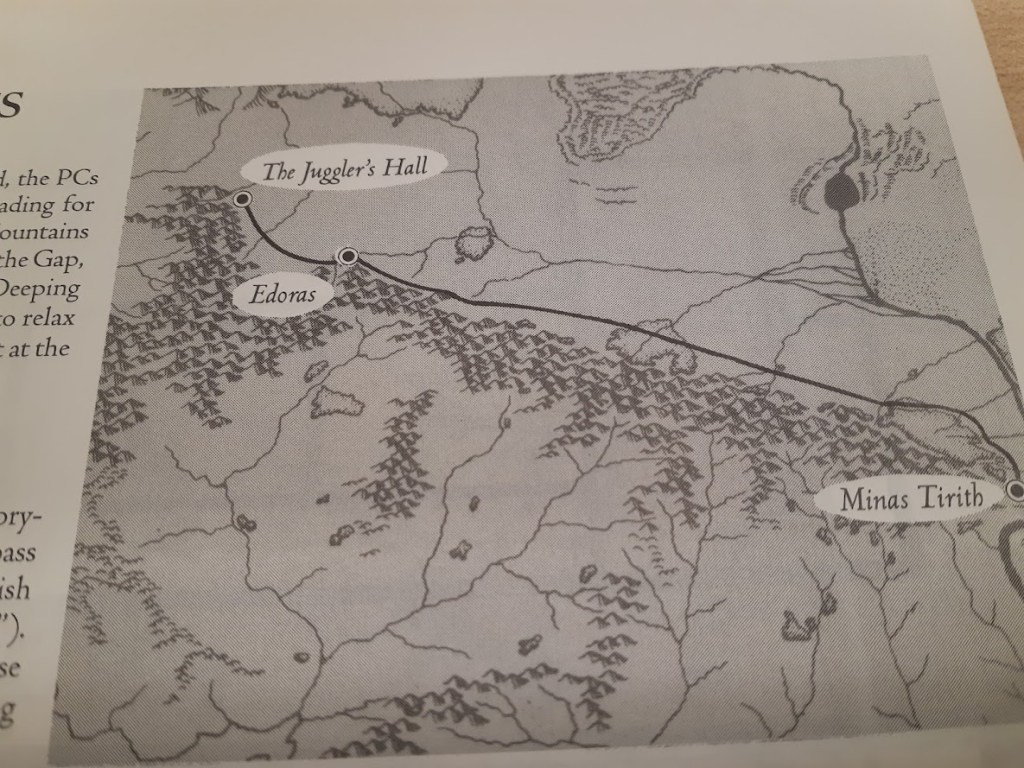
I’ll add that the Juggler’s Hall is oddly, really in the middle of nowhere, but it’s also a base for smuggling operations so there’s that. Talking of smuggling, there’s a bit of foreshadowing in this chapter as it’s mandatory that the PCs witness two NPCs shaking hands in « business-like fashion ». One of these NPC « may draw attention to himself by way of his disturbing laugh ». BUT: « However the PCs should be given no grounds to become suspicious of him ». Well, good luck with that Game Master! Hey players, here’s this fixed scene involving two shady NPCs, one has this disturbing way of laughing, y’know like a cartoon villain would laugh just sayin’, but don’t be suspicious! No no no, no reason at all!
And then the Thespian Intrigue.
The play itself is nicely conceived I’ll say, with a nice plot as mentionned taken from the kin-strife period (a Cromwell-like usurper gets hold of power in Gondor) and plenty of stuff happening (including a real knife stab (instead of a fake one) that the PC victim should try its best to go along with so that the play isn’t disrupted!). Of course the whole thing is nonsensical and out of place (irrelevant to the mission) but I’m pretty sure it could be great fun for the players. The Game Master though, in true Rolemaster fashion, has the cumbersome job to evaluate which + and – to use in the provided chart and get the results for the « Audience Appreciation Level » (AAL): « Having totalled the appropriate modifiers, the actor should roll on the appropriate column. The result is the number to which the GM must roll equal or less than in order for the AAL to increase by 5. If the GM rolls over the number, the AAl decreases by 5. At any time, an AAL of 0 means that the audience boos the company off the stage and leaves, while an AAL of 100 means that the audience immediately rushes the stage in a frenzy of hero worship and adulation. If the play end naturally, then the AAL should be added to an open-ended roll on the Hard column of the maneuver table, and the result is the number which the GM needs to roll under in order for the critics to like the play. »
Phew. I wonder why Rolemaster isn’t a popular system anymore!
Anyway, the PCs can get a substantial bonus reward (or not) depending on how well the play went and also experience points based on what happened so far or « as we recommend, he or she may just award points in a subjective fashion corresponding to how well the players are able to cope with the stress of being onstage ». How well the players cope with the stress of being onstage. Wow, that’s a weird thing to say. I thought the players were like, around a table with pens & papers & dice, not onstage.
This concludes this chapter, a weird one for sure. Next the PCs will leave to continue their journey to Tharbad, en route to the ruined city of Annuminas where they will get to explore a dungeon! Yay!


[…] Part II […]
J’aimeJ’aime
« Phew. I wonder why Rolemaster isn’t a popular system anymore! » lol
J’aimeJ’aime
Yep ! Huge IQ drop in 40 years …
J’aimeJ’aime
That’s one way to looak at it. I’ll say, certainly the attention span in average as dropped a lot.
J’aimeJ’aime
[…] Part II […]
J’aimeJ’aime
[…] Part II […]
J’aimeJ’aime
[…] Part II […]
J’aimeJ’aime