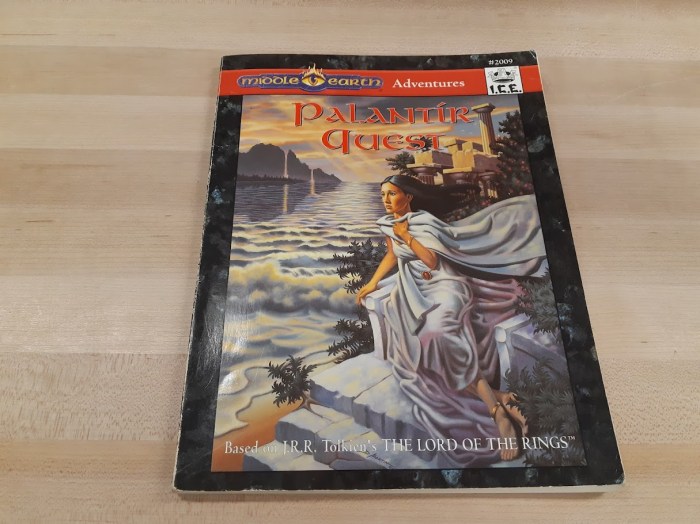
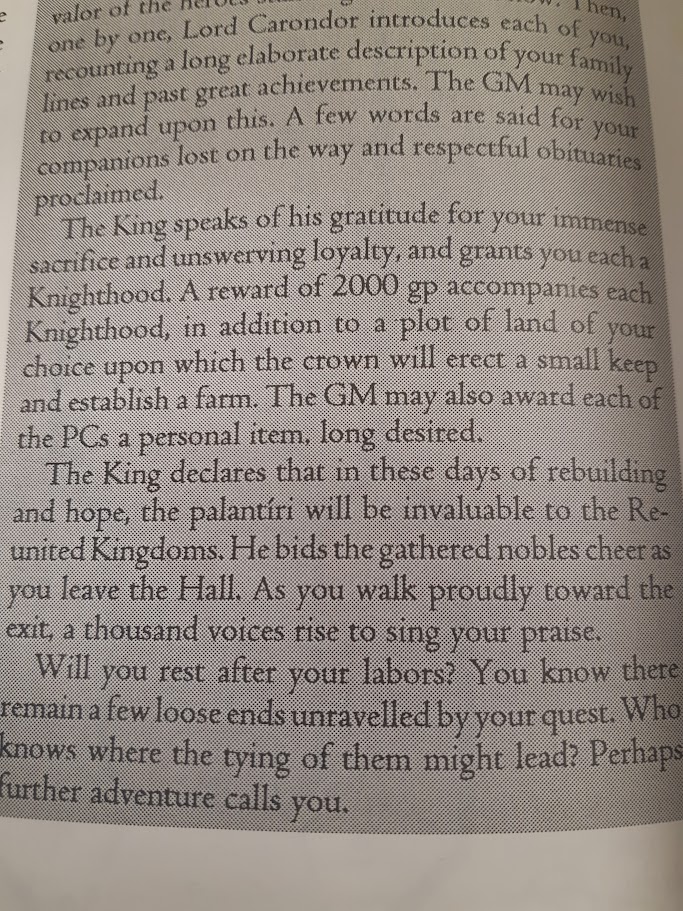
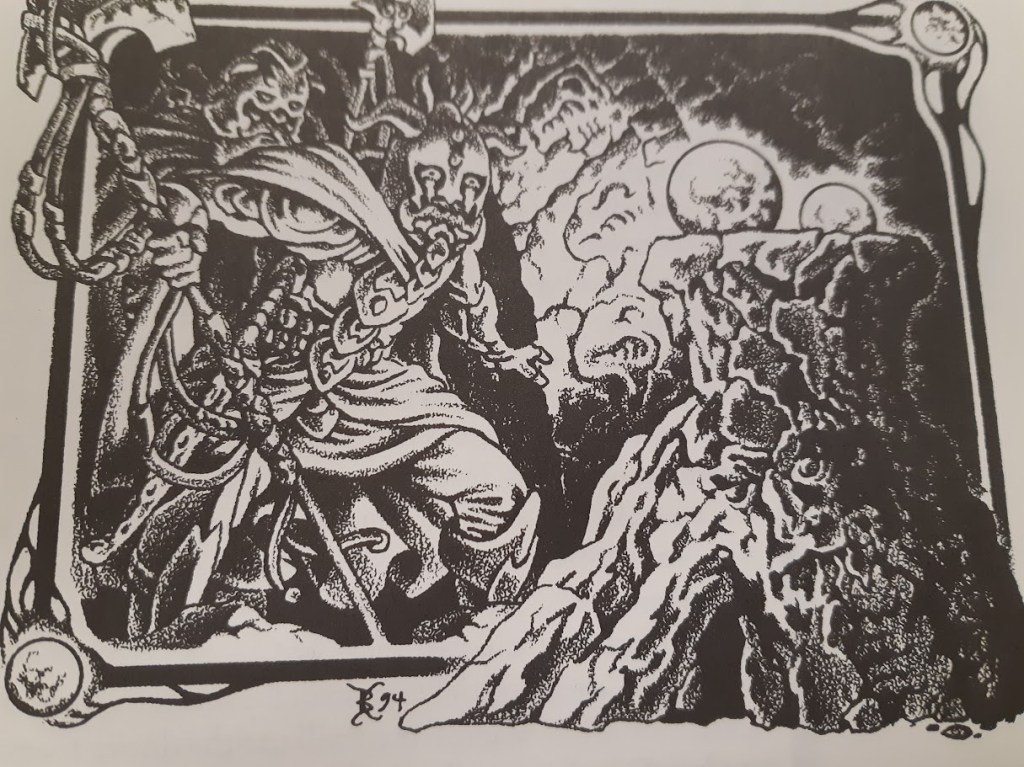
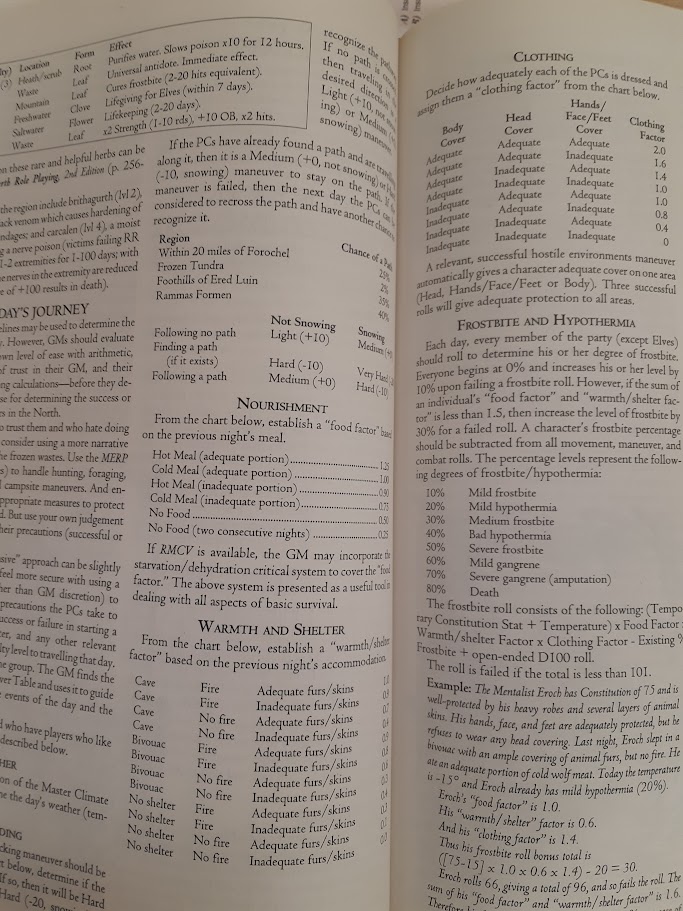
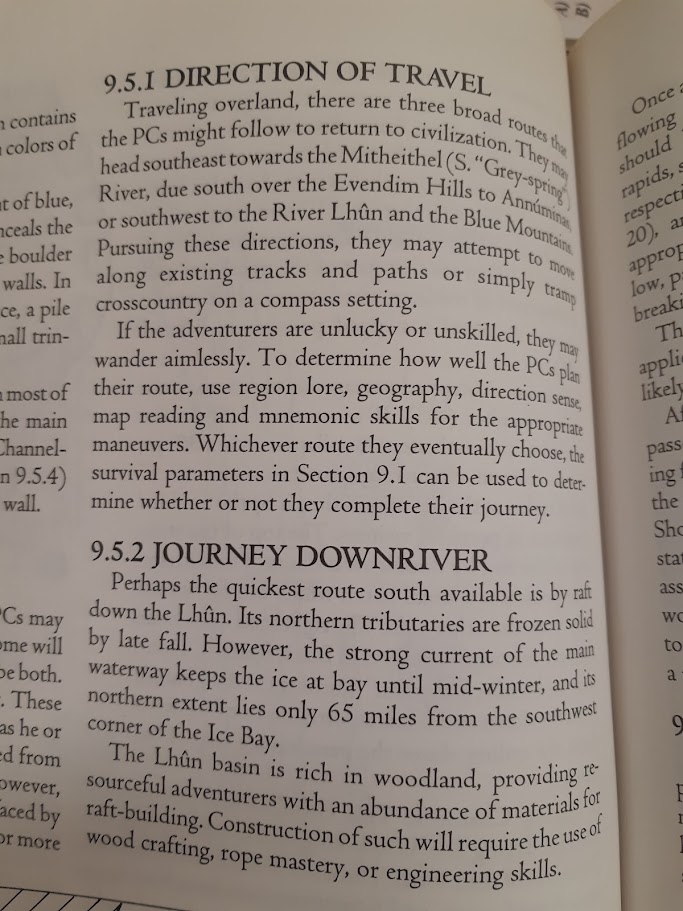
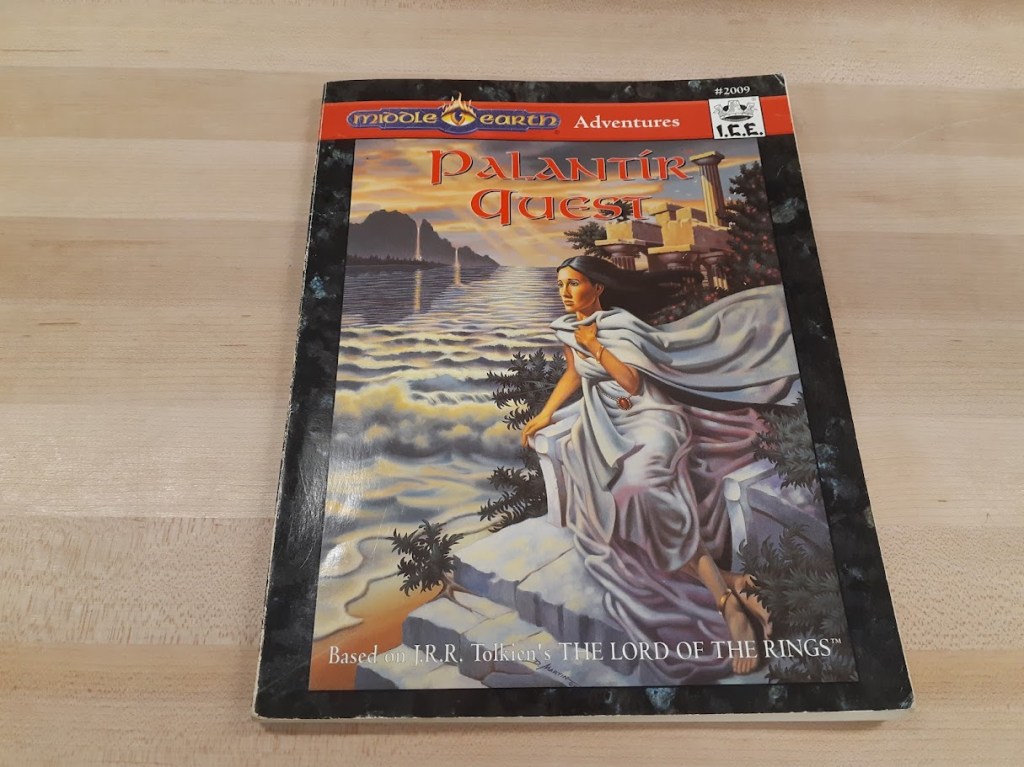
Palantir Quest (1994): look at those ballz (review part IV)

We’re now covering chapters seven, eight and nine of the adventure. With the first two doing all the wrong things in a rpg book and with the latter being actually interesting.

Part I

Part II

Part III

The adventurers have found the locate spell in the Royal Library of Annuminas and upon reading it, they get a strange vision whereas one player get to make a bunch of rolls, of course, and then learn three things:

  • There’s in fact two palantiri to be found!
  • They’re in a cave near a rocky shore.
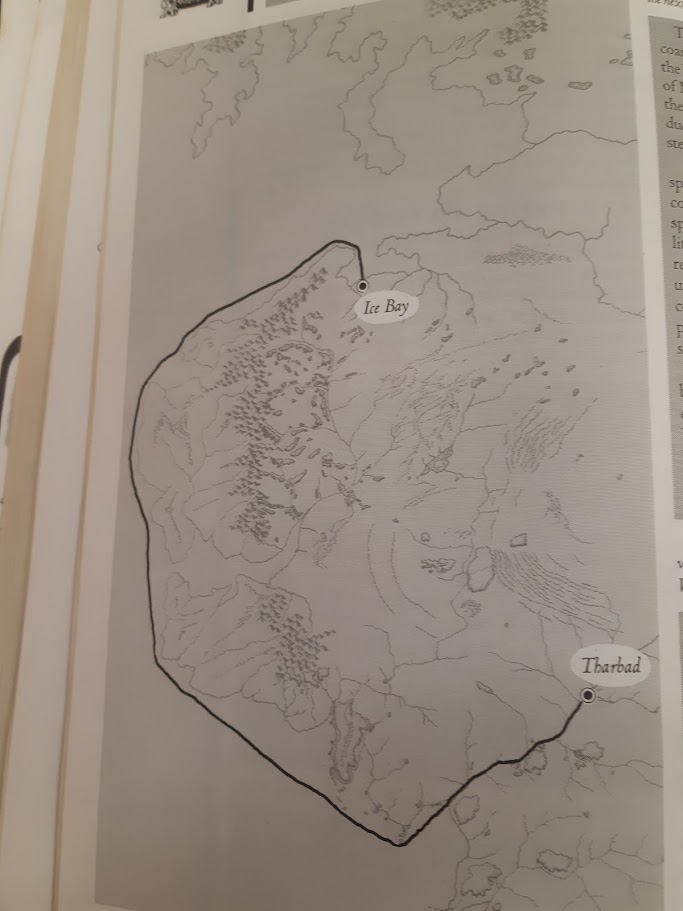
  • Somewhere in the Bay of Forochel in the North.

The Plot Must Go On

Now they must get back to Tharbad as instructed. Commander Cilis requisition a boat, a crew and twenty fighting men to go with them. Before they can leave though, their boat will be the target of sabotage. The player characters can try to pursue the arsonists but as written they’re just impossible to catch. However, a Medium perception roll reveals a document detailing the plan for sabotage and written on a concert program coming from the Juggler’s Hall. Hilariously, if the PCs failed to get this clue they’ll automatically find: « Three, round, wooden balls uncomsumed by the fire also serve as a clue (they are juggling balls) […] ». Just to be sure that the players make the connection (or more likely, shrug it off).

And that was the whole of chapter 7, showing the players that they do indeed have opponents, the kind that bring their juggling balls everywhere they go, whatever they do.

« The Evenstar leaves Tharbad with sailors still repairing the fire damage resulting from the efforts of the saboteurs. »

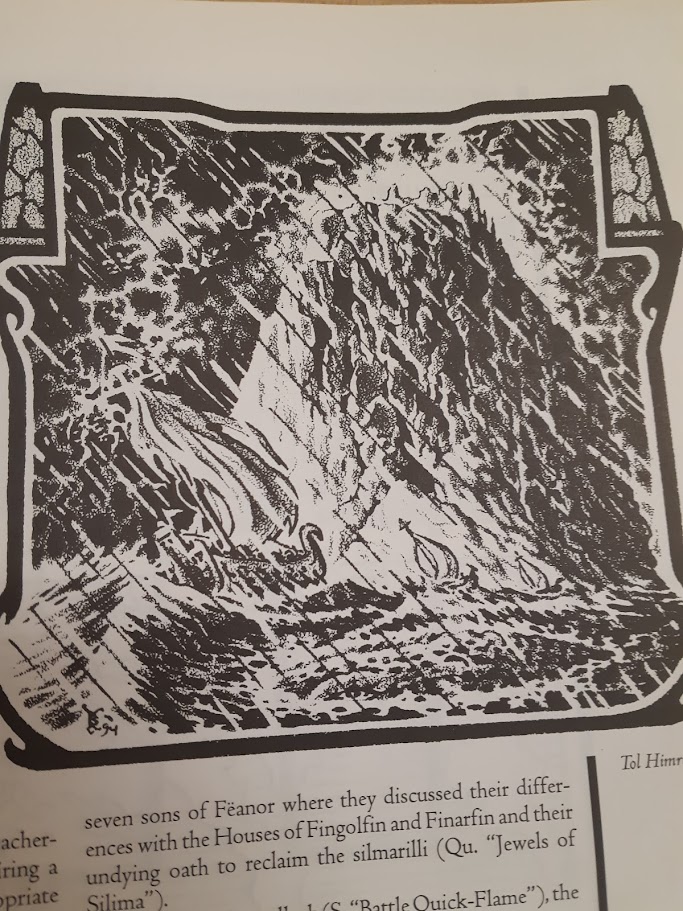
After 12 days and a check on the seasickness table, the boat is now on the open sea north of Forlindon and gets caught in a tempest. The Evenstar manages to take shelter on a natural bay of the Isle of Himring. Why don’t the PCs go explore a bit while the crew make the necessary repairs?

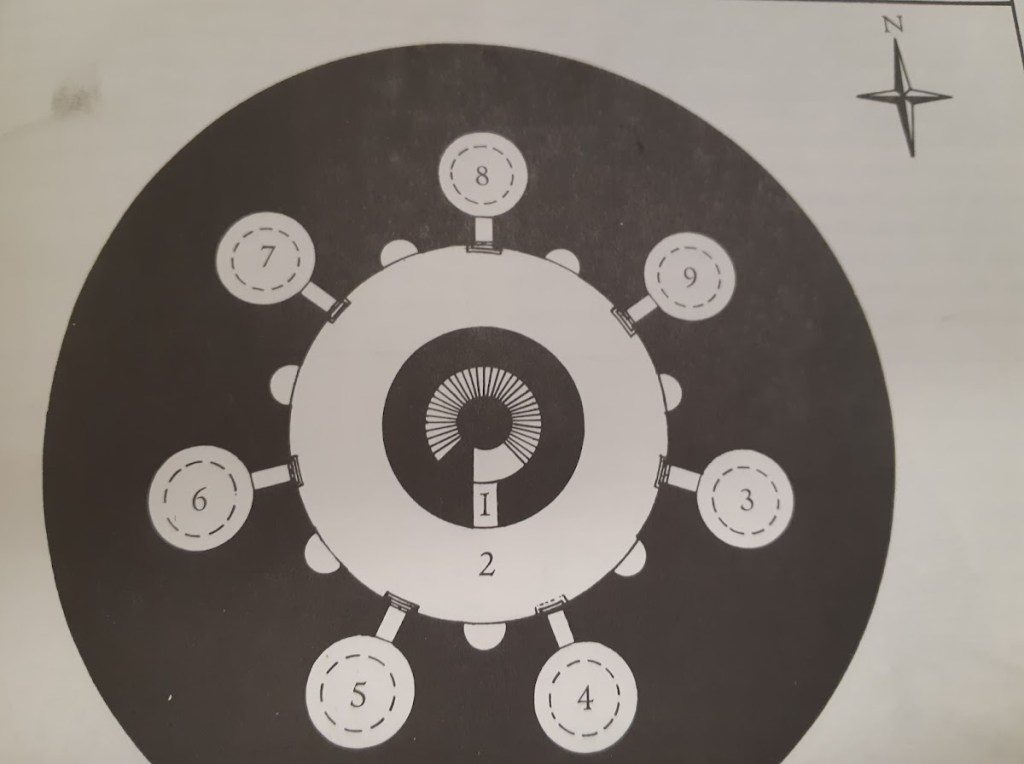
On top of the steep cliffs lie the remnants of the fortress of Himring, which has an impressive backstory (taken from the silmarillion) as it was built in the First Age by the Noldo Elf Maedhros, the eldest son of Fëanor (and almost a demi-god really), as part of the defences against Morgoth. The structure, originally 900′ feet tall, is almost erased aboveground and what the PCs get to explore is that:

So, hmm yeah, a bit underwhelming isn’t it?

This is chapter 8.2.1 and it’s rightly titled « Digression on the Isle of Himring ». This « digression » it must be said is haunted by the 60th level (!) ghost of Uldor the Accursed, a First Age man who sided with Morgoth and is paying in his afterlife for his bad life choices. This Uber-ghost does have a stat block provided and, unsurprisingly, he’s a beast with 145 hit points, a +205 scimitar attack , +55 defensive bonus and can only be harmed by Elven made weapons, hugely outclassing the adventurers. Except that he’s been nerfed, his sword attack does no damage but inflicts a 1-5 temporary constitution loss (don’t forget that it’s Rolemaster, a character has most likely 60+ constitution) on the target. They still have to harm him with an Elven weapon though but serendipitously, this 7’8 » dude Maedhros has left his 12′ practice 2-hands sword there to be picked up millennia later. A very unwieldy weapon to be sure, even for a super strong character, so what we’ll be getting I think, is the most inefficient duel of all time. Just picture this ghostly warrior howling in frustration with his sword going through his adversary without apparent effect and his opponent just having a hard time swinging his final fantasy weapon around…

That resolved, there’s many other very strong magic weapons and other precious items to be found in fact, if the adventurers get part the locked doors on each side and get their hands on them.

Hmm, a totally uncharacteristic amount of treasure, including magic items, in one haul. Something fishy going on?

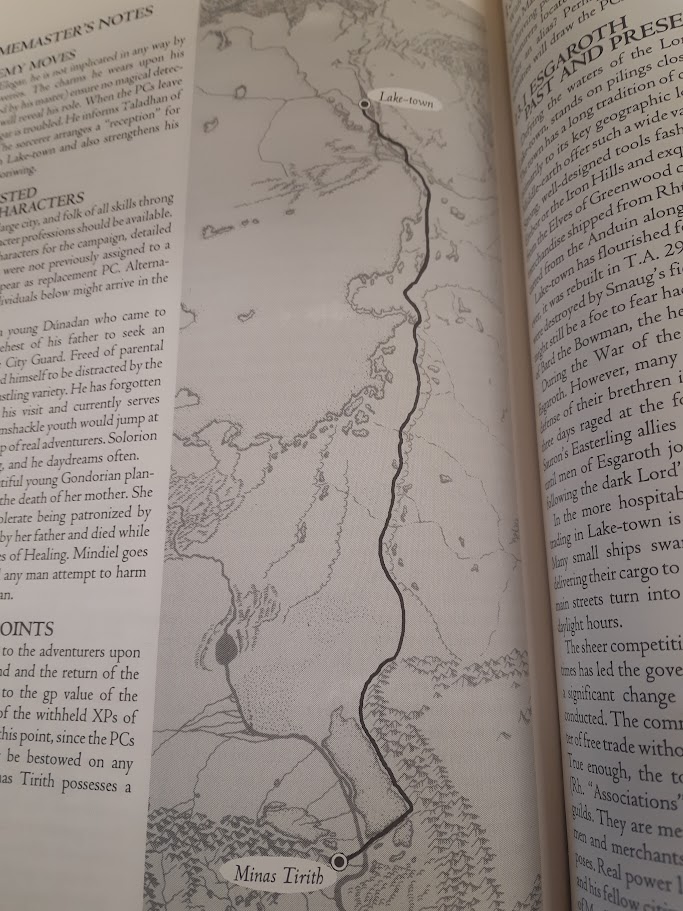
Leaving the Isle of Himring behind, there’s a few more days of travel before arriving at the Ice Bay of Forochel. The read-aloud says that the bay is a full 100 miles long and the plan is simply to follow the shoreline until there’s something worth investigating.

Which happens a few hours later, the PC who read the locate spell and received its vision recognizes the headland. It’s the spot!

They enter a cave:

The adventurers found the palantiri! Hurray!

And then they get screwed BIG TIME.

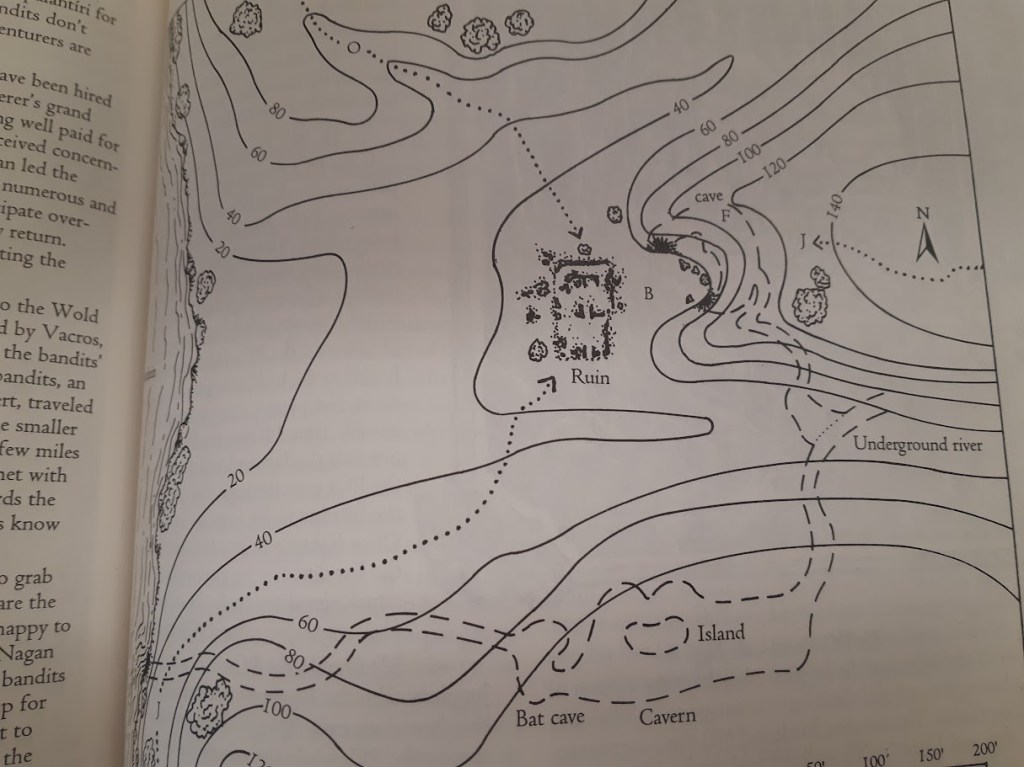
Because you see the bad guys are already there, hidden. Remember the guy with the disturbing laughter from the Juggler’s Hall? His name is Vacros and he’s here with 60 men, his damaged ship now sunk and the plan is to capture the PCs’ ship and leave with the palantiri…

« The GM is warned that Vacros’ success is crucial to the plot of the campaign: the ruffian should obtain both Stones and leave the PCs stranded in the Ice Bay. This does not mean that a fair fight won’t ensue, merely that Vacros must win. »

So a rigged but fair fight. Huh huh.

There’s nothing the PCs can do.Their boat is gone. Their equipment is gone and bye bye the cool stuff you just found like an hour ago.

Okay this is like all the worst sins a GM can do combined into that last scene but at least the coming chapter is interesting.

It’s about surviving.

And making allies of distrustful locals. Fighting dangerous beasts. Exploring lairs. Making a deal with a dragon.

All very nice.

And a somewhat restored agency to the players. Of course, the chapter is only nine pages long, it could have benefitted from being a bit more meaty.

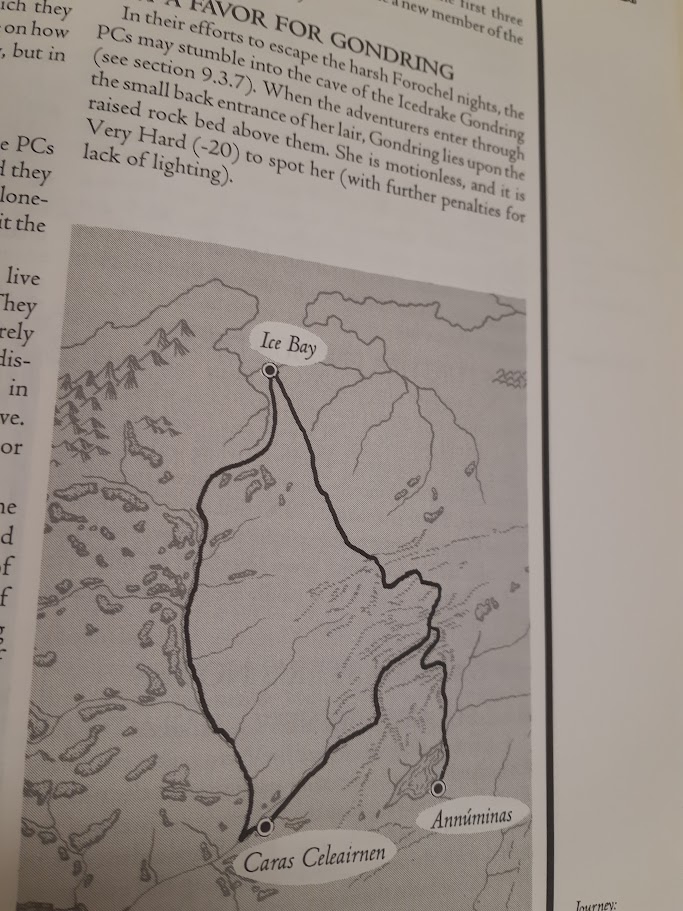
Which way will you go?

Next, we’ll witness a wild goose chase going all over the place because clearly 3000 miles is not enough for an epic adventure. And then I might have some suggestions on how I would do things with the more interesting concepts of Palantir Quest.

Palantir Quest (1994) – dungeon à la sauce Rolemaster (review part III)

I’ll be dividing my review of Palantir Quest in something like 7-8 parts I’m thinking. Yeah I’ll be quite thorough with this one, I’m not exactly sure why I feel the need to do so to be honest. On the one hand I don’t think there’s ANY real review of this product that exists at the moment. On the other hand I would be really surprised if someone was waiting for it at all. So that’s one of these things, just for the heck of it…

Part 1

Part II

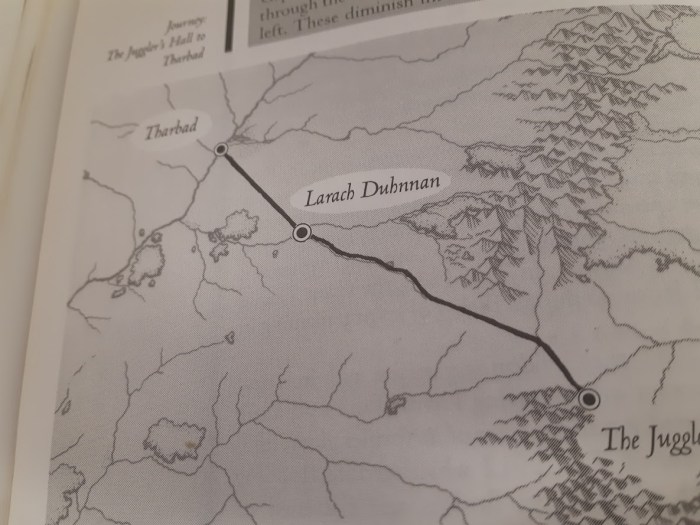
We’ll now be examining the content of chapter five and six of the book. The player characters are leaving behind the kingdom of Rohan and should reach the reconstructing city of Tharbad into the Eriador region after a journey of about seven days.

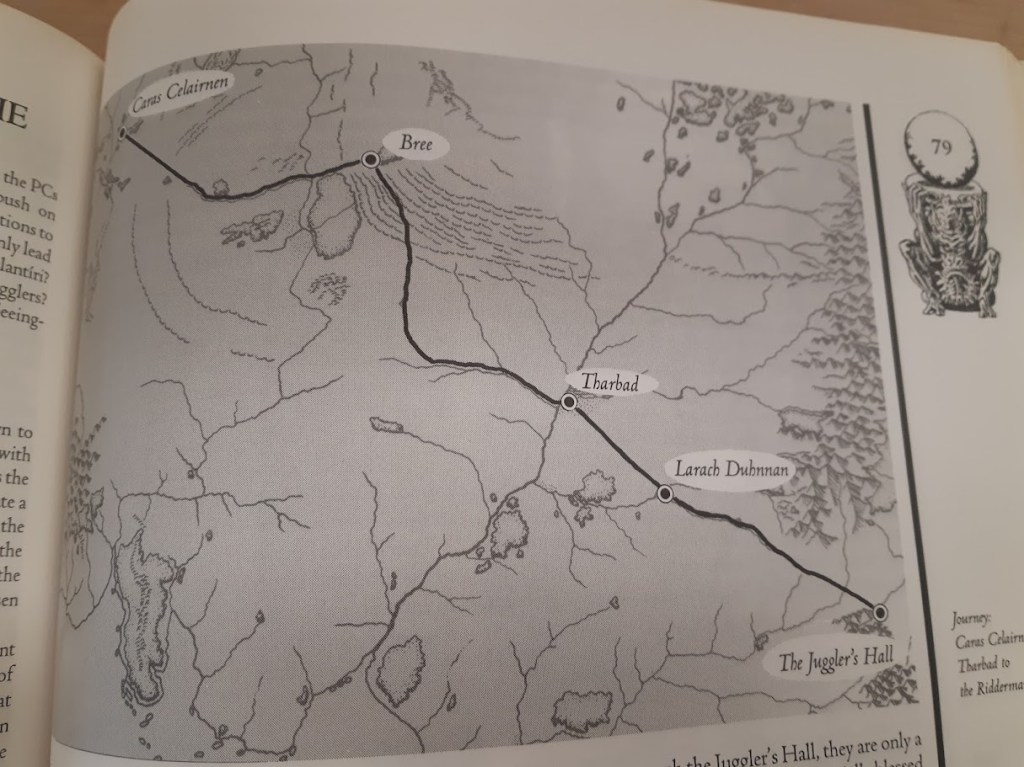
There’s one fixed event on the road whereas the PCs have the opportunity to save a wounded Eriadorian guy and defeat some hostile nameless Dunlendings. In similar fashion to the earlier chapter, the rescued NPC will ask if he can be escorted to the next point on our map, in this case the town of Larach Duhnan. There, the PCs will have to take the soul-rending decision of which of two inns will they sleep in for the night. As there’s nothing to do (and no npc roster), I suppose the Game Master will encourage the PCs to leave asap and get to Tharbad not that far away.

Maybe it’s time to address somewhat of a big flaw of the book: there’s no sidequests hooks anywhere to be found to go along each chapter’s background history, truly excellent maps with keyed locations, nice buildings layouts and a « People of Note » section. Of course a GM worth its salt can add his own but it’s still a glaring omission.

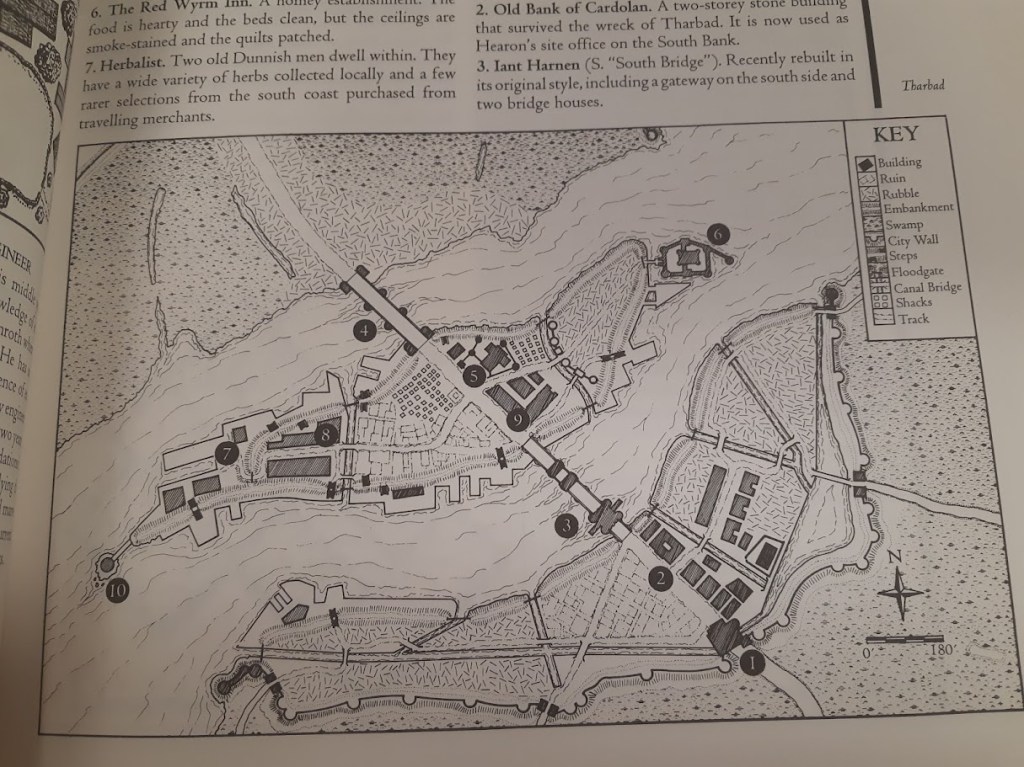
Then, the player characters reach Tharbad and, as they were told to do so by the Royal Seer back in Minas Tirith, meet Commander Cilis in the restored Royal House. The latter expresses his doubts that there’s any books left in the library, he has seen it a few years ago and it is « no more than a moss-covered ruin ». They also meet Chief-Engineer Hearon who brings them on a tour of Tharbad and we get: « this is a good opportunity for the GM to adlib some meetings with the multi-cultural work force enjoying a well-earned drink in the cool evening air. » Nothing else from these two NPCs, not even a if you happen to find a… or a be on the lookout for… You know, something signaling opportunities, danger, anything!

I’ll note that Tharbad, with a bit of work, would make a very interesting homebase for adventurers as it should have a central role to a resurging kingdom of Arnor (northern Eriador) with its strategic location and afflux of newcomers.

So after after this talk with two NPCs and a rest at the Royal House, the adventurers will leave Tharbad behind and go further north.

Fortunately things will get more eventful in this next chapter.

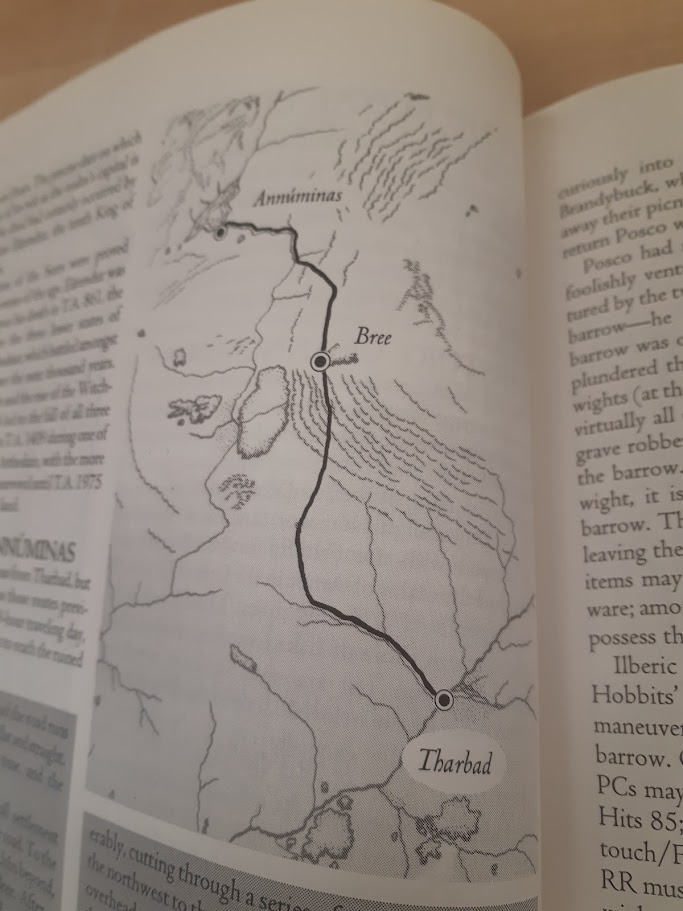
It takes about 10 days from Tharbad to reach Annuminas, with a stop in-between at the town of Bree. But before reaching Bree: « The air is oppressive. You notice standing stones and strange monoliths littering the downs to the west. Strange, unnatural hillocks deform these western ridges. As you contemplate the scenery, a small figure runs across the hills waving its arms frantically and shouting in a high-pithced voice. »

The player characters have the opportunity to save the hobbit’s friend who was foolish enough to enter a barrow (as in Barrow-downs) – as a great pastiche from The Fellowship of the Ring (the book, it’s absent from the movie). The barrow, Lord Ravenor’s tomb, is a small eight-keys dungeon. There’s two wights within in one corner of the dungeon performing their morbid ceremony on the poor unconscious hobbit. There’s some treasure to be gained too: a few pieces of jewelry, gold coins, a nice magic ring (not powerful but useful) and some magic arrows.

Serviceable and, like I said, a nice pastiche.

After that, the PCs arrive in Bree. It is assumed that they relax a bit at the Prancing Pony, of course, I mean why not, and then continue on their way.

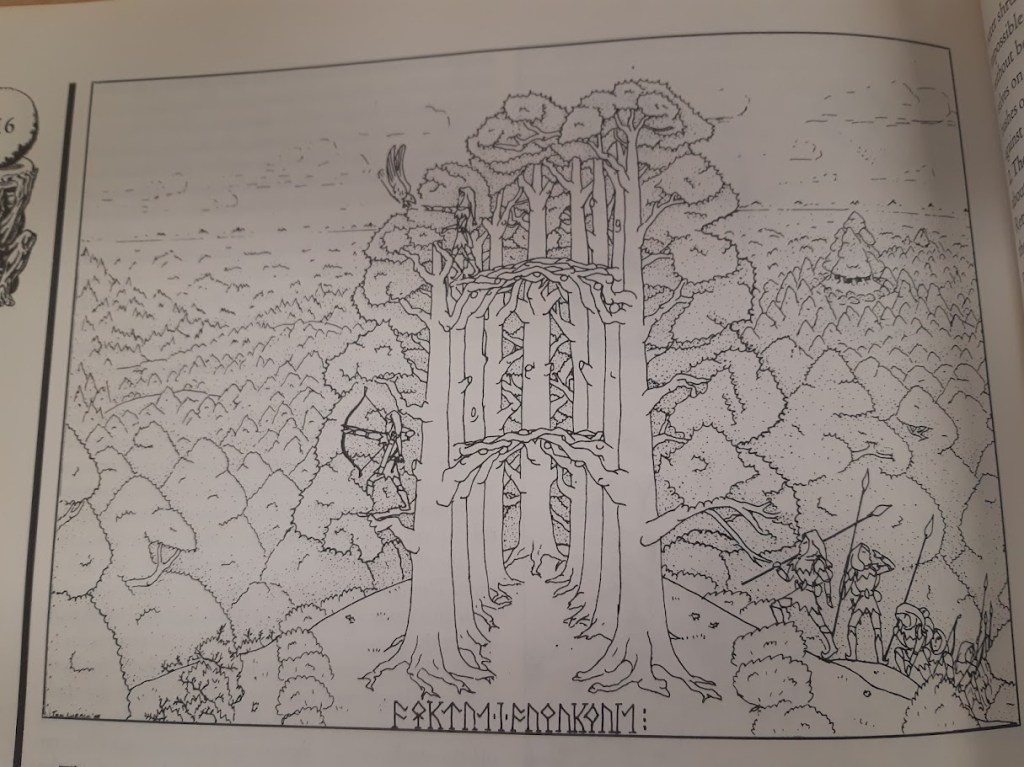
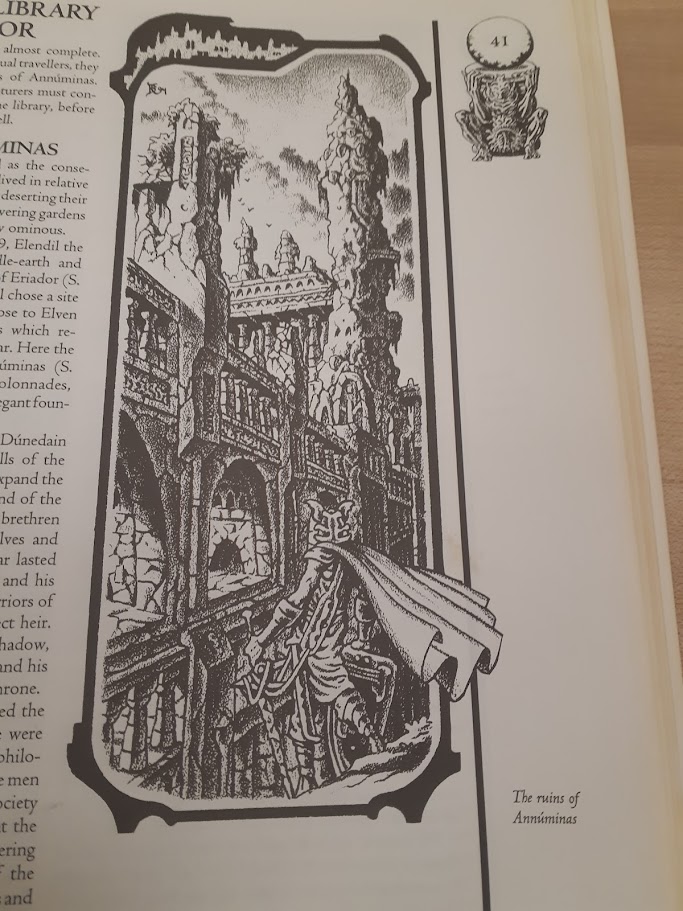
Top-notch art, as Middle Earth/ I.C.E. products were known for.

And now in Annuminas.

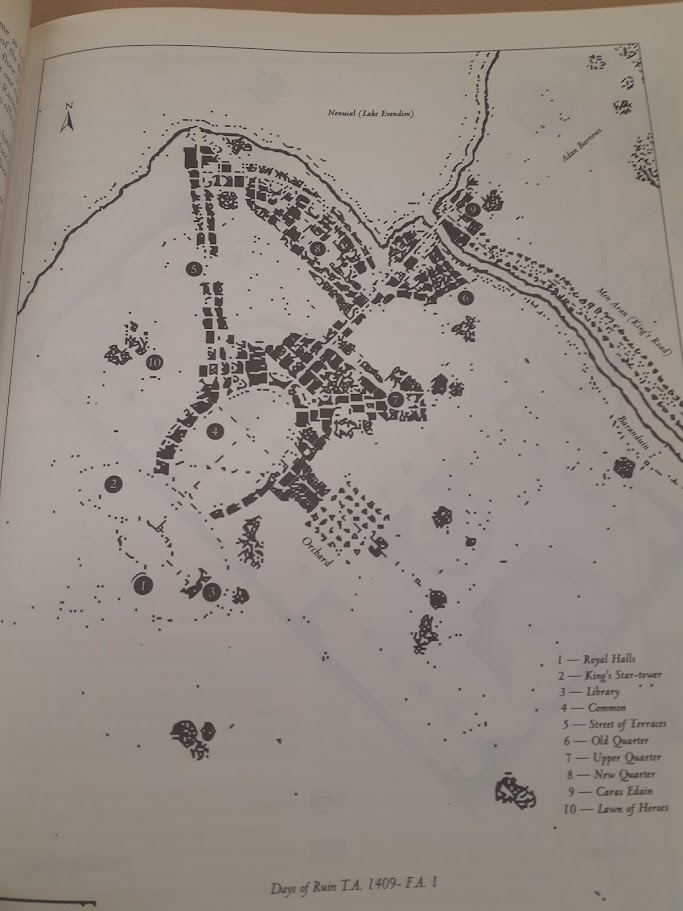
The city is completely in ruins, has been for centuries. The map (below) provides us with 10 keys but except for one (the Royal Library), they’re only for ambiance (i.e. « King’s Star Tower. A half-ring of stone remains from the royal observatory. It provides a sheltered camp site. »). There’s no encounters table provided either, though I suppose one could use the Old Arthedain‘s table of the Roadside and Wilderness Encounters found with the others at the end of the book.

Annuminas is not completly empty as there’s a family of seven trolls (3 males, 2 females, 2 youngsters) having a camp, guess where? Right at the PCs’ objective: the Royal Library! But I’m not really complaining, players must have challenges to overcome after all. The trolls would be quite dangerous to fight without a solid plan, probably impossible to beat in a fair fight in fact. Which is fine by me.

The trolls dealt with in some way or the other, the adventurers are free to explore the Royal Library. There’s not much aboveground anymore, a building with half of its walls ruined, but stairwells lead underground. An undergound library? That’s a terrible, terrible idea for books conservation! But, er, yes, maybe there’s some magic involved, let’s not delve on that too much.

« The most valued records and documents were removed from their ordered resting places to occupy the largely vacant shelves of the buried lowest floor of the library. Hasty but deadly traps were contrived and armed to protect the wealth so carelessly assembled. Then the last, brave, hopeless men turned to fight and fall to the hordes of the Witch-King. »

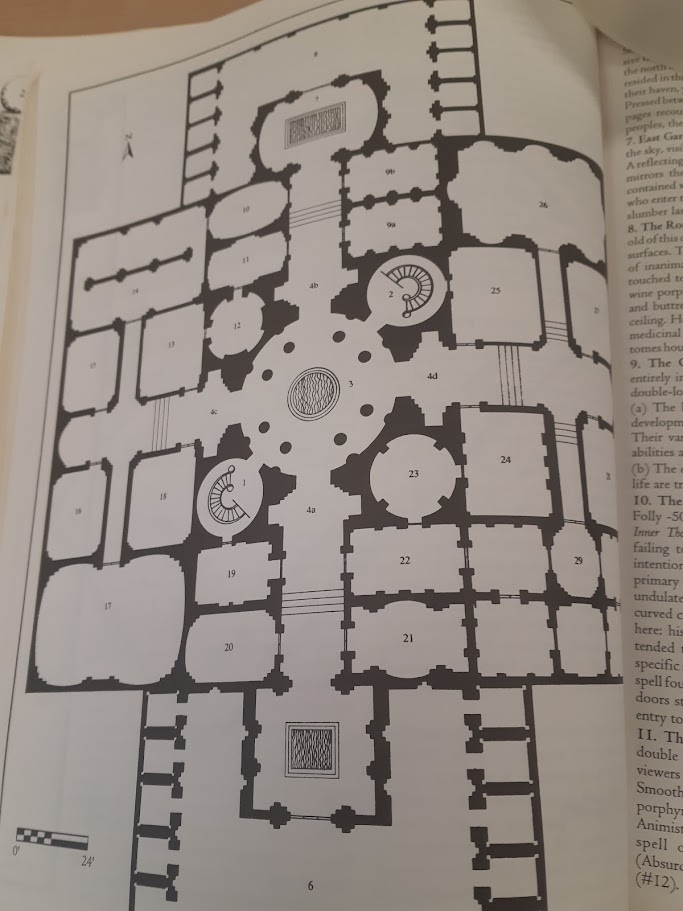
The Royal Library is a single Level dungeon with 29 keys, the only « real » dungeon of the adventure, such as it is.

(Side note: Not surprising, dungeon-crawling isn’t a primary feature of the I.C.E./MERP books. There is certainly some to be found of course and you know, there’s this little thing called the Moria fortress in the series. I guess you could also include Dol Guldur, Mount Gundabad and Angmar. Well, it’s more like stealth missions than dungeon-crawling as a real assault on either of those places would be suicidal even with high-level PCs.)

So, the closest thing to a dungeon in a MERP book let’s say. Let’s take a brief look at it.

Now the first thing that strikes me is that it doesn’t look like an underground complex at all. Yeah I know we must be lenient with dungeon architecture but this isn’t what I mean. The room at the center that you reach with either stairs is the Central Dome. Now, height isn’t mentionned anywhere for any locations so maybe there’s enough space for a dome. But way more revealing are rooms 5 and 7, East Garden and West Garden (which are in fact North and South on the plan, oops): « broken glass allows the filtered rays of the sun », « Prolific greenery has overflowed », « A reflecting pool filled with rainwater, sketchily mirrors the green splendor surrounding it. » This seems obvious to me, this is a refurbished dungeon (not the first time I see this), for an aboveground structure and the authors didn’t changed everything (or much?) from its original purpose.

With that out of the way, lets get back to the entrance.

The two stairs are both on the verge of collapsing and won’t support the weight of more than three men at a time. The way the Rolemaster system works, it’s odd but this is considered a trap and you have to detect it (Very Hard -20 and Extremely hard -30 for the other staircase) and somehow you can disarm it (?) (Sheer Folly -50 in both cases). One of the two staircase has also a (+10) fireball trap set off by the mere presence of intruders. That’s weird design. Shouldn’t the PCs just see that the staircases are damaged and take precautions if they wish so? Even more problematic is that there’s no way to know about the fireball trap – any dungeon designer worth his salt will give some realistic hints – a visible rune, some traces of burning or an incinerated badger maybe? Something to induce players agency you know.

So, a roll for this, roll for that unfortunate tendency I’d say.

But the PCs are now inside (and a bit crisped if they chose the wrong stairs). They already have the Royal Library’s master key from the start of the adventure, convenient as almost all the doors are at least « Extremely Hard -30 » to lockpick or will set off a spell if forced open. They have to find a specific book within the library with 20 out of 29 rooms having books in them. The objective is like sixty feet away from the entrance but the PCs will have to search randomly room by room, or maybe they have the right Seer spell available and will find the right room and the book in like 5 minutes, that’s a possibility. If not, what they have to contend with is mostly a handful of animated statues and hostile spells at almost every door. There’s also a 10% chance per hour of a ghost of one of the deceased librarian to appear and simply attack the PCs.

The books they’ll be finding everywhere are mostly abstracted (this section has lore on beasts, this one on astrology and so on) except for a few canonical ones (i.e. the silmarillion). No value is given to any books and nothing else can be found in the vicinity. Well, this isn’t a gold for xp game but still, unfun.

I’d say overall, the dungeon has good texture (rooms descriptions are nice if impractical), but it’s severely lacking in interactivty.

To be blunt, I don’t think this dungeon is worth it as is nor is the work of adapting it to one’s campaign unfortunately.

Adventure-wise, we have reached the next milestone, the PCs have obtained the spell to locate the palantir and will be sent to retrieve it.

Coming up, after a digression or two, we’ll see the adventurers become arctic explorers!

Part IV

Palantir Quest (1994) – players are actors (review part II)

Just to be clear, I’ve never ran this adventure (nor played in it).This is a 3 decades late, external look at it we might say.

Part I

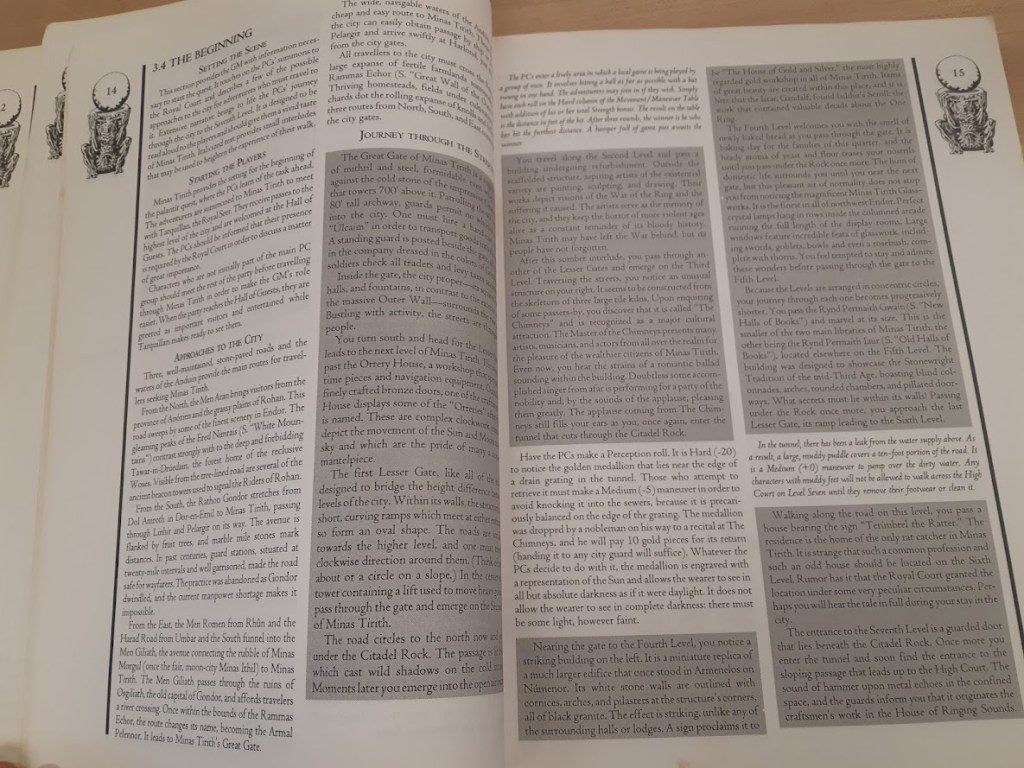
At page 14, after having informed the Game Master of relevant background information, the adventure begins with… extremely long read-alouds.

Well-written mind you, interesting for a true Tolkien aficionado perhaps, but boy if my mind would drift away as a player if I was read all this by someone!

But notice, between two grey boxes, a first challenge for the player characters! On how to deal with a « ten-foot portion » of muddy road. Yeah, well, small beginnings and all that…

Railroading into Middle-Earth’s 4th Age

(Side note: There’s a big hint on how the adventure will present itself on chapter 1.0 Guidelines: « Fantasy role playing (FRP) is akin to a living novel where the players are the main characters. Everyone combines to create a story which is never short of adventure. They help forge a new land and strange new tales in which the characters are forever immortalized. » (bold emphasis is mine)

After their mission briefing by the Royal Seer, the Player Characters (PCs) are ready to leave Minas Tirith.

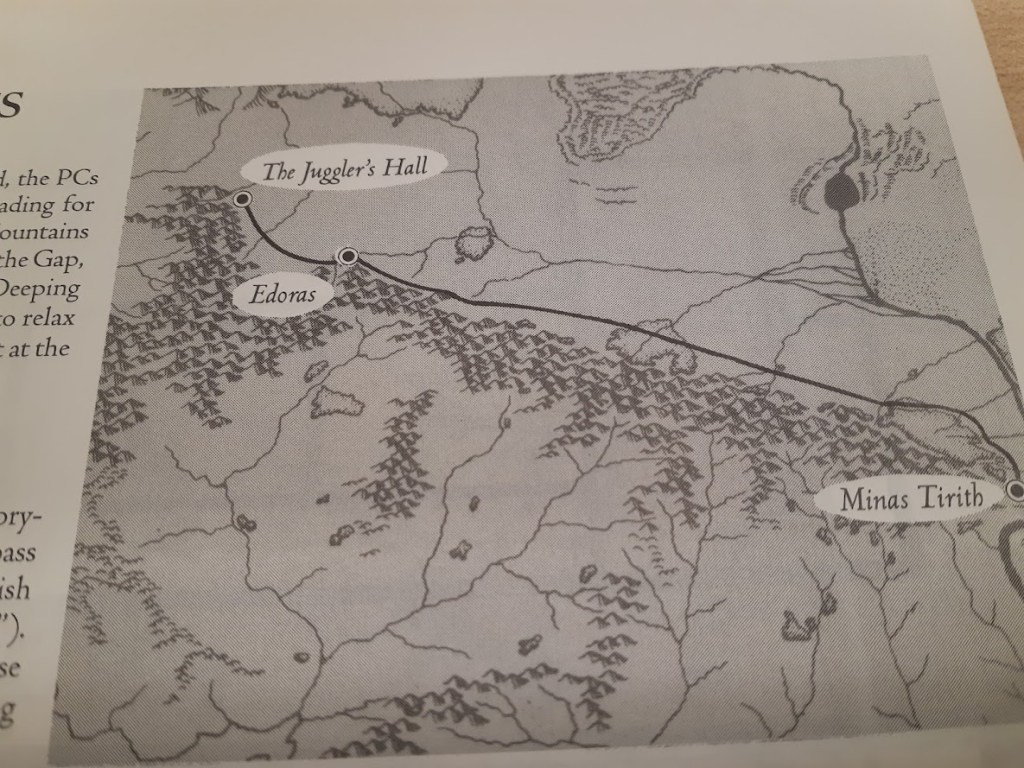
The utlimate goal is to retrieve the lost palantir but in order to do that they first have to reach the Royal Library in ruined Annuminas in the north, to find a tome of spells that will help pinpoint its location. First stop is in Rohan in a place called The Juggler’s Hall.

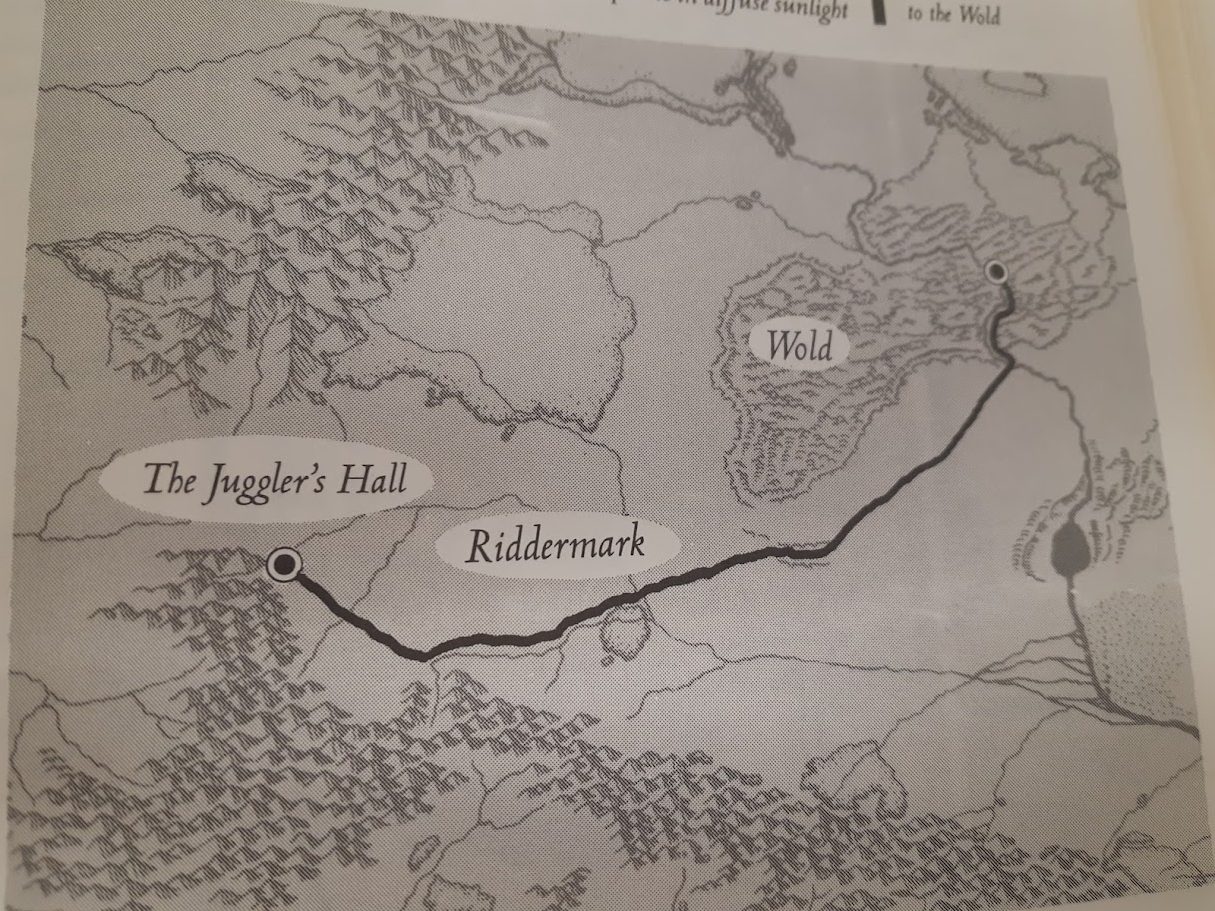
It takes 10 days of travel to get there and somewhere in the middle we get this fixed event: upon arriving at the Inn of Greys the PCs see that it’s being attacked by bandits and the adventure just assumes that the PCs will intervene (and to be fair, why wouldn’t they?). Upon defeating the bandits the PCs meet Turibor the minstrel who’ll ask if he can accompany them on their journey north. This guy is a key NPC, I mean key as in unlocking another scene kind of thing. He’s the one who will bring the PCs to the Juggler’s Hall and if you had players that were expecting to go to Edoras and meet rohirrim riders they’d better forget about it, aside from taking new horses nothing happens in Edoras. No, instead you get the Thespian Intrigue in the Juggler’s Hall, involving the PCs in a theatre play (about the kin-strife that happened in Gondor, again. not really a nice fit for Rohan). The leader of the Wandering Conscience Company will offer 10 silver pieces and a choice of nice clothes to each character, for participating (acting) and help guard against sabotage from a rival company.

I’ll add that the Juggler’s Hall is oddly, really in the middle of nowhere, but it’s also a base for smuggling operations so there’s that. Talking of smuggling, there’s a bit of foreshadowing in this chapter as it’s mandatory that the PCs witness two NPCs shaking hands in « business-like fashion ». One of these NPC « may draw attention to himself by way of his disturbing laugh ». BUT: « However the PCs should be given no grounds to become suspicious of him ». Well, good luck with that Game Master! Hey players, here’s this fixed scene involving two shady NPCs, one has this disturbing way of laughing, y’know like a cartoon villain would laugh just sayin’, but don’t be suspicious! No no no, no reason at all!

And then the Thespian Intrigue.

The play itself is nicely conceived I’ll say, with a nice plot as mentionned taken from the kin-strife period (a Cromwell-like usurper gets hold of power in Gondor) and plenty of stuff happening (including a real knife stab (instead of a fake one) that the PC victim should try its best to go along with so that the play isn’t disrupted!). Of course the whole thing is nonsensical and out of place (irrelevant to the mission) but I’m pretty sure it could be great fun for the players. The Game Master though, in true Rolemaster fashion, has the cumbersome job to evaluate which + and – to use in the provided chart and get the results for the « Audience Appreciation Level » (AAL): « Having totalled the appropriate modifiers, the actor should roll on the appropriate column. The result is the number to which the GM must roll equal or less than in order for the AAL to increase by 5. If the GM rolls over the number, the AAl decreases by 5. At any time, an AAL of 0 means that the audience boos the company off the stage and leaves, while an AAL of 100 means that the audience immediately rushes the stage in a frenzy of hero worship and adulation. If the play end naturally, then the AAL should be added to an open-ended roll on the Hard column of the maneuver table, and the result is the number which the GM needs to roll under in order for the critics to like the play. »

Phew. I wonder why Rolemaster isn’t a popular system anymore!

Anyway, the PCs can get a substantial bonus reward (or not) depending on how well the play went and also experience points based on what happened so far or « as we recommend, he or she may just award points in a subjective fashion corresponding to how well the players are able to cope with the stress of being onstage ». How well the players cope with the stress of being onstage. Wow, that’s a weird thing to say. I thought the players were like, around a table with pens & papers & dice, not onstage.

This concludes this chapter, a weird one for sure. Next the PCs will leave to continue their journey to Tharbad, en route to the ruined city of Annuminas where they will get to explore a dungeon! Yay!

Part III

Palantir Quest (1994) – tunnel vision (review part I)

I’ve been rummaging through my collection of (twenty-something) I.C.E. middle-earth books lately. I could get good money for them – last time I checked Palantir Quest in particular was on sale for 175 usd on ebay despite being in terrible condition (mine isn’t much better!). But y’know, I’m quite sentimental about these, they are the first rpgs books I’ve bought, some thirty years ago, at age fourteen-fifteen with my hard-earned money as a field hand at the time.

So, no selling.

Paid for in sweat and sore knees.

Palantir Quest is in fact an unusual one among this collection as being one of the rare Adventures book along with Kin-Strife, as well as several much slimmer adventures compilations. All the others in the line are sourcebooks, as far as I know. Incredibly detailed and well-researched sourcebooks I must add in case you haven’t heard of them, something that doesn’t exist anymore in rpgs I think, that required an entire team of dedicated people to do. Something to be nostalgic about no doubt. Keep that in mind if you please, because I’ll be a bit harsh with this one: I.C.E’s sourcebooks were absolutely great.

But back to our current subject.

From the book’s back cover: « Strange portents in the great Seeing-stone of Minas Tirith give promise that one of the lost palantiri of the North has returned to the lands of Men. Can the adventurers find this legendary treasure and bring it to King Elessar? Rogues of the wilds, blizzards out of the Forodwaith, and the greed in Men’s hearts all conspire against them. »

Adventuring into Middle-Earth’s 4th Age

The premise is quite interesting, unlike most of what has been published by I.C.E. this adventure takes place some years AFTER the events of the Lord of the Rings. Sauron has been permanently defeated, what remains of his forces has been scattered away and Aragorn, as the ruler of both Gondor and Arnor is now known as King Elessar. This is the begininng of a new era, the 4th Age of Middle-Earth, and what better news to go with this time of triumphant joy than the resurfacing of a long-lost palantir that could help unite both halves, North and South, of this new victorious kingdom?

Elon: « Imagine holding this super heavy bowling ball in your hands, straining your mind in a superhuman effort, and talk to ONE other person in the world … »

Yes, thank you Elon, very impressive.

But you need two palantiri to do that.

Aragorn/King Elessar has the one from Orthanc of course and the one that Sauron had has been destroyed (or is lost, buried under the ruins of Barad-Dur presumably) and Minas Tirith’s palantir (this book says) has been unfortunately imprinted by Denethor’s last moments of agony (a rather unpleasant sight to behold), this is why finding this other palantir would be incredibly useful.

Enter the PCs.

(Side note: Suggested starting level is 4, the PCs are presumed to have some prior accomplishments. There’s also a provided list of pre-made characters as well as suggested eventual replacement, one for each chapter.)

They’ve been convoked to Minas Tirith by NPC Tarquillan, the venerable Royal Seer, to do the king’s bidding and find the lost palantir of the North. Or not exactly that way – they’re told that a spell from a tome called « A Treatise on Subtle Magika » has been discovered to exist and (much faith has been put into that it seems) it could be used to locate the palantir that has only been glimpsed at. (a written spell? a bit peculiar to me thematically speaking but okay, let’s get on with it). The most likely location of the tome is in the Royal Library of the ruined city of Annuminas.

Unbeknownst to the PCs and their employer, Taladhan, a powerful evil magician no one has ever heard of (he apparently hasn’t got the memo that evil has been defeated) who’s scheming from his hideout in faraway Greenwood, knows everything about the plan to recover the palantir because the Royal Seer’s assistant in fact spies for him. Very astute of him to have put a spy there I must say, just in case there would specifically be news from a resurfacing palantir. But anyway.

Thus begins one of the most Tangential Fetch Quest in the history of RPGs. Probably.

Palantir Quest – Contents:

  • 1.0 Guidelines
  • 2.0 Introduction
  • 3.0 Minas Tirith
  • 4.0 The Juggler’s Hall
  • 5.0 Tharbad
  • 6.0 The Royal Library of Old Arnor
  • 7.0 The Docks of Tharbad
  • 8.0 The Ice Bay of Forochel
  • 9.0 Return to Civilization
  • 10.0 Return to the Riddlemark
  • 11.0 Search in the Wold
  • 12.0 The Fourth Tier
  • 13.0 Lake-Town
  • 14.0 Into the Forest
  • 15.0 Return to the King
  • 16.0 Master Tables
  • 17.0 MERP/Rolemaster Tables
  • 18.0 LOR Tables

Part II

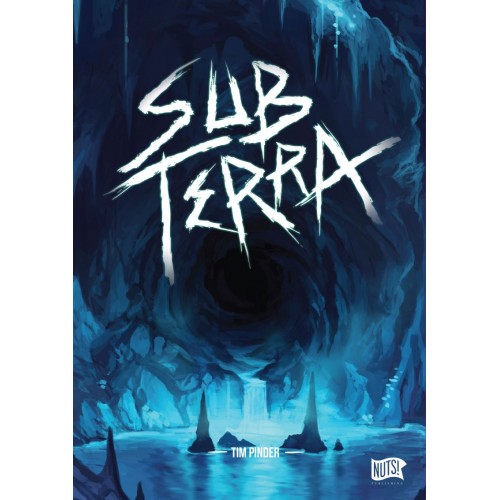
Sub Terra: mille et une façons de mourir sous terre

Sub Terra, du game designer français Nuts!, est depuis son acquisition il y a quelques mois rapidement devenu notre jeu de prédilection à jouer en famille et j’ai décidé de vous en glisser un mot.

C’est un jeu coopératif à la base, nos personnages (qui ont chacun des capacités spéciales) sont sous terre, dans un réseau de caverne infesté d’horreurs et doivent s’échapper en trouvant la sortie.

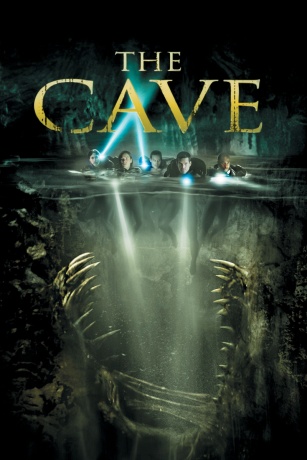
La mécanique du jeu est ainsi faite (le temps « s’écoule » via un paquet de carte, à la dernière carte nos lampes frontales s’éteignent et les chances d’être dévorés sont extrêmement élevées) qu’il est préférable de se séparer pour explorer plus efficacement. Comme tout bon film d’horreur quoi! D’ailleurs le jeu fait énormément penser au film The Cave, 2005 (et dans la même veine, à Sanctum (2011) et The Descent (2005)):

Pas le meilleur film du monde mais un bon divertissement en soi, avec une introduction (église de templier construite au-dessus d’un grand réseau de cavernes) absolument inspirante pour fans de rpgs je dois dire.

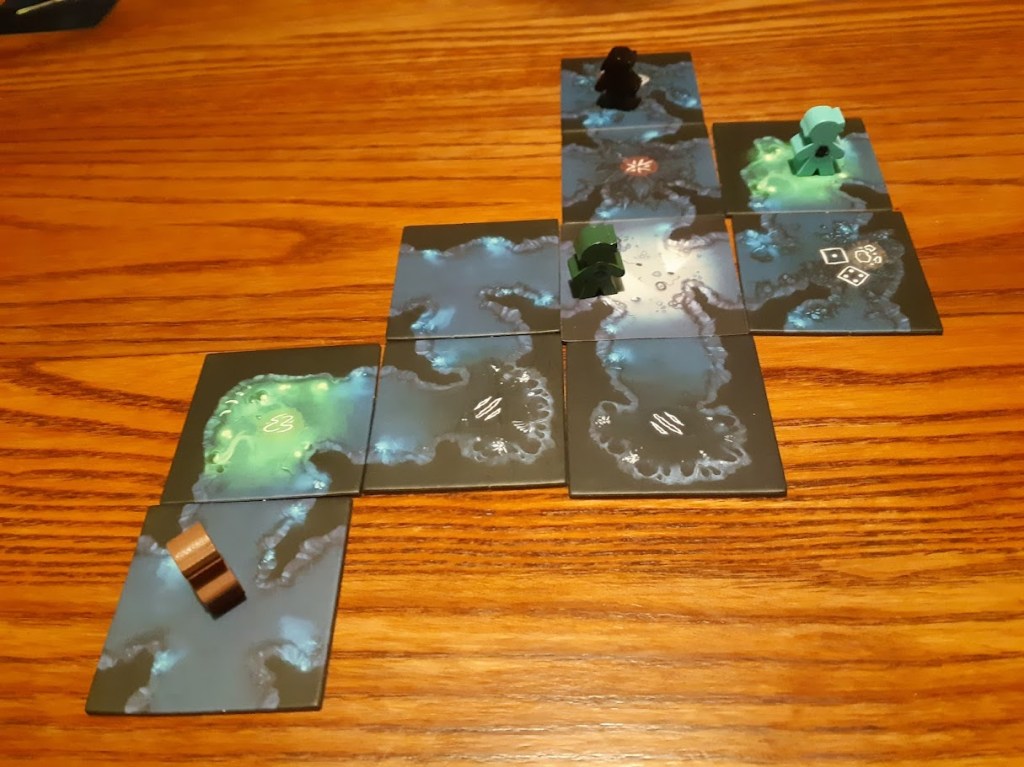
Entre les secousses, les éboulements, les poches de gaz, les inondations et bien sûr, les horreurs, l’exploration n’est jamais de tout repos.
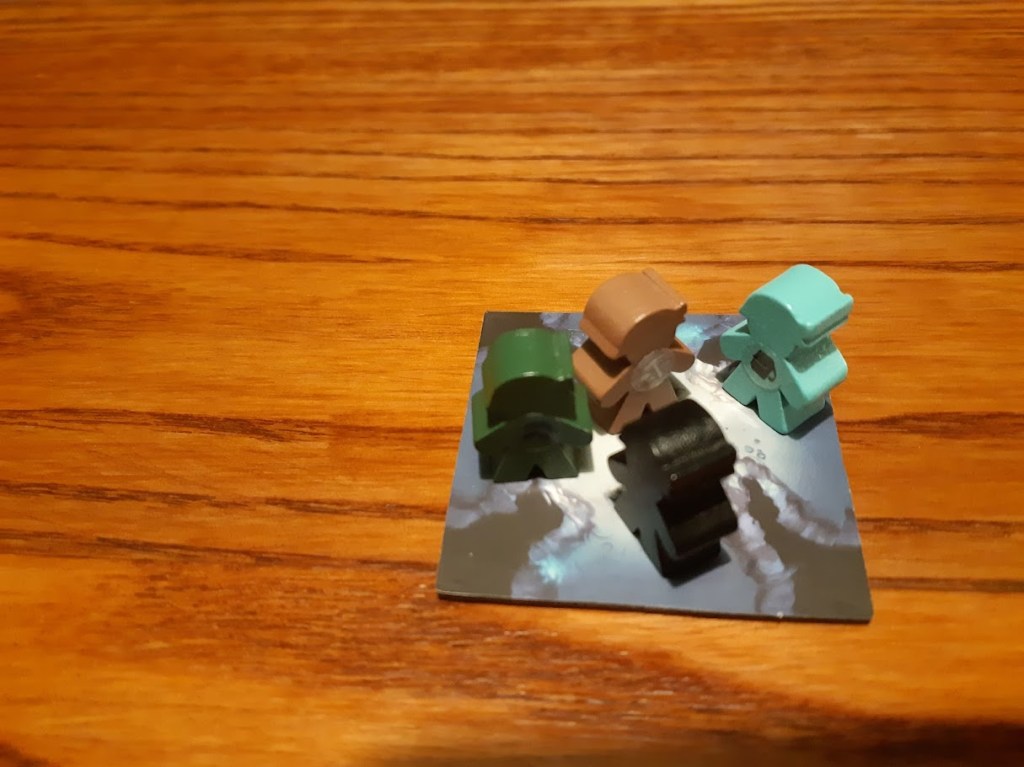
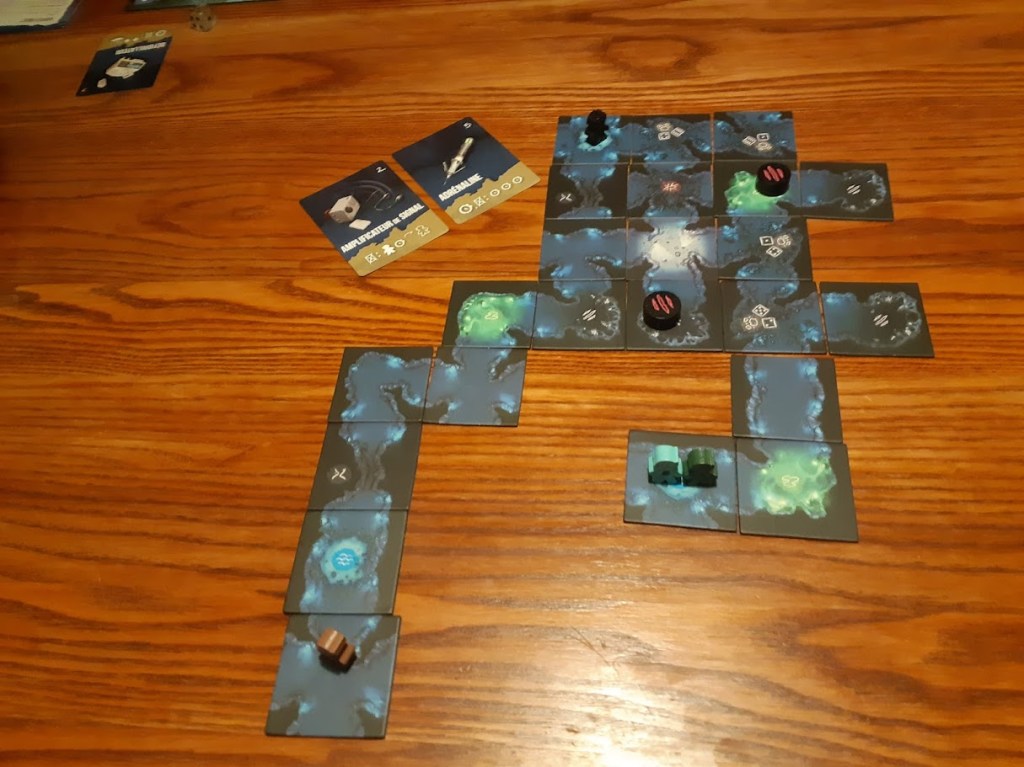
L’exploration avance, l’agent et le chef y vont en duo mais l’éclaireur et la géologue sont bien loin de leur côté maintenant!
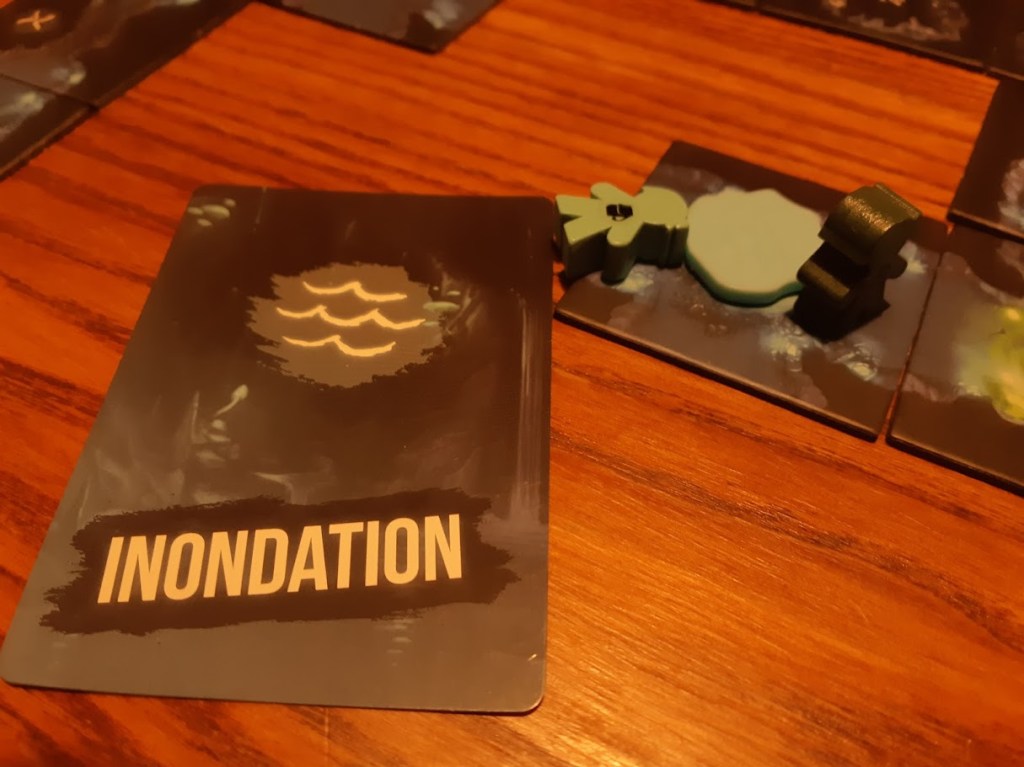
Une soudaine montée des eaux a mis l’agent inconscient le chef est à côté de lui et pourra le réanimer heureusement.
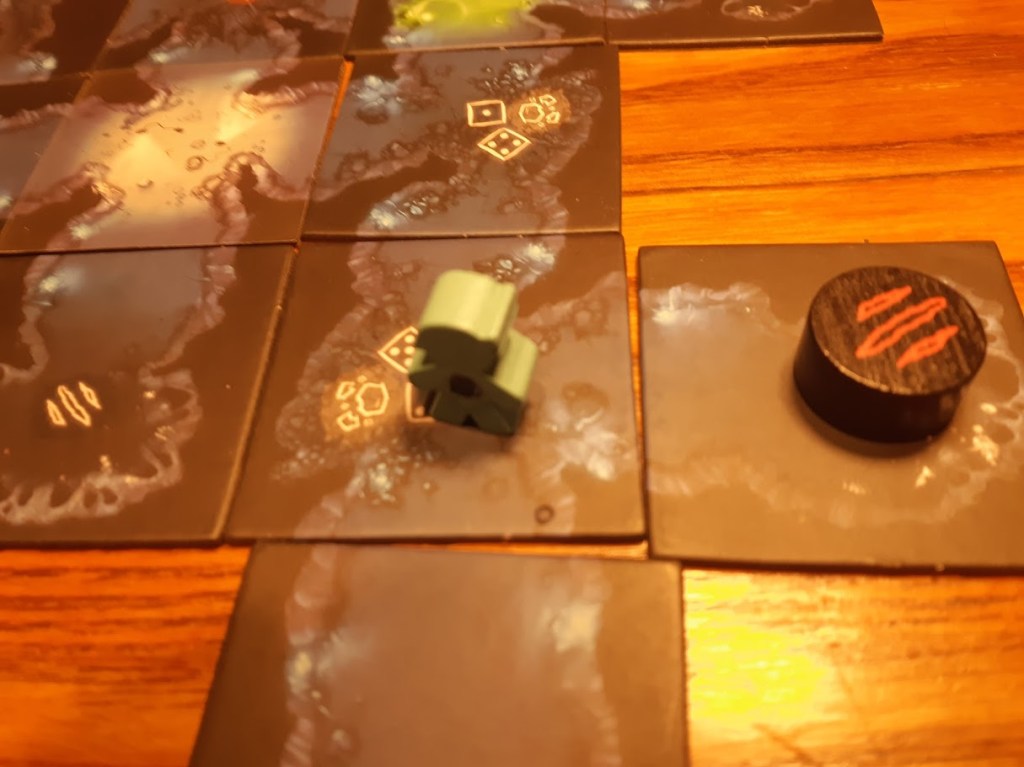
Un nid d’horreur, tout près…

Les parties durent environ 60 minutes à quatre joueurs. La difficulté est présente, nous échouons une fois sur deux à facile, mais échec ou succès les parties sont toujours enlevantes. Je recommande!

Dragonbane – rulebook walkthrough pt 2: character advancement & conditions

Part 1: Character creation and magic

If character creation in Dragonbane is a bit different from other D&D-adjacent system, we’re now gonna talk about two mechanics that makes it, hmm maybe not groundbreaking (what is nowadays?), but unusual in a good way.

Character advancement:

There is no levels in Dragonbane. Instead how your character can improve is by increasing his skills (including with weapons), gaining new spells (see part 1) and, less frequently, gaining new heroic abilities.

Each time you roll a d20 and roll a 1 (a dragon) or a 20 (a demon) you check a box next to the skill you used.

In addition, if you answer yes to these questions at the end of the session you can check a skill box of your choice:

  • Did you participate in the game session? (a freebie)
  • Did you explore a new location?
  • Did you defeat one or more dangerous enemies?
  • Did you overcome an obstacle without using force?
  • Did you give in to your weakness (optional rule)

(You can also find a teacher that has at least 15 in the skill you wish to improve and is better than you. The cost in time and money is left to the GM discretion, no direction is given in the rulebook beyond that unfortunately.)

Then, at the end of the session, with all checked boxes you must roll a d20 and exceed the number you already have in order to increase your skill by one. Pretty simple.

Heroic abilities: There’s 2 ways to gain new heroic abilities. The first is if you manage to increase a skill to 18 you immediately gain a new heroic ability of your choice. The other way is by accomplishing a « grand heroic deed », that’s also left to the GM’s discretion but it’s mentionned that it should be a rare event.

Pushing your roll & Conditions:

Now, another fun and interesting mechanics that is actually an optional rule, but I really see don’t why one wouldn’t include it, is the Pushing your roll. If a character fails a skill check he can choose to re-roll but with a cost, he’ll suffer from a condition from now on. Each attribute is linked to a specific condition: Strength >> Exhausted, Constitution >> Sickly, Agility >> Dazed, Intelligence >> Angry, Willpower >> Scared, Charisma >> Disheartened.

You choose the condition you’ll gain and will have bane (roll two d20 take worst) on any skill check linked to the affected attribute. You can’t choose a condition you already have and you’re also supposed to roleplay somewhat the whole deal.

You can also gain conditions in other ways, an environemental effect, a monster attack, etc. To remove a condition (or all conditions) you must do a shift rest (6 uninterrupted hours).

Closing Comments:

  • For me the character advancement system is reminiscent of the Elder Scrolls video games (I’ve played extensively to Morrowind back in the day, didn’t even try Skyrim though) where your stats simply improve with how much you use them. I like this.
  • An unfortunate side-effect though, at least for my young players, is the « I want to roll… » just in the hope of rolling a 1 or 20 and check the skill box. Listening to a door with an awareness check has never been so popular I tell you.
  • I’ve homebrewed somewhat the questions in my game (i.e did you explore a new location? >> did you find an iconic location in the dungeon?)
  • The way we play, my players’ characters suffer from at least one or two conditions each session, both from pushing their luck and dungeon hazards. The way to remove a condition is a bit more arduous than simply shift resting in my game, they must find a way for their characters to have a good time (i.e having a quality meal).
  • The conditions makes me think of my basic military training where I saw several guys vomiting from exertion (sickly!) but still going on, I dunno, makes sense to me.

Part 3: Combat and Monsters

Dragonbane – rulebook walkthrough pt 1: character creation and magic

I’ve been using the Dragonbane ttrpg system (DB) for several sessions now- testing the limits of it in fact, with a megadungeon campaign, but I think for the moment I’d do something between a walkthrough and a true review. Suffice to say I like Dragonbane a lot but like every other systems, it also has some flaws.

First thing first, I’ve seen it often called an « OSR » game but I don’t think that’s quite accurate. It’s a fairly light system (the rulebook is slim at 112 pages) and there’s also many random tables (i.e magic mishaps, injuries, etc.), but here the comparison ends as I think the implied style of play is a bit different than OSR (i.e all the different actions you can do in combat).

Character creation:

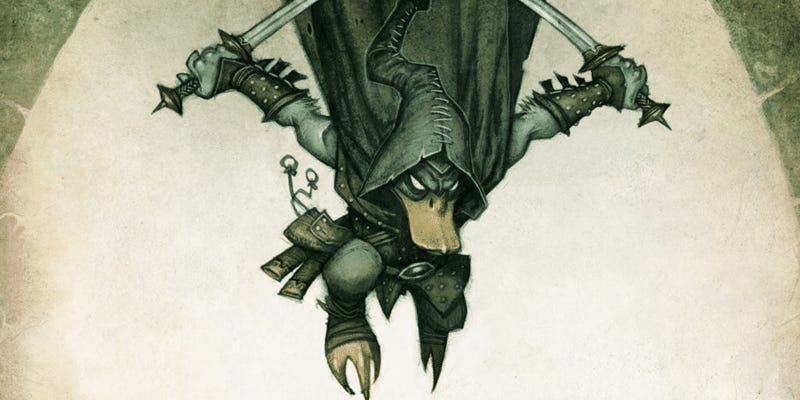
You have the classical humans, elves, dwarves, halfings and then you’ve also got those guys, the duck-persons mallards and also wolfkin.

Choosing your Kin, you get an ability from it, a small power that you can activate spending willpower points (your wp pool is equal to your willpower score), for example the mallards get « ill-tempered » giving them a boon (advantage, roll twice take best) on attacks at the cost of getting angry (a condition, more on that later).

Choosing a Profession (the complete list: artisan, bard, fighter, hunter, knight, mage, mariner, merchant, scholar and thief), you get an Heroic Ability, another thing you can activate spending willpower points (the fighter for instance gets Veteran, something that lets him play with his initiative order a bit).

If you choose the Mage profession, you don’t get a Heroic Ability but instead get access to three Rank 1 spells and two Magic Tricks from one magic School. Others can also learn magic but not at the beginning.

Next step is rolling your attributes (the same 6 as classic D&D, or thereabouts, willpower instead of wisdom, 4d6 take three, assign to one attribute at a time.

Lastly, based on your attributes numbers, you’ll have scores on skills, which are either free or trained (chosen from your profession’s list and a few you can choose as you wish), the minimum is 3, maximum is 14. thus if you have a 17 or 18 score in an attribute on a trained skill, you have 14 for that skill that will be used with a d20 roll under or equal. So, it’s a Roll Under system.

The whole character creation is pretty easy and fast as apart for Kin and Profession most of the choices are already made for you. A few more customizations, rolled randomly (i.e starting gear, a memento), and you’re ready to go. Nothing to complain there, all good.

Magic:

Spells are ranked from 1 to 5, with most within the 1-3 range, with each rank from 2 and above having a lower-ranked spell as a prerequisite.

There’s four magic schools: General, Animism, Elementalism and Mentalism. Everyone that has the Magic Talent heroic ability (from being a mage most probably) can access General magic and also choose one of the three other schools.

You can remember a finite number of spells depending on your Int score but can have more into your Grimoire. The magic system is somewhat Vancian (memorizing spells, spending them and getting to choose anew after resting) but with the addition that you can cast any spells that you have in your Grimoire if you double the casting time (2 rounds instead of 1 for most spells). That’s a nice touch, a bit more flexibility is good.

Spells also take magic points to cast (from you wp pool, as determined by your willpower score) and cost 2, 4 or 6 points depending on how strong you want the effet to be.

So both memorized spells and spell points, a bit cumbersome in my opinion.

But something pretty big is effectively missing from the whole thing: how do you acquire new spells? As it stands, it’s pretty much up to the DM to decide, that’s weird.

I would add that the spells list to choose from is a bit limited, some offensive spells are just stronger versions of lower-ranked ones, making the latter completely obsolete (which also feels wrong). There’s seventeen Rank 1 spells to choose from initially, with not too bad a variety of effects but it could also be better.

There’s also a nice (optional) Magical Mishaps table in case a character roll a 20 (remember, it’s a roll under system) whereas they could vomit a frog the moment they tell a lie for some time or some such.

Addendum:

There was a KS going on recently for financing two more Dragonbane books, one being the Book of Magic… They clearly recognized the need, that’s great, because as it stands the magic part of the game is the weakest.

Part 2 – character development and conditions

Dungeon Rats (gritty fantasy prison break)

I think that video games have now too prominent an influence over tabletop rgs, often to the point of denaturing the latter. But if we stay clear of what works for crpgs but should absolutely not be imported to ttrpgs, we can absolutely borrow some great ideas from one to the other.

Now the game I’m gonna talk about I can’t say it’s a great game, I would not even recommend it except for a very specific kind of gamers, those who like punishing turn-based tactical games, like say Darkest Dungeon or Battle Brothers.

Dungeon Rats by Iron Tower Studio is kind of an annex to the more complex Age of Decadence game, both set in the same ancient Rome-like world. If the latter offers a full immersive rpg experience, the first only focus on tactical combat with some (very well-made) crafting on the side.

The premise is quite interesting to me: we’ve been sent to a special kind of prison, a deep and nearly depleted mine, we’ve arrived at Rock Bottom… As we’re the fighting type we’ll be spared the back-breaking work and have a few missions until we’ll be facing a hard choice: live our the rest of our miserable, short life in the oppressive darkness or… try to escape.

Now, as we’re in the aptly-named Rock Bottom, to see the light of day and gain our freedom we have to go up!

But in order to do so we first have to go through gang territory:

And that’s where I said to myself that this game would be highly interesting as a ttrpg conversion. DR is a pretty limited game, mostly linear, from one fight to another without a lot of choices. Converted into a proper tabletop dungeon and with faction play with the above-mentionned gangs? And with the fascinating crafting/alchemy system (i.e. you can make liquid fire, or craft The Claw, a spear made with a scorpion pincer). There’s a lot of potential there methinks.

There’s more to fight than fellow prisoners though. From giant ants, scorpions, carnivorous plants, giant spiky worms to… demonic metal-skinned beings! Hmm, yeah, there’s a weird turn into sci-fi in the later part of the game, that’s a matter of taste I guess if one would keep the abrupt theming change or not.

Just for fun, the levels/sub-levels are thusly arrayed in DR, note that the whole thing is more horizontal than vertical (maybe 4 Levels, 5 counting the Fort):

  • Rock Bottom, where the latest prisoners are dumped
  • Deep Caves, below Rock Bottom, full of critters and lava but somewhat less depleted in ressources
  • Old Town, neutral ground, I would imagine, of the upper level
  • The River, fast underground river, access to precious fresh water, controlled by the Dredgers
  • Crystal Caves, eerily-glowing minerals
  • The Mines, labyrinthine, controlled by the Molerats
  • The Forge, soot-blackened, controlled by the heavily-armored Praetors
  • Ancient Factory, sub-level, sci-fi, robots
  • Old Cellblock, « proper » prison, home of the Emperor, ex-gladiator, inhumanly enhanced
  • Fort, above the dungeon, sunlight at last! but we’re not out of danger yet, a century of legionnaires is between us and freedom

The Sword of Roele review – crappy adventure, good dungeon pt 2

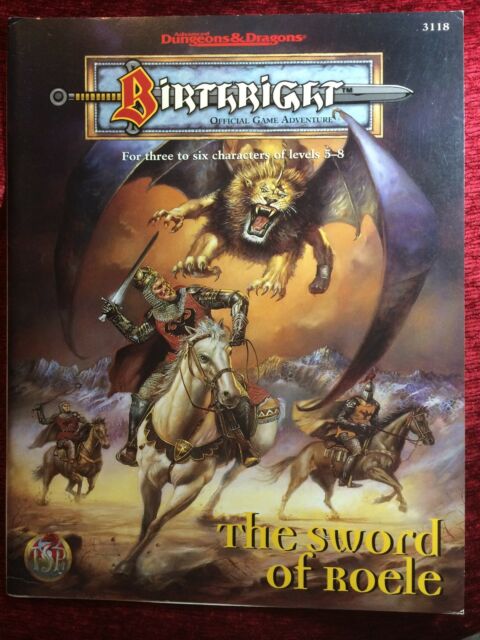
This is the long overdue second part of my review (that virtually no one was waiting for) of this mostly forgotten TSR adventure The Sword of Roele, for the Birthright setting. In the first part I’ve talked about how it has an absolute mess of a scenario, hilariously bad. But now I’m gonna talk about its main dungeon which I find, as the title says, pretty good.

The Sword of Roele, Wolfgang Baur, 1996, AD&D2E, levels 5-8

So you’ve gone through the arduous process of the module’s disjointed, scene-based nodes and finally found the adventure’s main dungeon where the macguffin, I mean the Sword of Roele is. You stand in front of:

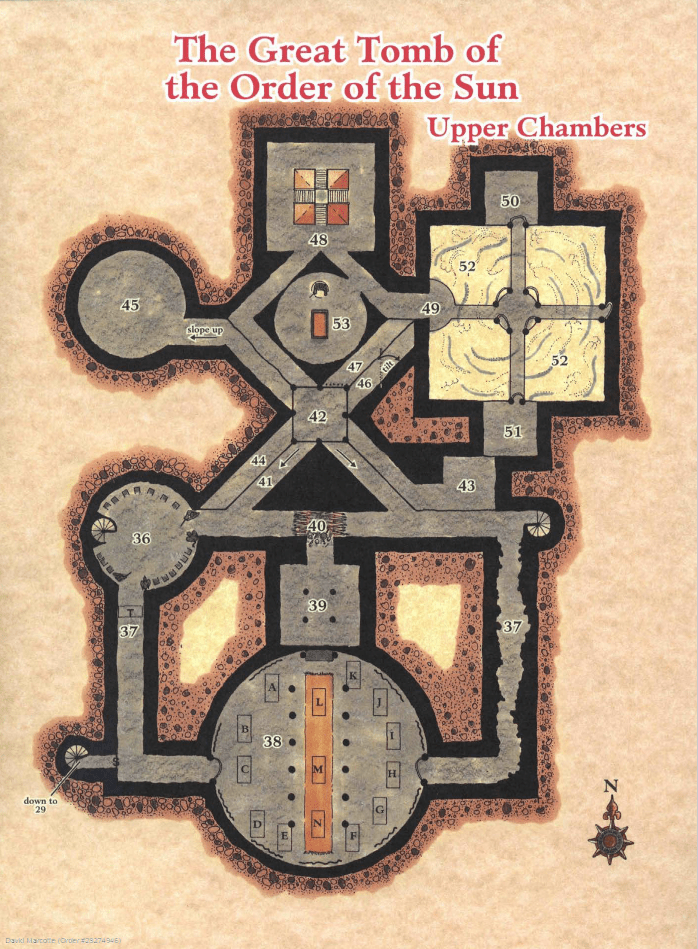
The Great Tomb of the Order of the Sun

  • Mid-sized dungeon, 2 levels, 53 rooms
  • funerary complex of knights do-gooders and some of their major figures
  • designed by an evil magic-user architect to accomodate his own needs in his plans to achieve lichdom

The tomb’s only entrance is collapsed with only a narrow path to get in (shown as the « goblin path » on the map even though there’s no goblins in the dungeon, a obvious sign that the dungeon has been refurbished and changed from its original purpose). The PCs will immediately have to confront the troglodyte sentries and do some tunnel fighting.

There’s an whole tribe of 41 trogs in the rooms near the entrance. The trogs are also intruders to the dungeons.

Here’s a great bit:

« If the troglodytes lose 10 or more of
their number, they retreat into Areas 3
and 6. In the storage area they climb up
the tunnel into the audience chamber
(Area 8). They are cold-blooded so they
suffer only one-quarter damage from the
brown mold’s cold. In the hall, they hide
in the shadows behind the statues, waiting
for a chance to ambush foes. »

The trogs take advantage of their resistance to brown mold, that’s great!

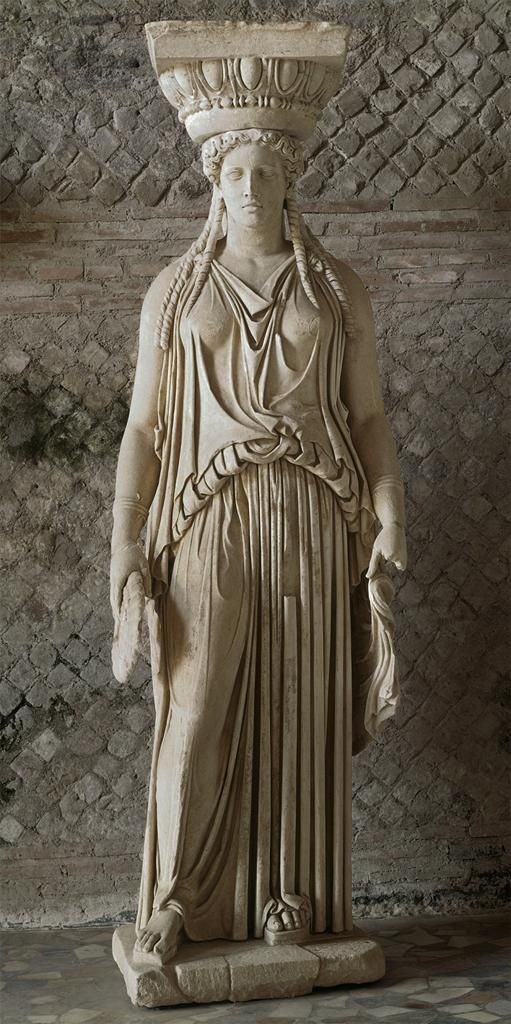
When the PCs are in they’ll see large double-doors at their left (upper right on the map), they’ll feel a draft of cold air coming from the right (caused by the brown mold) and see an impressive hallway in front with rows of stone statues/caryatids on each side. They’ll probably notice the corpses of dead thieves on the floor too, at the limit of their light source. Good telegraphing for what represents the main gimmick of this dungeon: of course some caryatids are monsters (circled in red below)! As written the caryatids are the equivalent of lesser stone golems and are perfectly beatable. When I ran this dungeon I’d upgraded the stone statues to full stone golems status, they absolutely have to constitute a proper threat to force some hard choices (and clever ideas) from the players IMO.

a caryatid ready to crush your skull
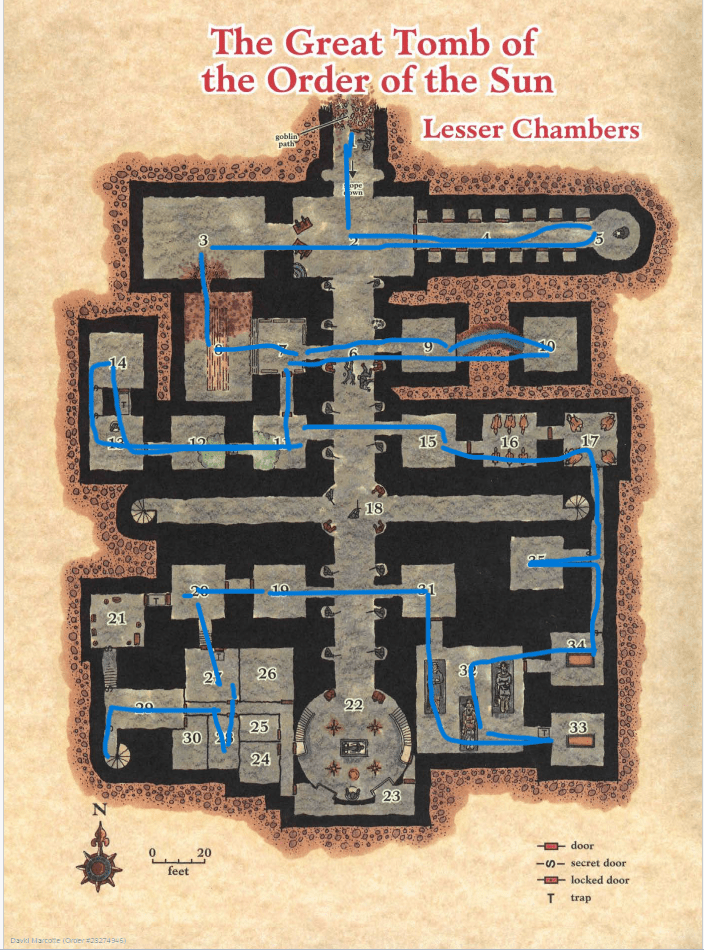
An « optimal » run to reach the second level could look something like that, with some tense moments of crossing the hallway with the help of diversions. (huh, you may want to include room 21 and 22 if you feel confident! 😉 )

Apart from the troglodytes and caryatids the main denizens are of the undead variety with some constructs sprinkled here and there. The dungeon definitely suffers from a gygaxian naturalism syndrome where things make sense for a tomb but there’s a lack of wonder involved.

Aside: Funnily enough there’s several mention of a resident vampire in the tomb, he’s supposed to be a big deal but he’s in fact nowhere to be found, he’s not even statted! Oops!

The rooms themselves are a mixed bag.

Some are great, like the Chamber of Shadows:

« Three of this chamber’s walls are covered
with an abstract pattern of black
lines. The fourth wall depicts a black
bridge over a misty chasm to a gate of
light. Words are carved into three of the
four stone walls. »

[…]

« The painted bridge at the far side of the
room is the Bridge of Sighs and Shadows,
a magical link through solid rock between
this room and the Divination Room. Only
those who know its secret can cross it. »

Other rooms are pretty boring. There’s several rooms in a row that are just filler; here’s a room with undead falcons, here’s a room with undead hippogriffs, the next one with undead griffons…

The second level is smaller and is designed essentially to confuse the players. It’s heavy on teleportation tricks, traps and of course it has more undeads and constructs.

There’s no faction play in this dungeon, the troglodytes are immediately hostile and other than them there’s few sentient beings. There’s an imp to be found who actually gives good advice as it serves his purpose, that’s nice. There’s also an homonculus but if you’ve met the imp he’ll feel kinda redundant. As written you may also be accompanied by the ghost of the order’s high priest that you can meet before entering the tomb and he does have useful information to provide (and some big secrets) but he’ll get angry if you fall into the usual adventurer’s tomb-robbing habbits and most people will be happy to put him to rest one way or the other before long.

So all in all, this dongeon has several weaknesses, even a few gaffes, but it has also several strong points, the hallway with the caryatids being a favorite of mine. It’s not a great dungeon but it’s good and it certainly doesn’t deserve to be completely forgotten as it is now.

Worlds Without Number rpg – almost a review

Edit 2024-04-09: I’ve refined a bit my thoughts after more sessions of play.

Edit 2024-06-25: idem

Worlds Without Number (WWN) is a 396 pages book by Kevin Crawford. It’s origins lies in the Stars Without Number sci-fi rpg system by the same author. This time the default setting « Latter Earth » is a science fantasy world in the vein of Jack Vance’s Dying Earth, Gene Wolfe’s Book of the New Sun or M. John Harrison’s Viriconium (those are my own references, sadly the author doesn’t cites his inspiration sources).

What the book claims to offer is nothing less than everything you need to run a sandbox campaign, or about 2/3 of the book on worldbuilding, mostly in the shape of random tables. The worldbuilding part seems well done to me but I’ve only skimmed through that part, I might use some of this content some day but as of yet I didn’t. The reason why I’ve bought WWN is for the rpg system it offers – so my comments for today will focus on this (much slimmer) part.

What the WWN system is all about?

  • It’s a hybrid system. An old-school D&D chassis (i.e roll 3d6 in order for your six attributes) combined with a modularity (i.e foci (feats) that let you be an expert at something, combat or otherwise that also have hydrid classes) that you don’t find in most standard old-school systems.
  • It has only 4 main classes: Expert, Warrior, Mage, and the Adventurer (that lets you combine with one of numerous « part-classes » with something like 80 combinations). There’s sub-classes for the Mage: the classical High Mage, the Necromancer, Elementalist and many more. To be frank, I’m on the fence with this whole part-class thing, it offers a lot of options for customizing a character but it also feels a bit wonky. It’s like two systems of character creation instead of one, maybe not a bad thing per se but not the most elegant piece of design either IMO.
  • Human-centric world. You can play an elf or dwarf or WWN’s own brand of fantasy races, but only with a bit of fiddling.
  • The spells have Vancian names like: « The Coruscating Coffin » or « The Jade Palanquin of the Faceless God ». The magic-users have very few spells per day (only one at 1st and 2nd level!) but again, they’re a lot more impactful than your regular magic missile, i.e. Invisibility at level 1. Magic isn’t risky (like in DCC for example) but you have to choose your moment carefully for maximum impact. Aside from the spells, mages have Arts, lesser magical abilities, most of them utilitarian in nature (read magic + darkvision combined as one example). Each magic specialities have a good list to choose from.
  • Combat is d20 based but skill checks use 2d6 + attribute mod + skill level (1 to 4) to beat 6, 8 or 10 or more depending on difficulty. With this less random formula, the characters skill’s competency feels a LOT more relevant.
  • On the character’s sheet there’s a list for « readied items » based on the encumbrance capacity (strength-based) of the character. It’s great and efficient.
  • Combat is fast and deadly and in my impression it feels more chaotic than tactical (not necessarily a bad thing) unless you pay very close attention to the list of combat options provided i.e. screen ally, snap attack, etc.

Some things unique to WWN:

  • There’s a « Shock » mechanics in combat – martial melee weapons will often (except against an opponent with high AC or with a shield) do damage, even with a miss. It’s a bit conterintuitive but characters that are built for combat (warriors in particular) can do potent damage without ever succeeding with their d20 fight checks…
  • There’s a System Strain mechanics that put a limit (your constitution score) on the number of time you can be healed before having to recuperate in a safe place (i.e in town).
  • Levels are capped at 10 at which point you may (depending on the type of campaign) become a « Legate » and have access to new powerful abilities.
  • A lot of character features to mitigate randomness, including automatic hits, sucesses on skill checks, balancing of hit points the more you level up, etc.

So here’s a few from the hip comments after we had several sessions of play, this might change with further experience:

  • Overall WWN characters are as fragile (edit: not quite true, they have several options to mitigate damage) as your standard old-school one but feel a lot more capable.
  • The list of part-classes and foci available ensure a great customisation but that comes at a cost: if a player wishes to examine all the options then creating a character in minutes like in simpler systems would be impossible.
  • My players are a bit confused with the Shock thing. A low hit points character can easily die from just the shock damage and that seems a bit excessive. But overall I think it makes more sense than wooshing weapon swings half the time.
  • My brother Jason played an Adventurer (part-Expert, Part-Healer) and can do magical healing all the time, like every frikin round. He even calls his character a « healing tower » like in these tower defense video games… It’s an odd design choice, in stark contrast with the full Mages who have one big moment per session and I’m still on the fence on what to do with this character. (edit; removed the character)
  • The system strain is, as far as I can tell, designed to be implemented within an expedition of several sessions’ worth of play. With how we’re playing now with the PCs always back in town after their session of dungeon-crawling (and with downtime), it doesn’t come close to being relevant. I think I’ll have to adjust that.
  • My sister’s Necromancer has wiped out 20 out of 24 (1 HD) skeletons with her Smite the Dead spell in last session. Her unique spell of the day but certainly well-spent. The magic system is still fairly close to D&D but its tweaking of limited-use but POTENT spells is interesting. But don’t expect your main villain to fare well in this environment!
  • If most of the WWN system is perfectly okay for generic fantasy, the crafting system notably is pretty much designed with science fantasy in mind.
  • The Intelligence attribute isn’t linked to magic-using this time around so I guess you could have a dumb as a rock Mage? It feels wrong to me. Intelligence is linked with « efforts » which are used to fuel the « Arts », the lesser magical abilities.
  • The book lacks a proper bestiary, (edit: it has some creature base stats as well as options/powers to add but that’s it, creatures have to be « built », they are not ready to use). Edit: That’s still my biggest complaint to date.

All in all, WWN has some weaknesses and I might tweak a few things but I like it. It offers a solid core, with its main strengths being the handling of skills, character customization and idiosyncratic magic system. The main character classes are well thought out and you can easily create whatever you have in mind if you invest a bit more time. A D&D-adjacent game that has a pretty unique feel.