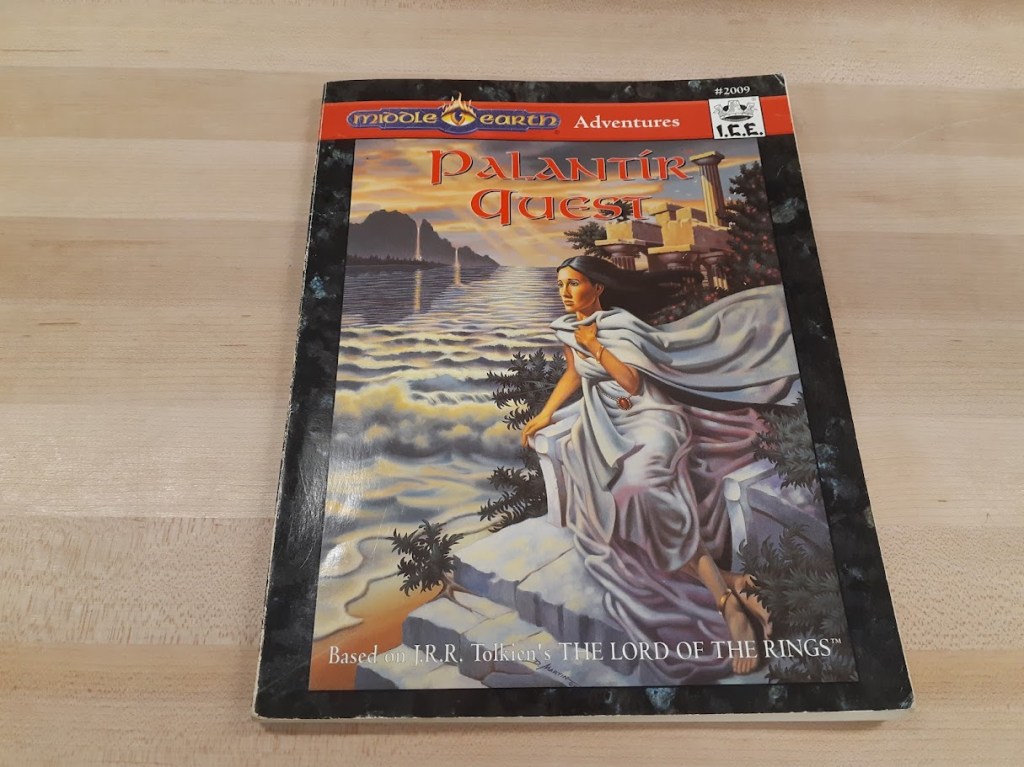
Palantir Quest (1994) – dungeon à la sauce Rolemaster (review part III)

I’ll be dividing my review of Palantir Quest in something like 7-8 parts I’m thinking. Yeah I’ll be quite thorough with this one, I’m not exactly sure why I feel the need to do so to be honest. On the one hand I don’t think there’s ANY real review of this product that exists at the moment. On the other hand I would be really surprised if someone was waiting for it at all. So that’s one of these things, just for the heck of it…

Part 1

Part II

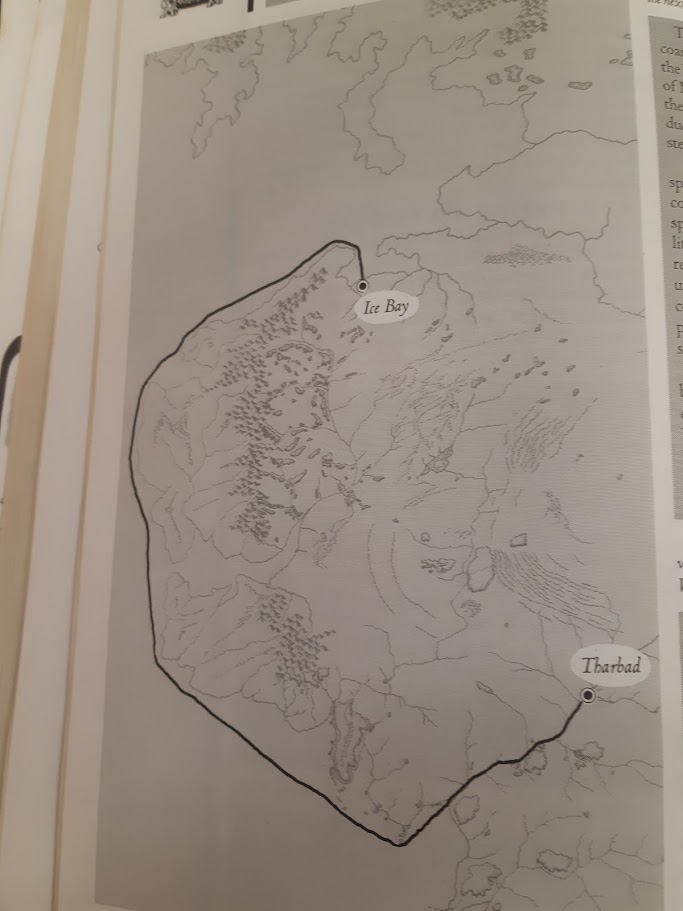
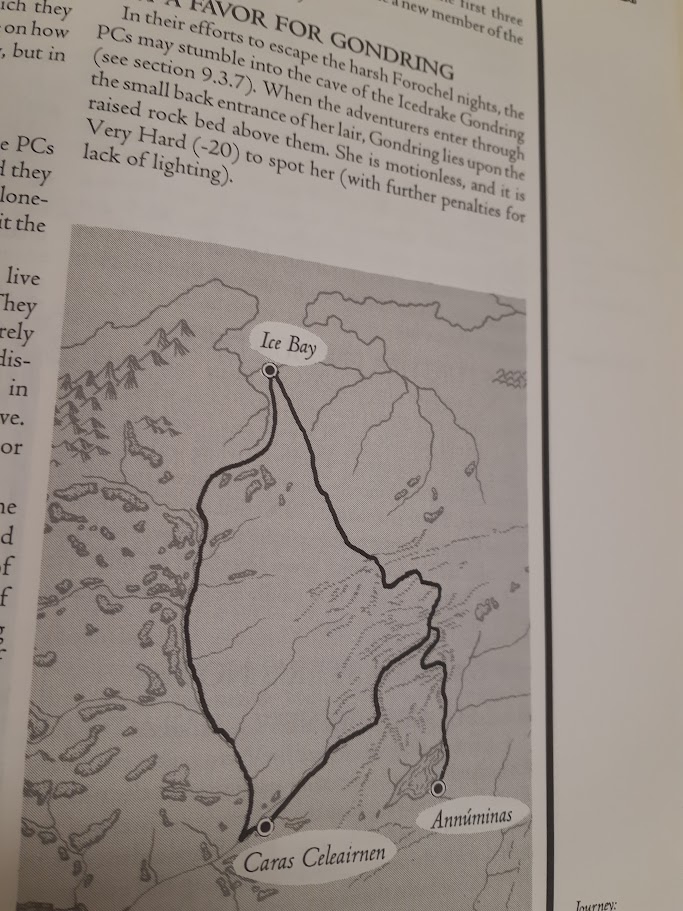
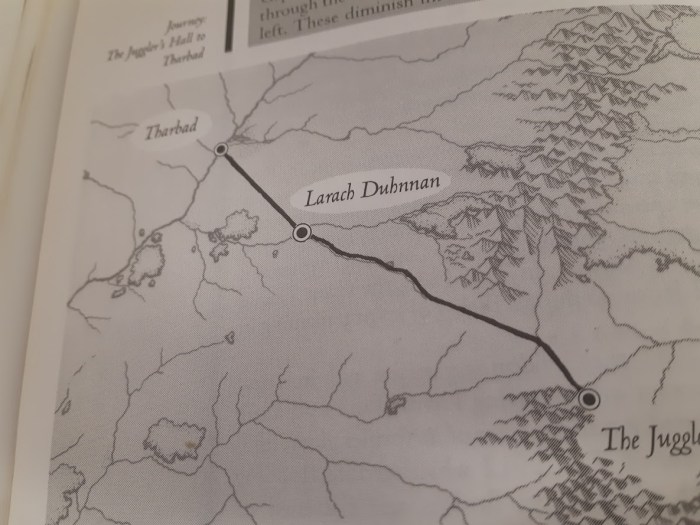
We’ll now be examining the content of chapter five and six of the book. The player characters are leaving behind the kingdom of Rohan and should reach the reconstructing city of Tharbad into the Eriador region after a journey of about seven days.

There’s one fixed event on the road whereas the PCs have the opportunity to save a wounded Eriadorian guy and defeat some hostile nameless Dunlendings. In similar fashion to the earlier chapter, the rescued NPC will ask if he can be escorted to the next point on our map, in this case the town of Larach Duhnan. There, the PCs will have to take the soul-rending decision of which of two inns will they sleep in for the night. As there’s nothing to do (and no npc roster), I suppose the Game Master will encourage the PCs to leave asap and get to Tharbad not that far away.

Maybe it’s time to address somewhat of a big flaw of the book: there’s no sidequests hooks anywhere to be found to go along each chapter’s background history, truly excellent maps with keyed locations, nice buildings layouts and a « People of Note » section. Of course a GM worth its salt can add his own but it’s still a glaring omission.

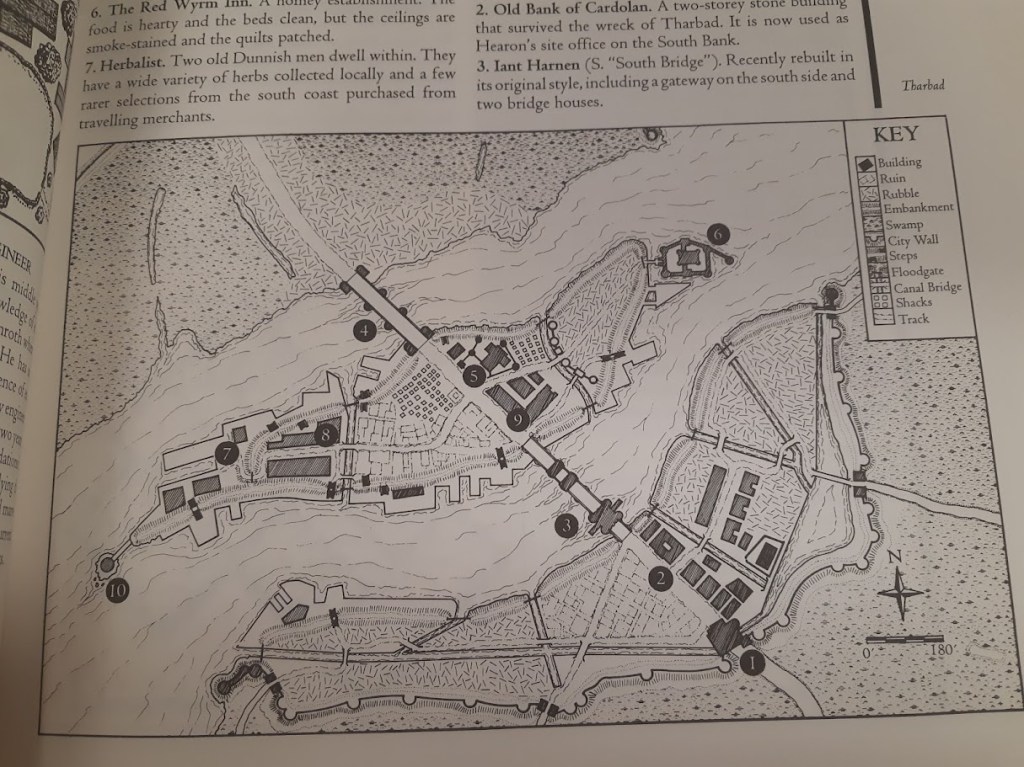
Then, the player characters reach Tharbad and, as they were told to do so by the Royal Seer back in Minas Tirith, meet Commander Cilis in the restored Royal House. The latter expresses his doubts that there’s any books left in the library, he has seen it a few years ago and it is « no more than a moss-covered ruin ». They also meet Chief-Engineer Hearon who brings them on a tour of Tharbad and we get: « this is a good opportunity for the GM to adlib some meetings with the multi-cultural work force enjoying a well-earned drink in the cool evening air. » Nothing else from these two NPCs, not even a if you happen to find a… or a be on the lookout for… You know, something signaling opportunities, danger, anything!

I’ll note that Tharbad, with a bit of work, would make a very interesting homebase for adventurers as it should have a central role to a resurging kingdom of Arnor (northern Eriador) with its strategic location and afflux of newcomers.

So after after this talk with two NPCs and a rest at the Royal House, the adventurers will leave Tharbad behind and go further north.

Fortunately things will get more eventful in this next chapter.

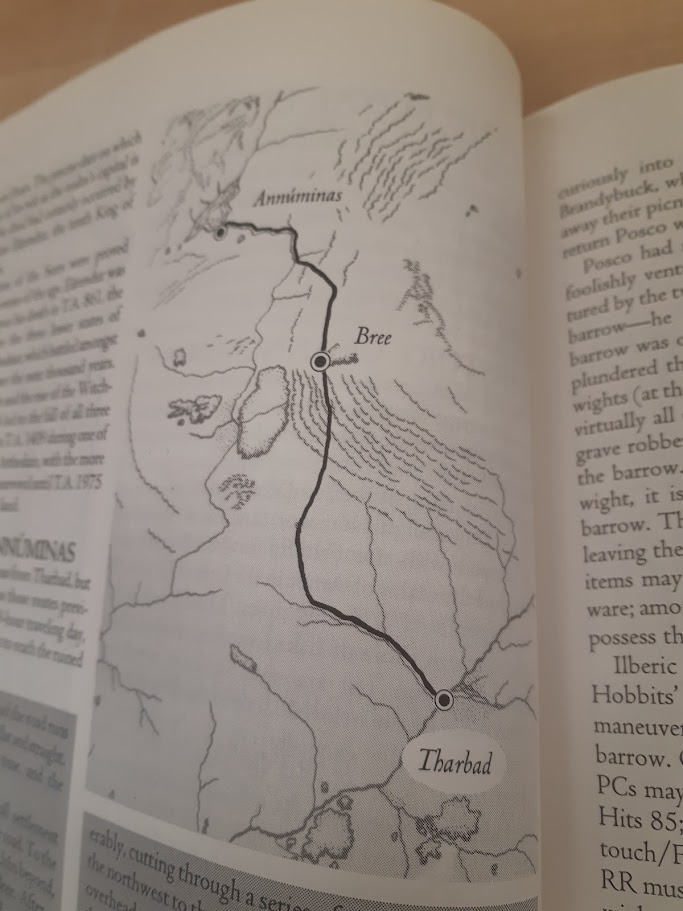
It takes about 10 days from Tharbad to reach Annuminas, with a stop in-between at the town of Bree. But before reaching Bree: « The air is oppressive. You notice standing stones and strange monoliths littering the downs to the west. Strange, unnatural hillocks deform these western ridges. As you contemplate the scenery, a small figure runs across the hills waving its arms frantically and shouting in a high-pithced voice. »

The player characters have the opportunity to save the hobbit’s friend who was foolish enough to enter a barrow (as in Barrow-downs) – as a great pastiche from The Fellowship of the Ring (the book, it’s absent from the movie). The barrow, Lord Ravenor’s tomb, is a small eight-keys dungeon. There’s two wights within in one corner of the dungeon performing their morbid ceremony on the poor unconscious hobbit. There’s some treasure to be gained too: a few pieces of jewelry, gold coins, a nice magic ring (not powerful but useful) and some magic arrows.

Serviceable and, like I said, a nice pastiche.

After that, the PCs arrive in Bree. It is assumed that they relax a bit at the Prancing Pony, of course, I mean why not, and then continue on their way.

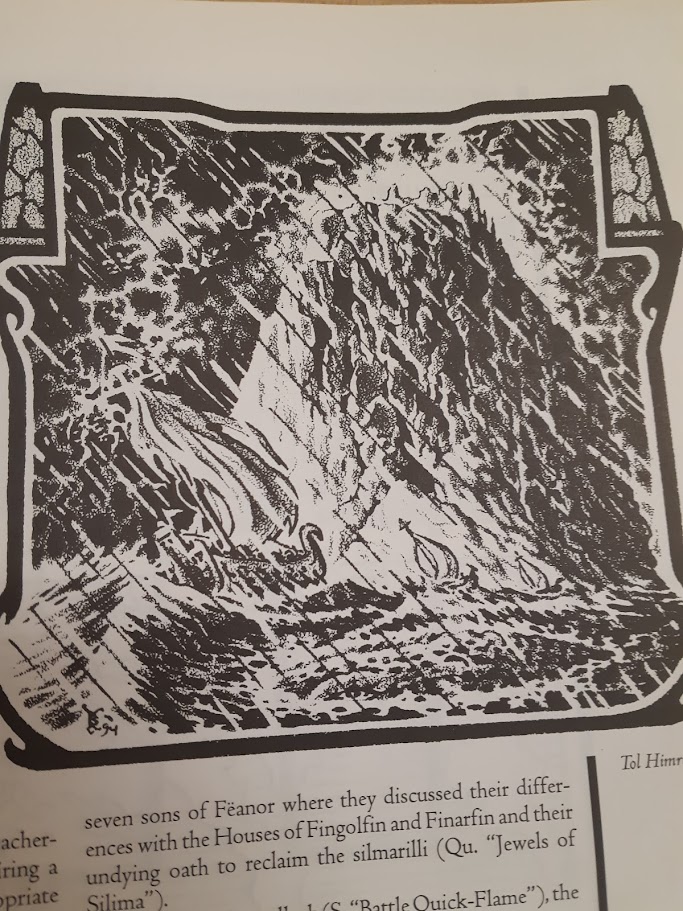
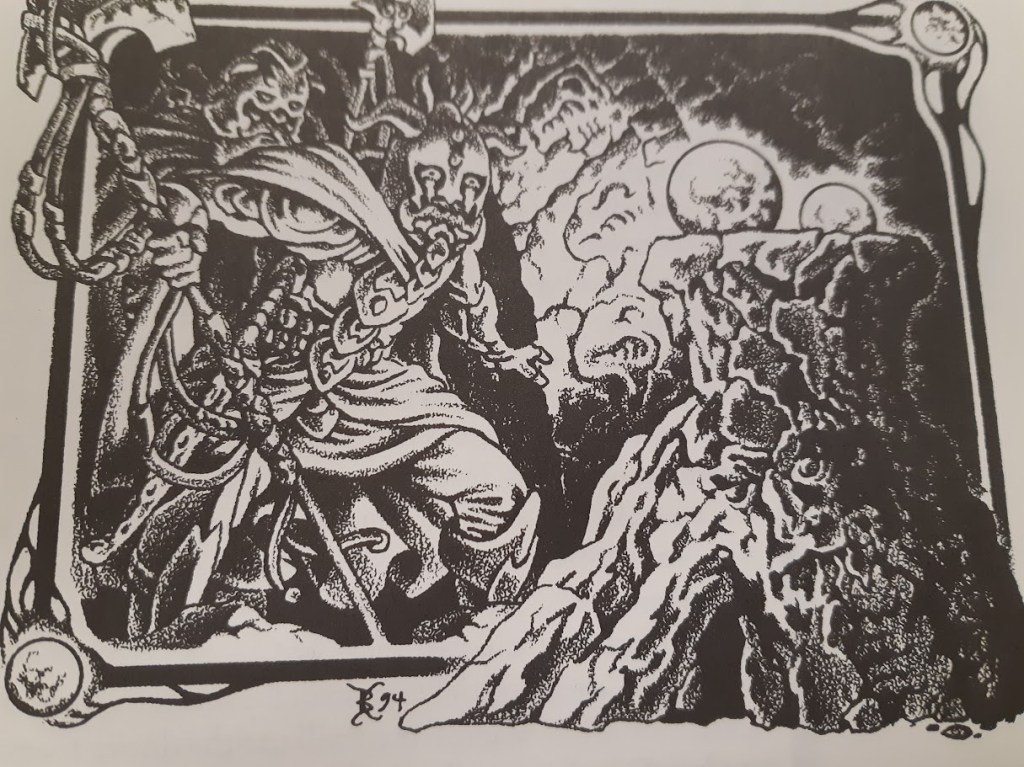
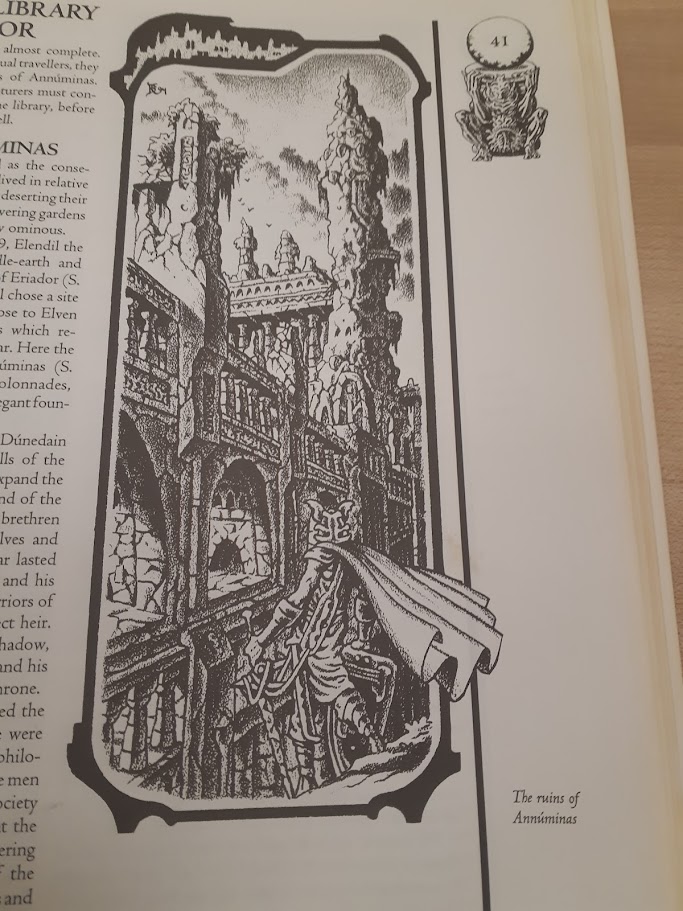
Top-notch art, as Middle Earth/ I.C.E. products were known for.

And now in Annuminas.

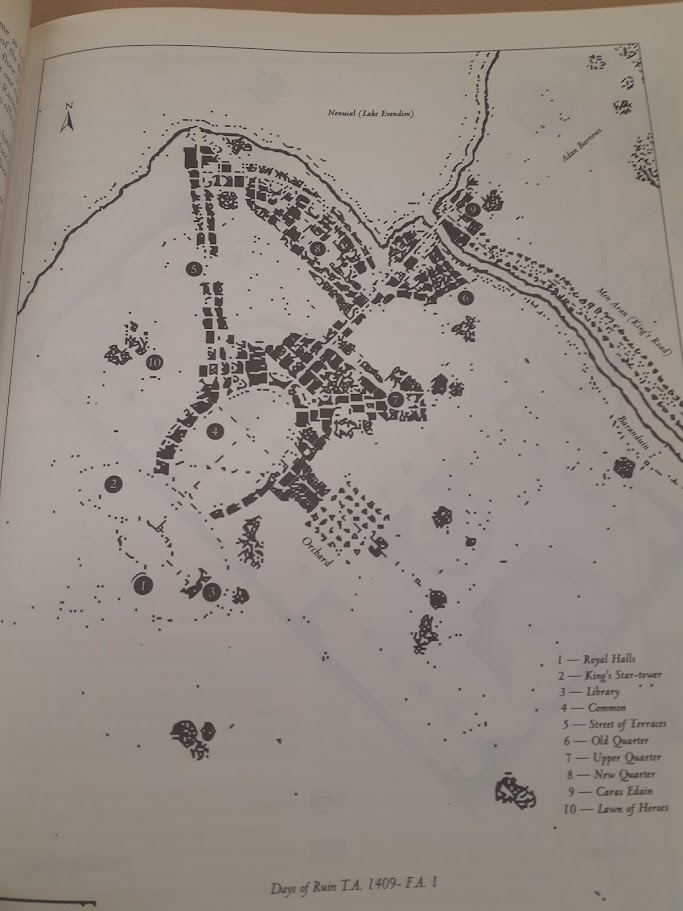
The city is completely in ruins, has been for centuries. The map (below) provides us with 10 keys but except for one (the Royal Library), they’re only for ambiance (i.e. « King’s Star Tower. A half-ring of stone remains from the royal observatory. It provides a sheltered camp site. »). There’s no encounters table provided either, though I suppose one could use the Old Arthedain‘s table of the Roadside and Wilderness Encounters found with the others at the end of the book.

Annuminas is not completly empty as there’s a family of seven trolls (3 males, 2 females, 2 youngsters) having a camp, guess where? Right at the PCs’ objective: the Royal Library! But I’m not really complaining, players must have challenges to overcome after all. The trolls would be quite dangerous to fight without a solid plan, probably impossible to beat in a fair fight in fact. Which is fine by me.

The trolls dealt with in some way or the other, the adventurers are free to explore the Royal Library. There’s not much aboveground anymore, a building with half of its walls ruined, but stairwells lead underground. An undergound library? That’s a terrible, terrible idea for books conservation! But, er, yes, maybe there’s some magic involved, let’s not delve on that too much.

« The most valued records and documents were removed from their ordered resting places to occupy the largely vacant shelves of the buried lowest floor of the library. Hasty but deadly traps were contrived and armed to protect the wealth so carelessly assembled. Then the last, brave, hopeless men turned to fight and fall to the hordes of the Witch-King. »

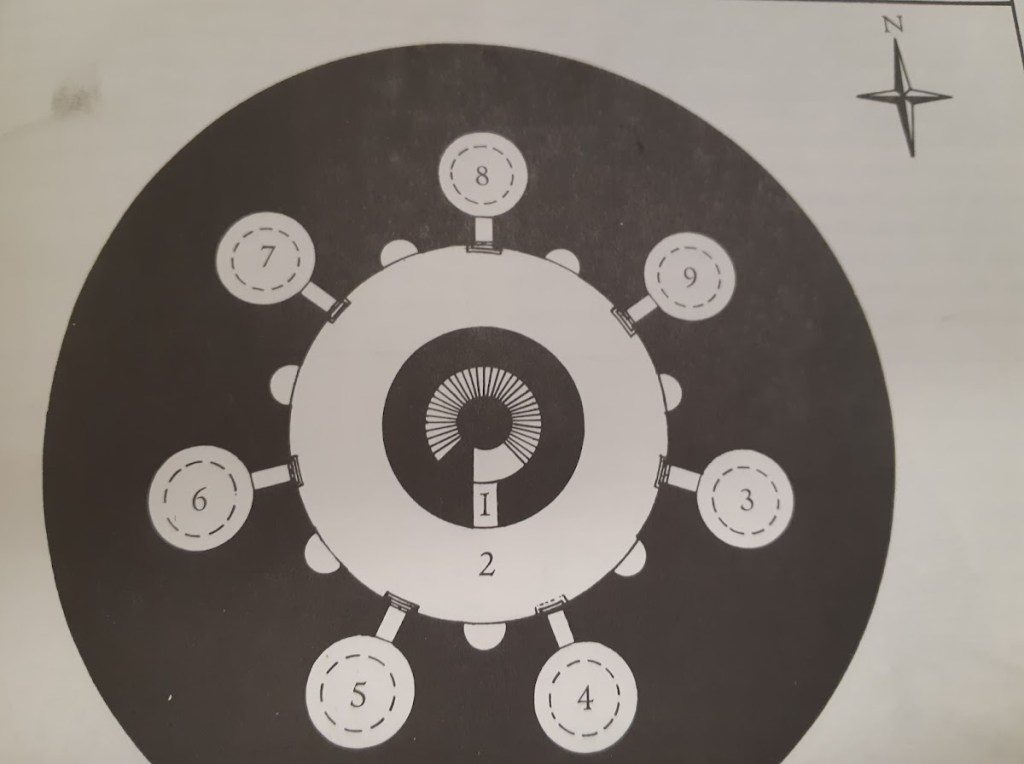
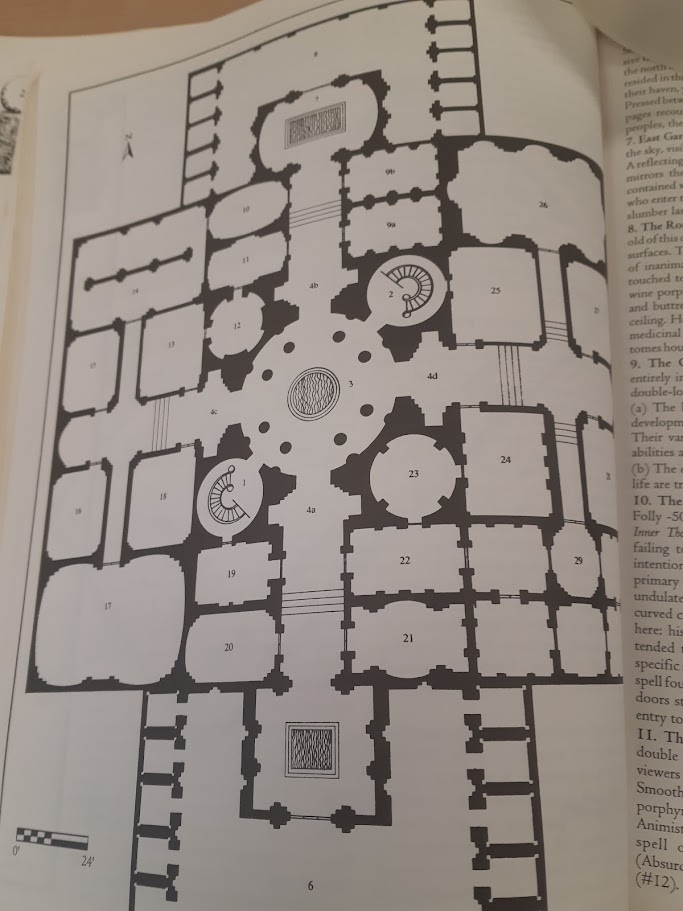
The Royal Library is a single Level dungeon with 29 keys, the only « real » dungeon of the adventure, such as it is.

(Side note: Not surprising, dungeon-crawling isn’t a primary feature of the I.C.E./MERP books. There is certainly some to be found of course and you know, there’s this little thing called the Moria fortress in the series. I guess you could also include Dol Guldur, Mount Gundabad and Angmar. Well, it’s more like stealth missions than dungeon-crawling as a real assault on either of those places would be suicidal even with high-level PCs.)

So, the closest thing to a dungeon in a MERP book let’s say. Let’s take a brief look at it.

Now the first thing that strikes me is that it doesn’t look like an underground complex at all. Yeah I know we must be lenient with dungeon architecture but this isn’t what I mean. The room at the center that you reach with either stairs is the Central Dome. Now, height isn’t mentionned anywhere for any locations so maybe there’s enough space for a dome. But way more revealing are rooms 5 and 7, East Garden and West Garden (which are in fact North and South on the plan, oops): « broken glass allows the filtered rays of the sun », « Prolific greenery has overflowed », « A reflecting pool filled with rainwater, sketchily mirrors the green splendor surrounding it. » This seems obvious to me, this is a refurbished dungeon (not the first time I see this), for an aboveground structure and the authors didn’t changed everything (or much?) from its original purpose.

With that out of the way, lets get back to the entrance.

The two stairs are both on the verge of collapsing and won’t support the weight of more than three men at a time. The way the Rolemaster system works, it’s odd but this is considered a trap and you have to detect it (Very Hard -20 and Extremely hard -30 for the other staircase) and somehow you can disarm it (?) (Sheer Folly -50 in both cases). One of the two staircase has also a (+10) fireball trap set off by the mere presence of intruders. That’s weird design. Shouldn’t the PCs just see that the staircases are damaged and take precautions if they wish so? Even more problematic is that there’s no way to know about the fireball trap – any dungeon designer worth his salt will give some realistic hints – a visible rune, some traces of burning or an incinerated badger maybe? Something to induce players agency you know.

So, a roll for this, roll for that unfortunate tendency I’d say.

But the PCs are now inside (with a 50% chance of them being a bit crisped). They already have the Royal Library’s master key from the start of the adventure, convenient as almost all the doors are at least « Extremely Hard -30 » to lockpick or will set off a spell if forced open. They have to find a specific book within the library with 20 out of 29 rooms having books in them. The objective is like sixty feet away from the entrance but the PCs will have to search randomly room by room, or maybe they have the right Seer spell available and will find the right room and the book in like 5 minutes, that’s a possibility. If not, what they have to contend with is mostly a handful of animated statues and hostile spells at almost every door. There’s also a 10% chance per hour of a ghost of one of the deceased librarian to appear and simply attack the PCs.

The books they’ll be finding everywhere are mostly abstracted (this section has lore on beasts, this one on astrology and so on) except for a few canonical ones (i.e. the silmarillion). No value is given to any books and nothing else can be found in the vicinity. Well, this isn’t a gold for xp game but still, unfun.

I’d say overall, the dungeon has good texture (rooms descriptions are nice if impractical), but it’s severely lacking in interactivty.

To be blunt, I don’t think this dungeon is worth it as is nor is the work of adapting it to one’s campaign unfortunately.

Adventure-wise, we have reached the next milestone, the PCs have obtained the spell to locate the palantir and will be sent to retrieve it.

Coming up, after a digression or two, we’ll see the adventurers become arctic explorers!

Palantir Quest (1994) – players are actors (review part II)

Just to be clear, I’ve never ran this adventure (nor played in it).This is a 3 decades late, external look at it we might say.

Part I

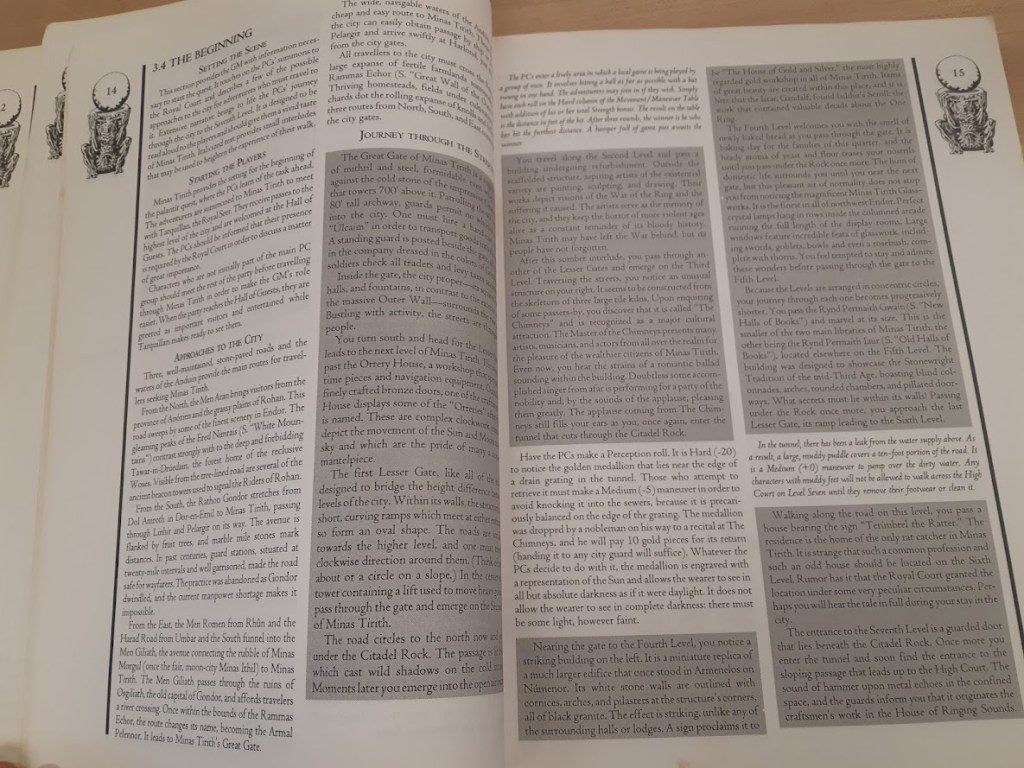
At page 14, after having informed the Game Master of relevant background information, the adventure begins with… extremely long read-alouds.

Well-written mind you, interesting for a true Tolkien aficionado perhaps, but boy if my mind would drift away as a player if I was read all this by someone!

But notice, between two grey boxes, a first challenge for the player characters! On how to deal with a « ten-foot portion » of muddy road. Yeah, well, small beginnings and all that…

Railroading into Middle-Earth’s 4th Age

(Side note: There’s a big hint on how the adventure will present itself on chapter 1.0 Guidelines: « Fantasy role playing (FRP) is akin to a living novel where the players are the main characters. Everyone combines to create a story which is never short of adventure. They help forge a new land and strange new tales in which the characters are forever immortalized. » (bold emphasis is mine)

After their mission briefing by the Royal Seer, the Player Characters (PCs) are ready to leave Minas Tirith.

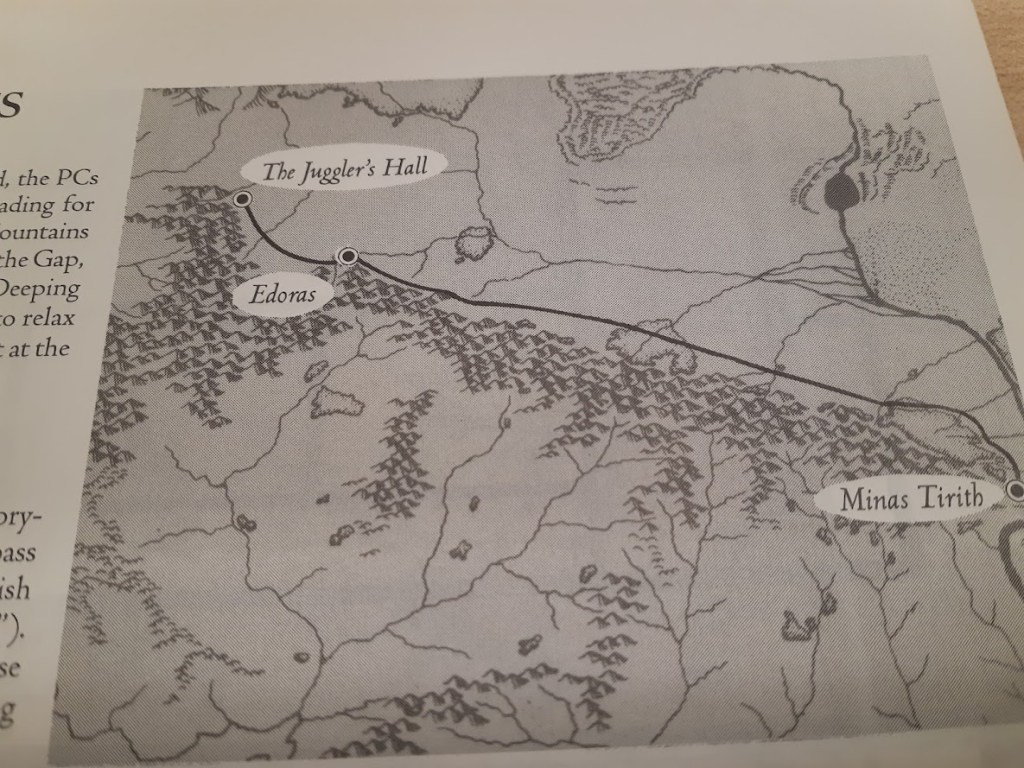
The utlimate goal is to retrieve the lost palantir but in order to do that they first have to reach the Royal Library in ruined Annuminas in the north, to find a tome of spells that will help pinpoint its location. First stop is in Rohan in a place called The Juggler’s Hall.

It takes 10 days of travel to get there and somewhere in the middle we get this fixed event: upon arriving at the Inn of Greys the PCs see that it’s being attacked by bandits and the adventure just assumes that the PCs will intervene (and to be fair, why wouldn’t they?). Upon defeating the bandits the PCs meet Turibor the minstrel who’ll ask if he can accompany them on their journey north. This guy is a key NPC, I mean key as in unlocking another scene kind of thing. He’s the one who will bring the PCs to the Juggler’s Hall and if you had players that were expecting to go to Edoras and meet rohirrim riders they’d better forget about it, aside from taking new horses nothing happens in Edoras. No, instead you get the Thespian Intrigue in the Juggler’s Hall, involving the PCs in a theatre play (about the kin-strife that happened in Gondor, again. not really a nice fit for Rohan). The leader of the Wandering Conscience Company will offer 10 silver pieces and a choice of nice clothes to each character, for participating (acting) and help guard against sabotage from a rival company.

I’ll add that the Juggler’s Hall is oddly, really in the middle of nowhere, but it’s also a base for smuggling operations so there’s that. Talking of smuggling, there’s a bit of foreshadowing in this chapter as it’s mandatory that the PCs witness two NPCs shaking hands in « business-like fashion ». One of these NPC « may draw attention to himself by way of his disturbing laugh ». BUT: « However the PCs should be given no grounds to become suspicious of him ». Well, good luck with that Game Master! Hey players, here’s this fixed scene involving two shady NPCs, one has this disturbing way of laughing, y’know like a cartoon villain would laugh just sayin’, but don’t be suspicious! No no no, no reason at all!

And then the Thespian Intrigue.

The play itself is nicely conceived I’ll say, with a nice plot as mentionned taken from the kin-strife period (a Cromwell-like usurper gets hold of power in Gondor) and plenty of stuff happening (including a real knife stab (instead of a fake one) that the PC victim should try its best to go along with so that the play isn’t disrupted!). Of course the whole thing is nonsensical and out of place (irrelevant to the mission) but I’m pretty sure it could be great fun for the players. The Game Master though, in true Rolemaster fashion, has the cumbersome job to evaluate which + and – to use in the provided chart and get the results for the « Audience Appreciation Level » (AAL): « Having totalled the appropriate modifiers, the actor should roll on the appropriate column. The result is the number to which the GM must roll equal or less than in order for the AAL to increase by 5. If the GM rolls over the number, the AAl decreases by 5. At any time, an AAL of 0 means that the audience boos the company off the stage and leaves, while an AAL of 100 means that the audience immediately rushes the stage in a frenzy of hero worship and adulation. If the play end naturally, then the AAL should be added to an open-ended roll on the Hard column of the maneuver table, and the result is the number which the GM needs to roll under in order for the critics to like the play. »

Phew. I wonder why Rolemaster isn’t a popular system anymore!

Anyway, the PCs can get a substantial bonus reward (or not) depending on how well the play went and also experience points based on what happened so far or « as we recommend, he or she may just award points in a subjective fashion corresponding to how well the players are able to cope with the stress of being onstage ». How well the players cope with the stress of being onstage. Wow, that’s a weird thing to say. I thought the players were like, around a table with pens & papers & dice, not onstage.

This concludes this chapter, a weird one for sure. Next the PCs will leave to continue their journey to Tharbad, en route to the ruined city of Annuminas where they will get to explore a dungeon! Yay!

Part III

Palantir Quest (1994) – tunnel vision (review part I)

I’ve been rummaging through my collection of (twenty-something) I.C.E. middle-earth books lately. I could get good money for them – last time I checked Palantir Quest in particular was on sale for 175 usd on ebay despite being in terrible condition (mine isn’t much better!). But y’know, I’m quite sentimental about these, they are the first rpgs books I’ve bought, some thirty years ago, at age fourteen-fifteen with my hard-earned money as a field hand at the time.

So, no selling.

Paid for in sweat and sore knees.

Palantir Quest is in fact an unusual one among this collection as being one of the rare Adventures book along with Kin-Strife, as well as several much slimmer adventures compilations. All the others in the line are sourcebooks, as far as I know. Incredibly detailed and well-researched sourcebooks I must add in case you haven’t heard of them, something that doesn’t exist anymore in rpgs I think, that required an entire team of dedicated people to do. Something to be nostalgic about no doubt. Keep that in mind if you please, because I’ll be a bit harsh with this one: I.C.E’s sourcebooks were absolutely great.

But back to our current subject.

From the book’s back cover: « Strange portents in the great Seeing-stone of Minas Tirith give promise that one of the lost palantiri of the North has returned to the lands of Men. Can the adventurers find this legendary treasure and bring it to King Elessar? Rogues of the wilds, blizzards out of the Forodwaith, and the greed in Men’s hearts all conspire against them. »

Adventuring into Middle-Earth’s 4th Age

The premise is quite interesting, unlike most of what has been published by I.C.E. this adventure takes place some years AFTER the events of the Lord of the Rings. Sauron has been permanently defeated, what remains of his forces has been scattered away and Aragorn, as the ruler of both Gondor and Arnor is now known as King Elessar. This is the begininng of a new era, the 4th Age of Middle-Earth, and what better news to go with this time of triumphant joy than the resurfacing of a long-lost palantir that could help unite both halves, North and South, of this new victorious kingdom?

Elon: « Imagine holding this super heavy bowling ball in your hands, straining your mind in a superhuman effort, and talk to ONE other person in the world … »

Yes, thank you Elon, very impressive.

But you need two palantiri to do that.

Aragorn/King Elessar has the one from Orthanc of course and the one that Sauron had has been destroyed (or is lost, buried under the ruins of Barad-Dur presumably) and Minas Tirith’s palantir (this book says) has been unfortunately imprinted by Denethor’s last moments of agony (a rather unpleasant sight to behold), this is why finding this other palantir would be incredibly useful.

Enter the PCs.

(Side note: Suggested starting level is 4, the PCs are presumed to have some prior accomplishments. There’s also a provided list of pre-made characters as well as suggested eventual replacement, one for each chapter.)

They’ve been convoked to Minas Tirith by NPC Tarquillan, the venerable Royal Seer, to do the king’s bidding and find the lost palantir of the North. Or not exactly that way – they’re told that a spell from a tome called « A Treatise on Subtle Magika » has been discovered to exist and (much faith has been put into that it seems) it could be used to locate the palantir that has only been glimpsed at. (a written spell? a bit peculiar to me thematically speaking but okay, let’s get on with it). The most likely location of the tome is in the Royal Library of the ruined city of Annuminas.

Unbeknownst to the PCs and their employer, Taladhan, a powerful evil magician no one has ever heard of (he apparently hasn’t got the memo that evil has been defeated) who’s scheming from his hideout in faraway Greenwood, knows everything about the plan to recover the palantir because the Royal Seer’s assistant in fact spies for him. Very astute of him to have put a spy there I must say, just in case there would specifically be news from a resurfacing palantir. But anyway.

Thus begins one of the most Tangential Fetch Quest in the history of RPGs. Probably.

Part II