Short session with one big fight taking a big chunk of it. Very dangerous situation that they got themselves into and the PCs had to flee again.
1h30
Gunderholfen by G. Hawkins: https://www.drivethrurpg.com/en/product/265629/gunderholfen
Player Characters (PCs) – The Battle Brothers:
- Aracyne, Elf Hunter, fearless Guild Leader, (Isaac)
- Jedri, Ratman Thief, he likes his rat-shape curse (Isaac)
- Grimoire, Goblin Mage, frail but smart (Isaac)
- Forka, Dogman Knight, fierce warrior (Edmond)
- Torch, Goblin Knight, not expendable anymore (Edmond)
This session’s main goal: finish the orcs
What the other adventuring guilds are doing at the moment:
- Green Imps: training in Longfelt
- The Protectors: adventuring, left Longfelt for Gunderholfen
- Black Axes: adventuring, try to find a tower in Ganfal swamp
- The Musers: adventuring, left Longfelt but kept quiet on their objective
Gunderholfen – Level 4A – Great Altar Cave
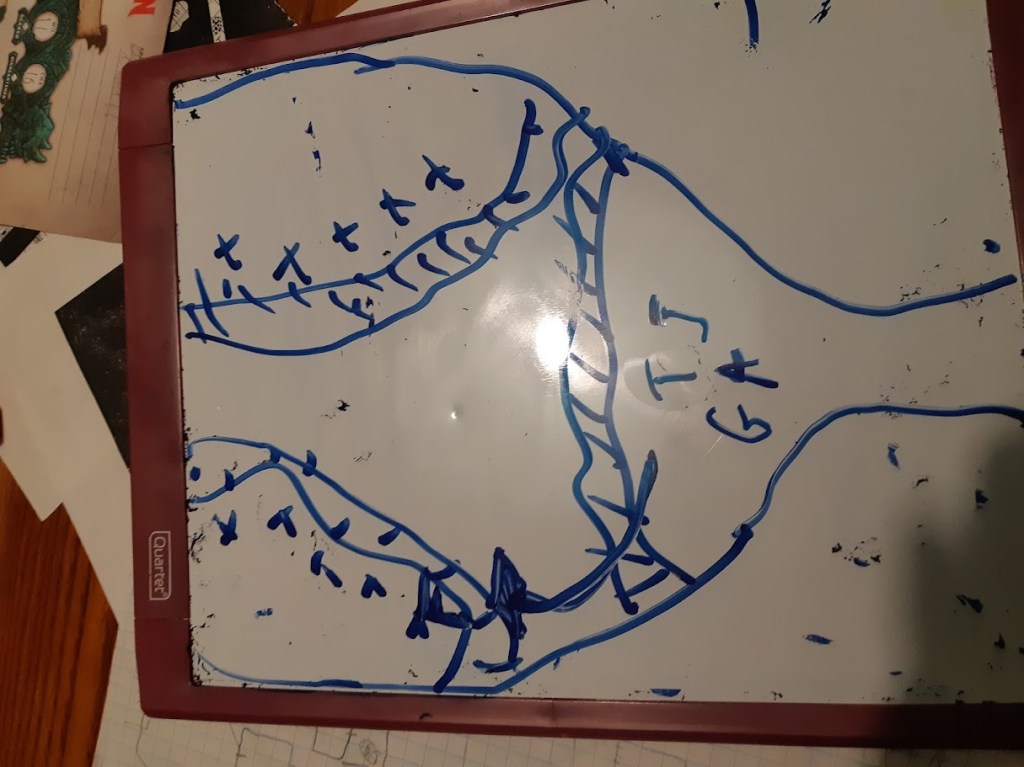
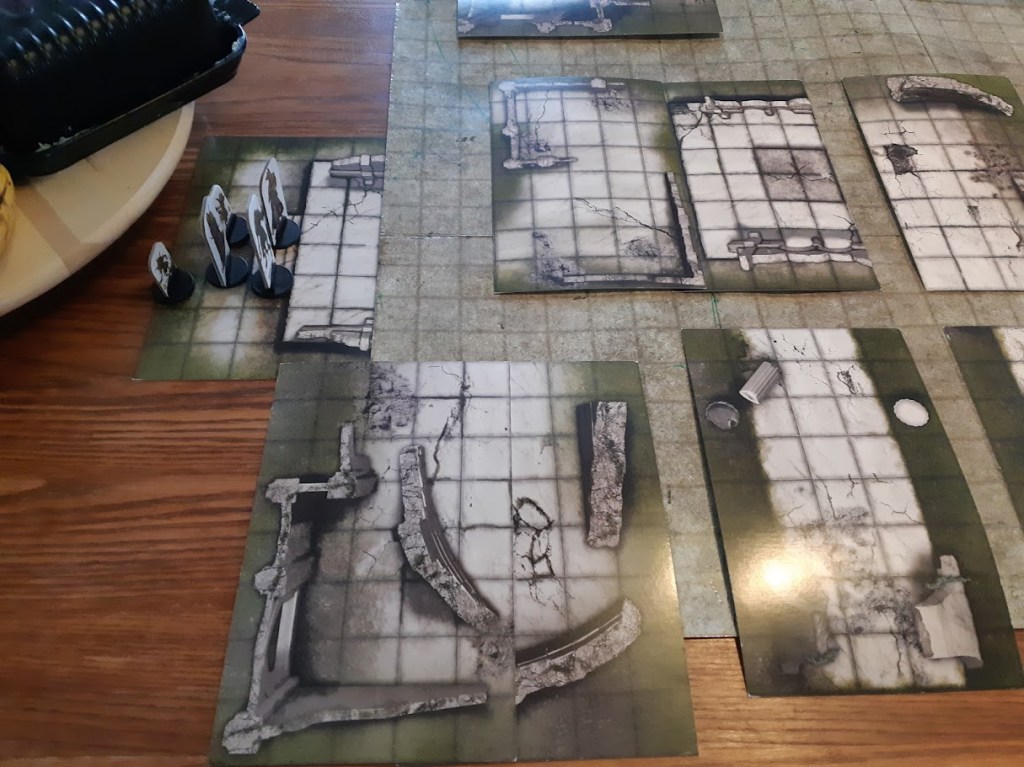
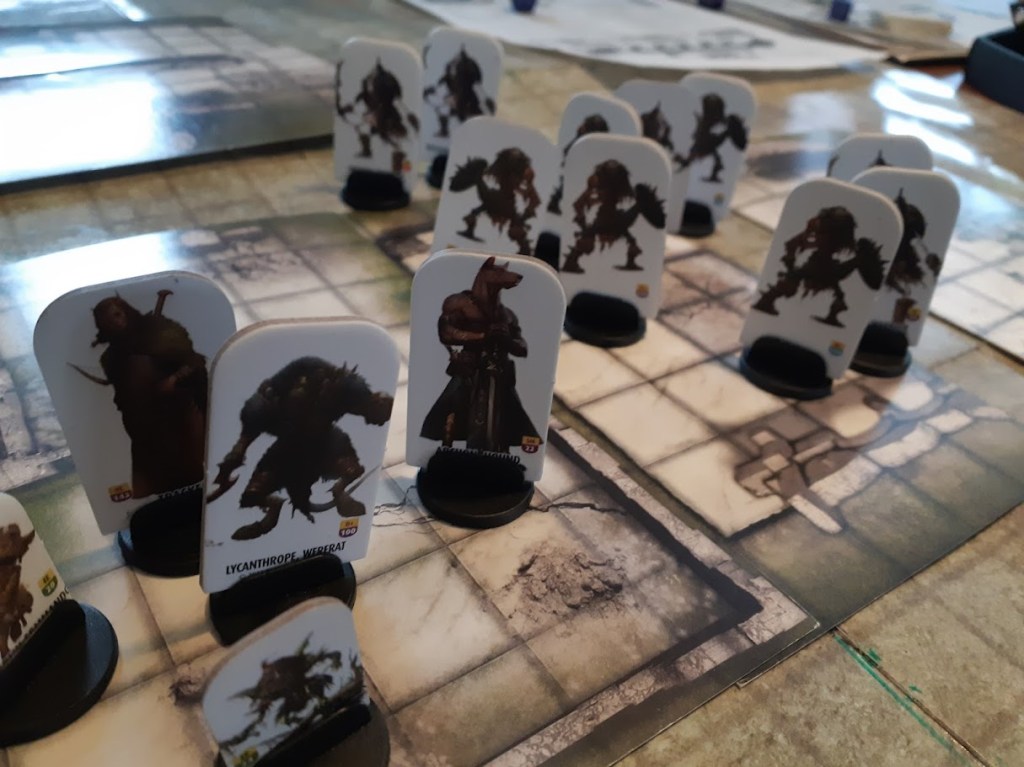
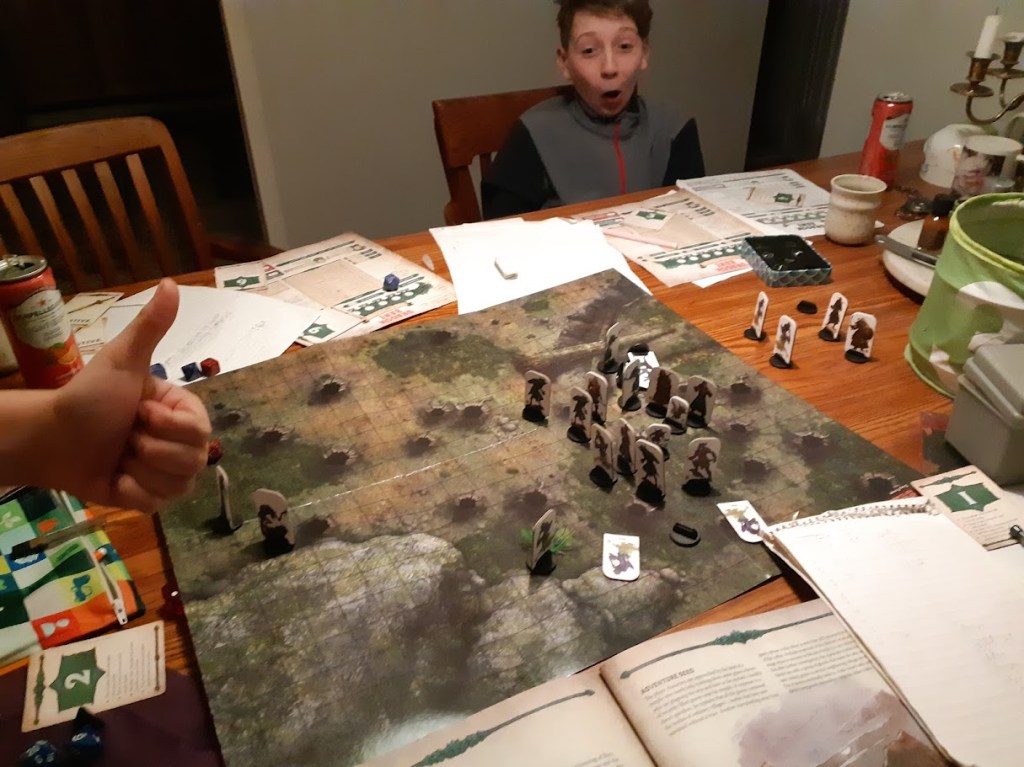
- The Battle Brothers have just killed the 10 orc archers that were guarding the entrance of the Great Altar Cave but now they hear many more orcs coming from around the corner to the north west. Two orcs with heavy crossbows come first, one shooting at Forka but the crossbow bolt bounces off his armor, and the other misses Torch. Two other crossbowmen run across the nearby rope-bridge in order to have a good shooting angle.
- Aracyne makes a risky leap to the eastern cliff and manages to climb up to get atop the promontory. He quickly takes his bow and kill one crossbowman with two arrows (twin shot). The other plunges to his death after Grimoire attacks him with a Mental Strike (telekinetic push).
- But more orcs move to attack the outnumbered adventurers, five brandishing falchions and five with spears attacking from behind, all wearing chainmail. Forka attacked one with his two-hands hammer, killing him with a massive blow but then the spearmen jab him several times and wound him badly. Jedri jumps into action with sword and light flail and kill an orc with two well-aimed blows.
- Fearing for his life, Forka shove the falchion-wielding orc in front of him, sending him crashing into the back rank, and he gets out of his near-encirclement. Torch takes care to guard Forka’s flank and stab an orc with his spear, hurting him lightly. Jedri manages to dodge several attacks coming his way.
- Aracyne does an headshot (crit) to an orc spearman, killing him instantly. A crossbowman aims at the goblin mage and hits him, inflicting a severe wound (1 hp remaining!), the other aims at Aracyne but the elf manages to dodge the incoming bolt. Forka kills another falchion-wielder. Grimoire avenges himself with another Mental Strike, pushing the two crossbowmen off the promontory to their deaths.
- The adventurers have now the upper hand as they manage to kill several other orcs but they can hear yet more orcs coming from the same direction and only Aracyne is unscathed among them. Torch is okayish but Grimoire and Forka are both severely wounded, Jedri only lightly but is exhausted (no more willpower pts, can’t fuel his heroic abilities anymore). Grimoire does a Levitate on Torch to bring him on his side of the cave, at the entrance beyond the cliff. Forka and Jedri jump over there. A bigger group of orcs is now in sight with its bardiche-armed chieftain in the middle. Several orcs throw spears at the retreating adventurers but none hit their targets.
- The Battle Brothers run to the west to go directly at their outpost. The orcs have no way to follow quickly and press their advantage.
- En route, Jedri is attacked by a Giant Cave Lizard coming from the south but he slays it efficiently with his two weapons.
- They reach their outpost and barricade themselves so they can rest safely. Not long after, they can hear some orcs looking for them close by, probably checking. the stairs to Level 3. The orcs still doesn’t seem to know that the PCs have taken over the Ogres’ den (and aren’t eager to inspect the place as they had been enemies).
- Five hours later they hear a knock on the door, its Bayard’s guild, the Protectors! Aracyne asks if the allied guild would be so kind as to offer healing and Bayard answers that it wouldn’t be free: how about 80 gp, the amount that Aracyne once asked to the at the moment hard-pressed Protectors? No deal. But still, the allies are glad to see each other.
Closing Comments:
- The PCs had decimated the orc archers with ease the previous session but now it was a very, very close fight, with character death looming just a step away. Aracyne and Grimoire were very efficient with arrows and telekinetic pushes respectively but the three melee fighters were in a perilous situation. Good armor and good evade ability have its limits when against 3:1 numerical superiority with a back rank able to reach.
- The orcs have once again repelled the adventurers but it’s clearly a pyrrhic victory for them, having lost 21 warriors between the two sessions and 6 more if we count the first assault. They still have a decent fighting force but they’ve been weakened for sure, probably enough to warrant a change on how they defend their territory.

 Streets & Spores