That’s a fancy title innit? Gigaxian naturalism refers to a concept developed into this article by James M at Grognardia, something of a fundamental OSR blog post in my opinion. It has to do with the idea that D&D founder Gary Gigax was getting out of his way to include such mundane, unglamorous things like latrines, food storing, detritus piles and also, more generally, the idea that monsters weren’t only waiting for adventurers to come by (and that they had babies) and so on in his dungeon-crafting and world-building methodology, and for the explicit purpose to get closer to some kind of realism in his game.
Now, I’m writing this mostly as a thought experiment & for the fun of it, I wouldn’t myself feel the need to implement most of this in my game. But the experiment is to try to add some biological/ecological layers on top of standard gigaxian naturalism and see how it could possibly be used for an elf game, specifically in a megadungeon environement.
Food Web
Do monsters need to eat? In this approach they do.
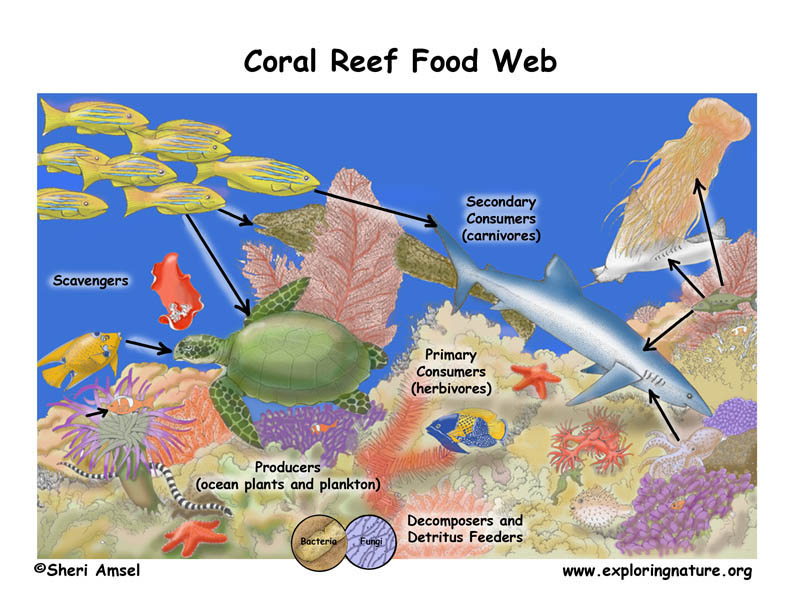
Life is all about energy and energy transfer. Autotrophs manage to get energy more or less autonomously, transforming light or chemicals around them for their needs. Decomposers and scavengers eat dead stuff. Heterotrophs eat other creatures and unless, it’s at the top of the food chain, a creature in the dungeon is probably prey to something else.
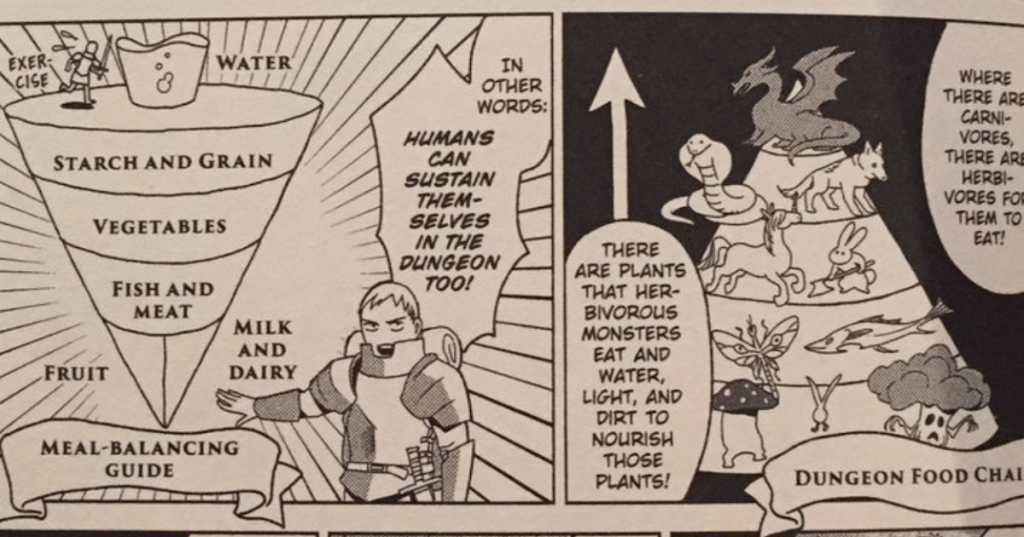
If we’re a bit serious about it, it would seem important to determine what’s the trophic base of the dungeon or in other words, what are the first things (that produces energy) to get eaten. A classic I’ve seen in many rpgs is some form of mushrooms. Which is fine, it’s a classic for a reason even if I once argued that it’s a bit unnecessary to have mushroom and mushroom-creatures limited only to the underdark in D&D. The truth is that a dungeon-environment would be a rather poor ecosystem. However, we’re doing fantasy over here and let’s handwave some of the real world in order to create something new.
One could imagine carpets of bioluminescent microorganisms « grazed » by small oozes that are in turn eaten (siphoned?) by stirges, that are eaten by fire bats, that are killed by harpies because they compete for the same ecological niche…
Stable or Disturbed Ecosystem
Most probably, the player characters will first enter a (mega) dungeon and find it as a somewhat stable ecosystem wherein groups of non-sentient creatures as well as factions of sentient ones have more or less defined territories for themselves. These territories can vary, overlap – there can be encroachment or raiding across certainly, but there’s still some kind of equilibrium in place.
There can even be some active agents or driving force that ensure that this equilibrium stays in place. A good example is the sun-scarred knights in Richard Barton’s Arden Vul, a neutral faction that has ambassadors in other factions and (seemingly) strive to keep the balance.
So, stable ecosystem at first but…
Player Characters acting as a Wildfire
PCs are not part of this dungeon ecosystem – they intrude, they bring chaos, they lit the powderkeg or, in keeping with the natural theme, they’re like wildfire. After them, or with enough delves anyway, it’s tabula rasa. But nature abhors vacuum, aka. the Game Master re stock the dungeon. Not with the same creatures that just got obliterated obviously. With something opportunistic that benefits from the demise of the previous inhabitants.
More half-baked ideas:
- Manatrophs, the trophic base thrives on magic that suffuses the dungeon. Anti-magic zones, devoid of magic, would also be mostly devoid of life: dead zones.
- Ruderal Species: or pioneer species, what are the most likely creatures to find a dungeon that is empty for some reason?Probably goblins, easy choice. And like real-world ruderal species, they’ll have a hard time once more dominant species come along.
- Dungeon as a vivarium. A twist on « the wizard did it » trope. The dungeon is not the place where the archmage experiment his magic, it is the experiment.
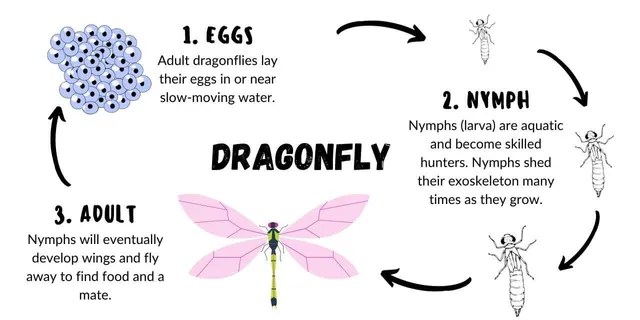
- Monsters that goes through metamorphosis. What if an ankheg had a larva phase? Or IS the larva?


Sorry for being away, I’m late now and the topic is interesting.
One thing about real cave ecosystems is that they aren’t always closed. I’d say they’re usually open, in fact. The bats fly out at night leaving their droppings (and the occasional dead body) inside, underground rivers bring in nutrients from outside… and I imagine an unlucky adventuring party is like a dead whale on the seabed. Goblins may have been a pioneering species, then a mushroom monster installed itself in their latrine, so they had to move to a new location, but others moved in because of the shrooms, which keep springing where goblins have been, who are growing annoyed by getting shroomed at a place where one should be able to relax… But anyway, the system can rest on them bringing their food from the outside. Perhaps a party can even get to explore a « dead » dungeon, after the goblins have moved out and there was nobody to keep the ecosystem running.
There also was an interesting case found in some WWII-era bunker somewhere in Poland: ants that fell in from outside and couldn’t get out formed a functioning hive without a queen, maintained instead by the continuous in-flow (I guess ants on the outside never figured to stay away from the edge). In the end, the researchers put up a scalable path outdoors to see what happens and the ants walked out, though I don’t exactly remember if they rejoined their hive of origin or anything else happened. Anyways, replace ants with kobolds or goblins or whatnot…
J’aimeAimé par 1 personne
I’m glad for your comment Pontifex, I’m getting late myself on several comments, including on some of your stuff that I read.
I’m not very happy with this post to be honest. I think there was something potent to be said about the subject and I mostly failed to convey it properly. It’s lacking in evocative examples for one, like talking about the ants like you did, that’s a great case! Leading to a perfect fantasy example with goblins.
And you,re quite right about the cave systems being open. Much like the deep sea scavengers and predators benefit from organic matter falling from above. I think the largest cave systems are different though if I’m not mistaken. I had in mind the Riesending system that I talked about in an earlier post and it seemed pretty devoid of life except for micro organisms. These days I have a tendency to see dungeons as always gigantic, sprawling comnplexes. Go mega or go home or something like that haha!
J’aimeAimé par 1 personne
Thanks! And with my recent posting frequency, the blame’s on me.
The topic is certainly extensive, I’m not even really sure one post would ever be enough. You can always go back to it when you gather up some thoughts – I just hope that I’ll manage to reply in days instead of weeks.
Dungeons: at first, you say you only need five rooms or so, but they grow on you! (Mad wizard’s vivarium, mhmmm…)
J’aimeAimé par 1 personne