The romance of archeology: extract


I’m gonna put a bunch of these extracts on my blog. I fucking love this book. The writing… the entertainment value is incredible!

Magoffin, R.V.D, Davis, Emiy C., The romance of archeology, Garden City Publishing Company Inc., 1929, New York
téléchargement

Chapter One: The spade is mightier than the pen, p10

The recall of the veterans to arms was sponsored by Alcibiades, handsome, aristocratic, very rich, and very clever, and quite the most gifted in effrontery of any Athenian of that time; and in the sequel he proved to be the most debonair of all the plausible rascals of history. The soldiers, and boys under military age, and the discharged veterans all leaped to the call of opportunity. Our veteran in Euboea got together what little he needed, and then, before he left his new little house, he buried in a terra-cotta pot under his floor the balance of his money, among the pieces being a number of the new coins that had been minted that very year and paid to him when he was discharged. He hurried to Athens, was enrolled, and sent on board the fleet which was so eager to go that the ships raced one another down the Saronic gulf, as all the women of Attica on top of the houses at Piraeus waved them bon voyage. The expedition was the greatest debâcle of history. The entire force was killed or captured. The pot of coins, after 2,333 years, turned up accidentally by a spade in 1921, is one of the thousands of pitiful mortalities of that ill-starred expedition now archeologically authenticated.
Robin Hobb’s Elderlings are Dragonborns well done

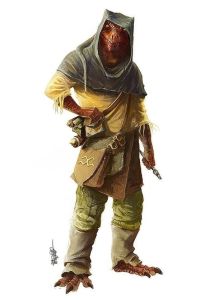
I recently read the amazing Liveship Traders trilogy by Robin Hobb and one thing that leapt to my mind is how much more interesting the Elderlings are compared to D&D Dragonborns.

23f8b4ac35366553ec7ea42199bbb910

In my actual (Chult) campaign, to contrast with my human-centric previous one, I’ve let the players choose any character race, « even the dumb ones » I said. I was kind of relieved when none of them chose to play a Dragonborn as, for me, this race is certainly one of the dumbest fantasy race out there.

 Shaped by draconic gods or the dragons themselves, dragonborn originally hatched from dragon eggs as a unique race, combining the best attributes of dragons and humanoids.

A cop-out if there ever was. At least there’s no sexually deviant dragons copulating with puny humanoids, oh wait, that’s where Half-dragons come from! Sigh…

Dragonlance’s  Draconians were not much better (I mean, how much stolen dragon eggs you need to make whole armies?!) but at least they replaced the overly used orcs.

Now, what about Hobb’s Elderlings?

They were ancient humans that pretty much lived side by side in a symbiotic society with dragons. Because of their proximity with these powerful beings’ essence and the occasional use of special rituals, they have acquired variable degrees of draconic traits: scaling, greater height, bright eyes, longevity and so forth. The culture of the Elderlings, what few glimpses we have of it, is also quite intriguing. All in all, much more convincing origins…

Class variant: Flâneur

9780719081873

I won’t mess with the mechanics of the rogue as it is one of the few character classes that is perfectly okay within my Streets & Turmoil D&D setting but here is a little more flavour coming along with the flâneur. As always, the players will be free to do as they wish (almost) but it seems to me that a rogue character could well be played with these lines in mind:

The flâneur belongs to the same social and moral universe as the spy, agent de sûreté and, somewhat later, the detective. Like them, he strives to be both all-seeing and invisible (though, just as spies were commonly spied upon, so too the flâneur is himself not infrequently the object of physionomie) and, no less than Vidocq or Hugo’s Javert, he is a Protean figure capable of assuming a variety of disguises in order to pursue his scopophiliac passion undetected.

extract from The flaneur and his city by Richard D.E. Burton

The flâneur is a keen observer, so much so that using physionomie knowledge he can, from the dress, gait, etc. in a mere moment gain, like Burton says: « god-like power-through knowledge over the Other. »

Rosler-LeFlaneur

Well I think that would help explain a few things about the features of the rogue class (versatility, skills strength, backstab ability and so on).