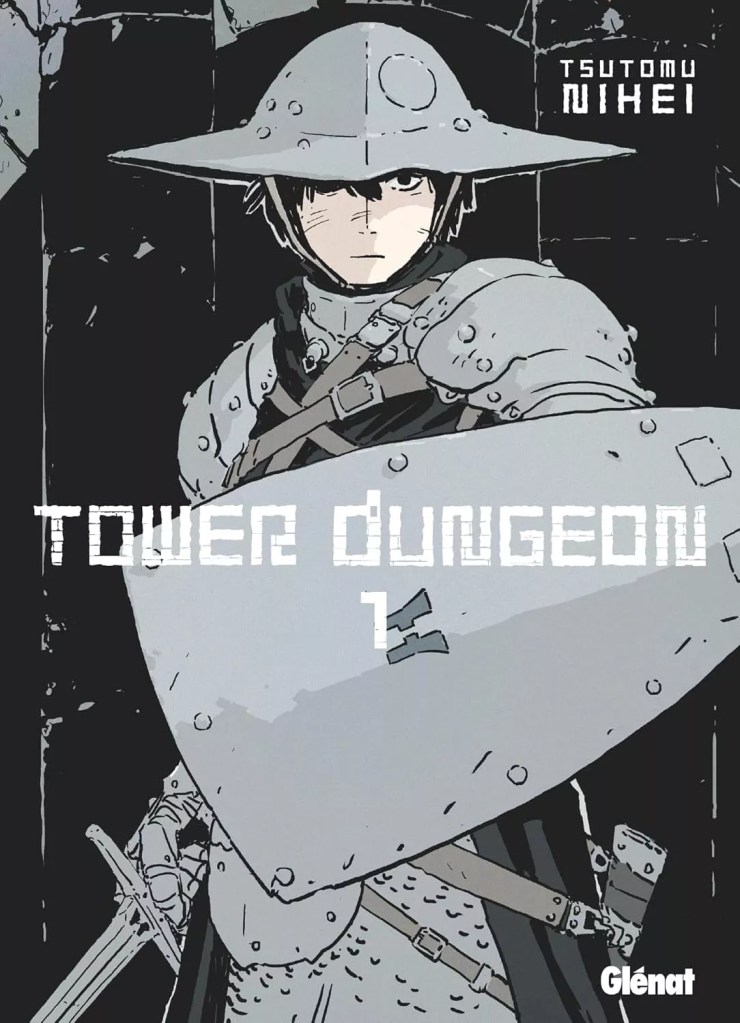
I briefly mentionned Blade & Bastard in an earlier post and if you’ve been reading my blog a bit you know I’m a big fan of Ryoko Kui’s Dungeon Meshi (Delicious in Dungeon). Tower Dungeon by Tsutomu Nihei (author of Blame!) would be another one in this rare breed of manga that goes DEEP in the dungeon aspect of fantasy.
Or maybe I should say HIGH, ’cause y’know, it’s a TOWER DUNGEON…
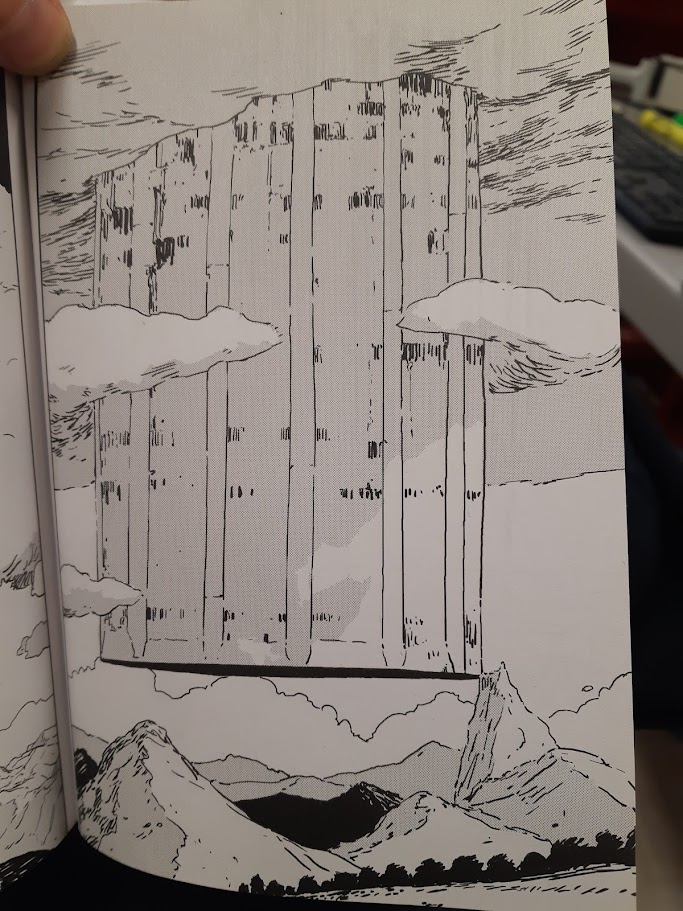
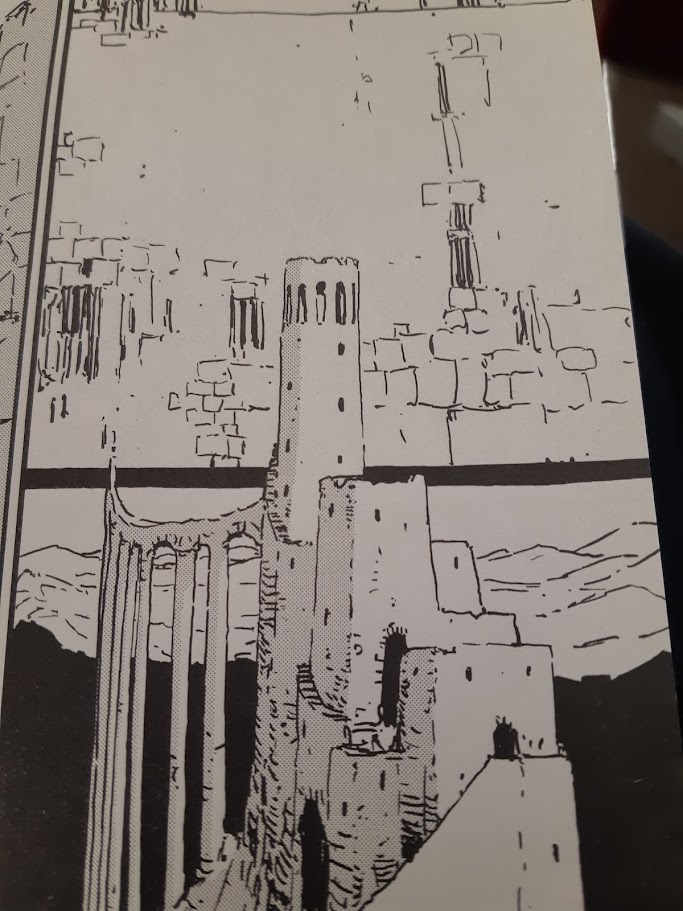
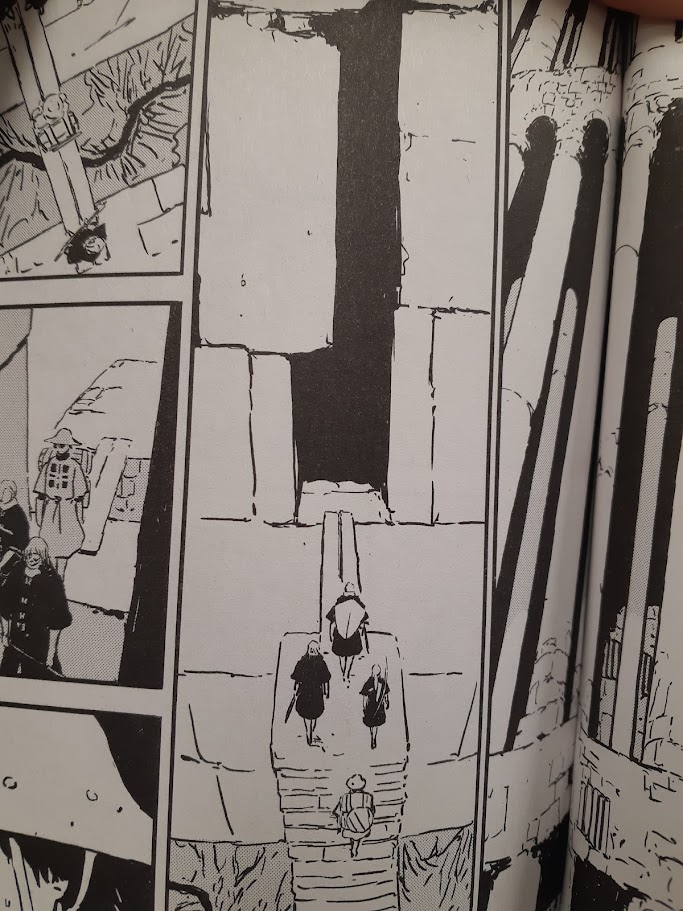
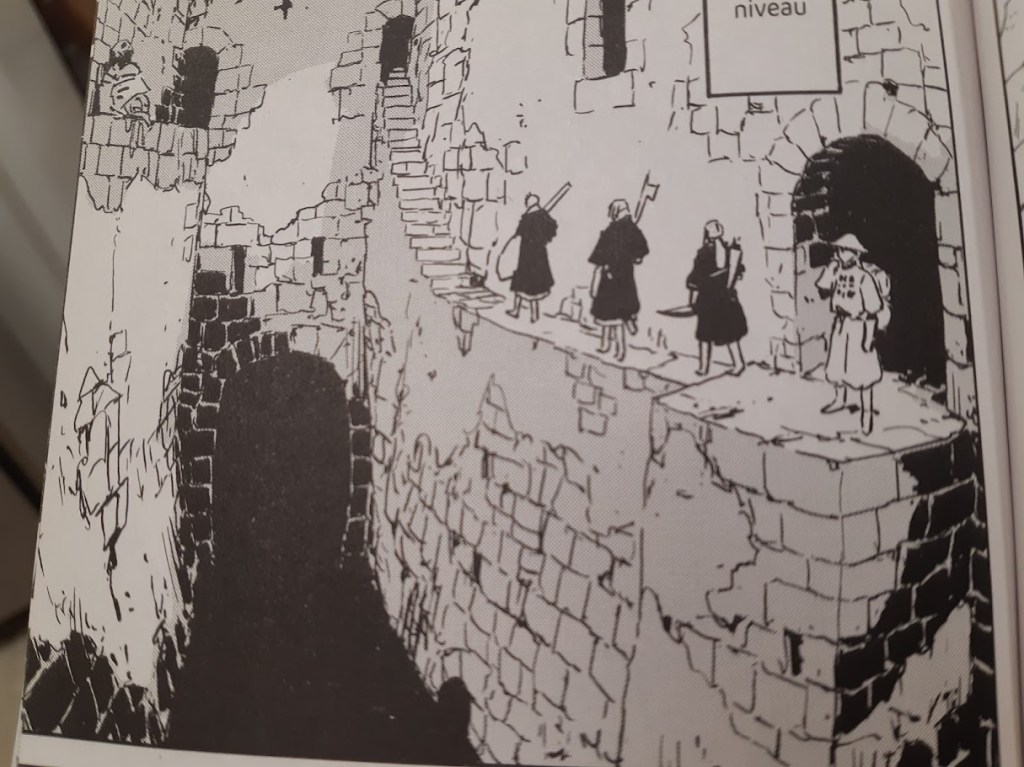
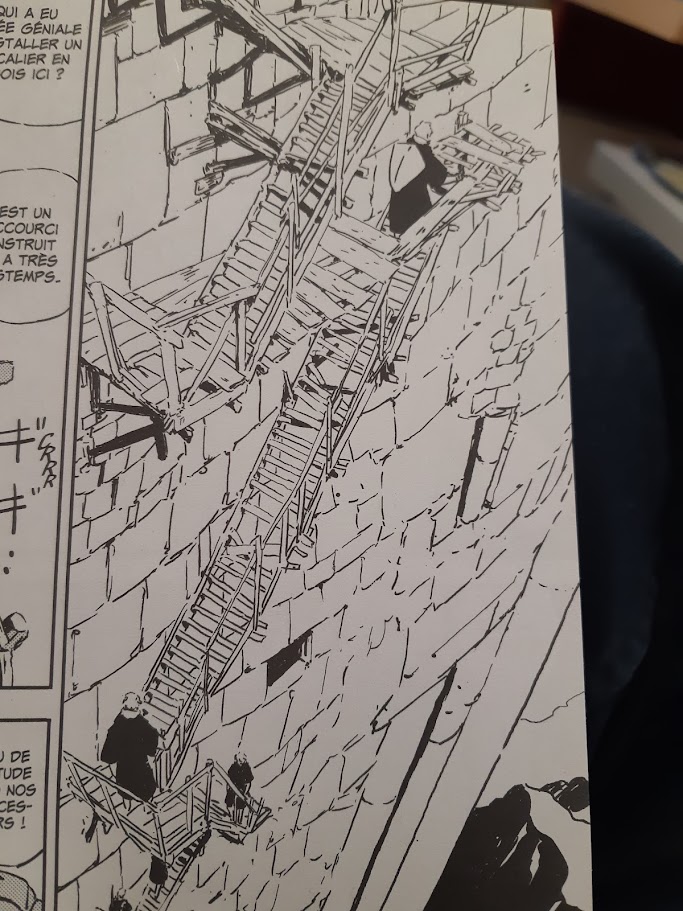
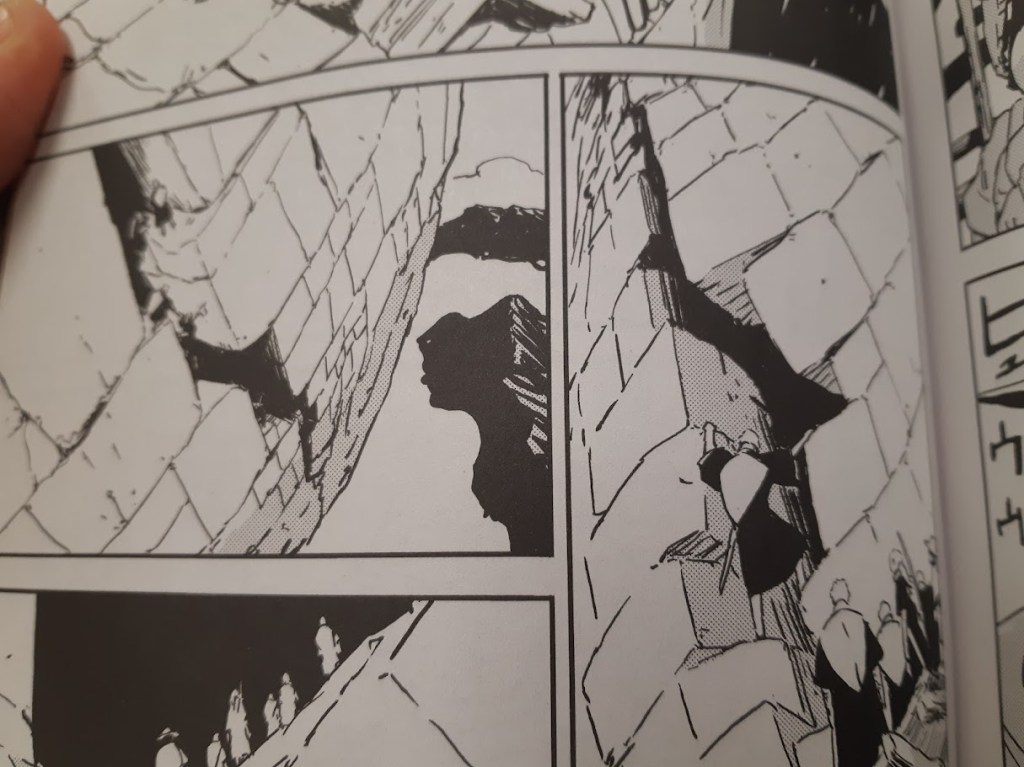
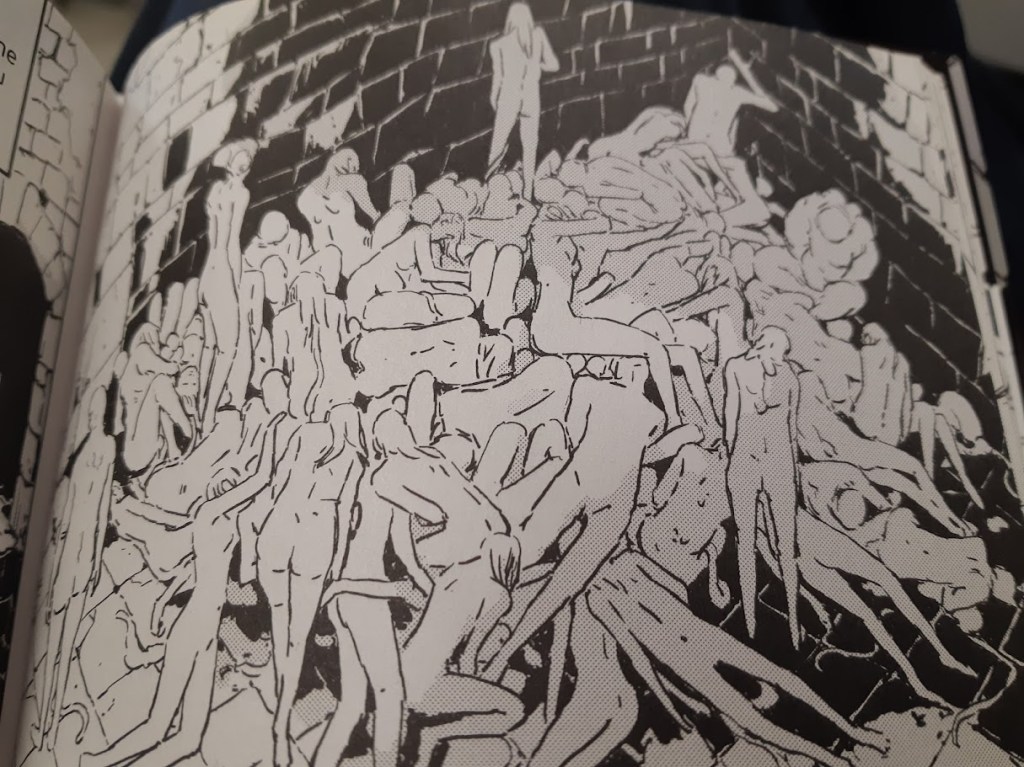
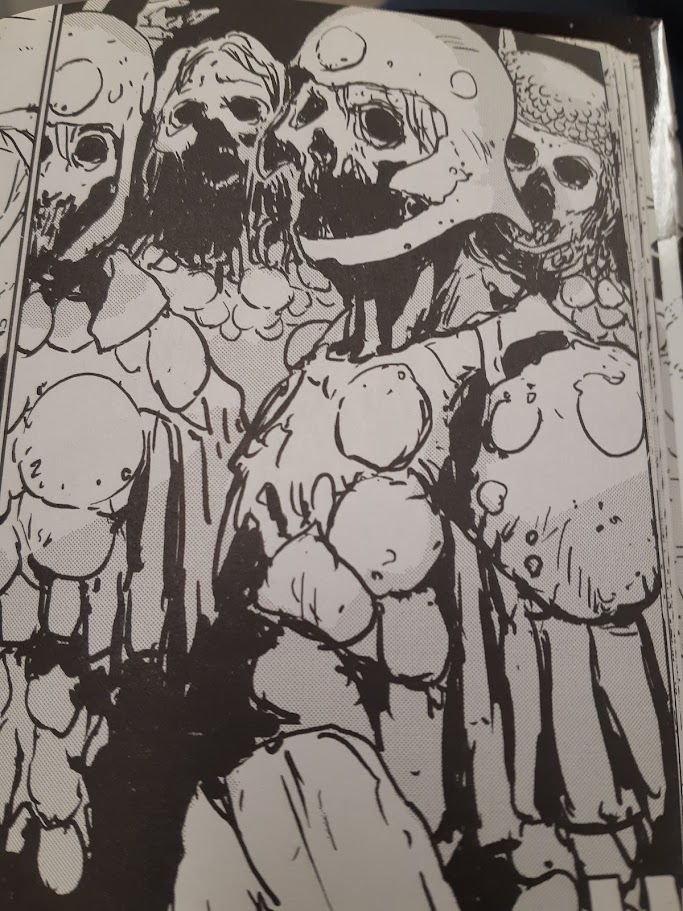
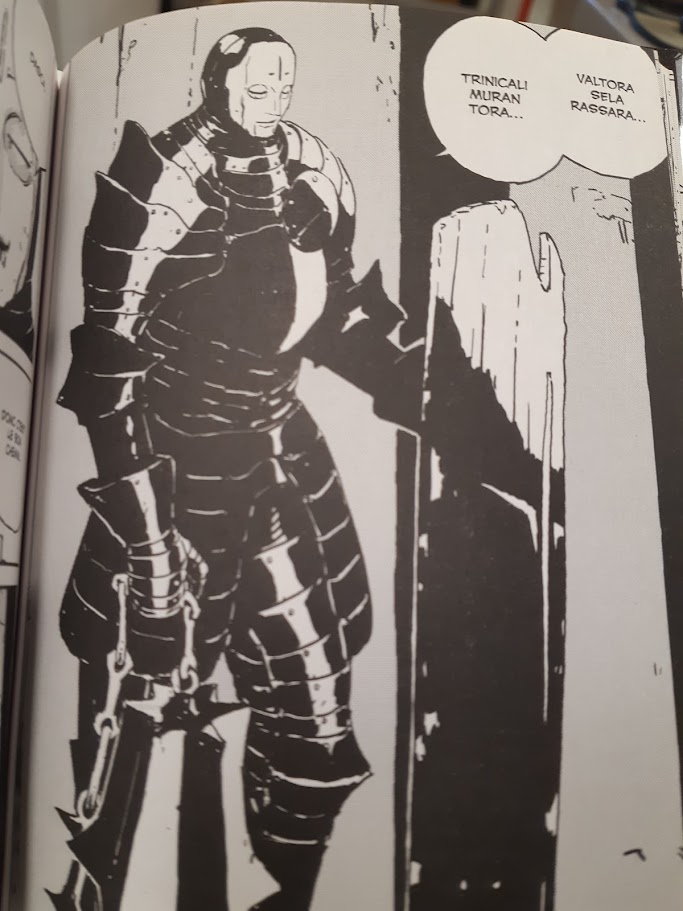
Brought forth from the Heavens by the Big Bad Evil. It’s so colossal that I think oxygen-deprivation should legit be a problem.The way to access it is via the old decrepit mountain fortress that is conveniently close to its base.The Tower, Dragon Tower to be more precise, appeared very recently. A makeshift bridge is all there is. Watch you step.The interior is a proper labyrinth, with nice verticality.You can bypass some Levels by climbing these rickety stairs outside, which obviously entails its own risk.The structural integrity of this 18km high, 3 km wide Uber Tower, is far from perfect.As for its denizens… They’re a close-knit bunch, a bit exclusive of outsiders one might say.And have seen better days themselves.What is he saying? Some kind of warning?
I should add that Tower Dungeon is kind of the opposite of something like Blade & Bastard (or most fantasy stuff really) that follows a set of fantasy conventions to a fault. Most things in Tower Dungeon are unique to this original setting as far as I can tell.
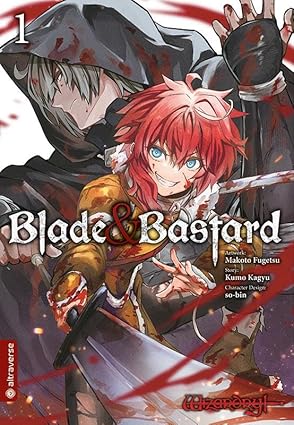
I’ve been reading two new mangas, published recently, both interesting and heavy on dungeon-delving but very different in style: Tower Dungeon and Blade & Bastard. Tower Dungeon is the more interesting of the two in my opinion and I’ll probably talk about it soon enough, but today I’m gonna talk about the other one, or more precisely I’m gonna talk mostly about the inspiration source of Blade & Bastard – the original video game Wizardry that started it all.
Note the Wizardry trademark on the bottom right of the book, it’s not simply wizardry-inspired like so many other stuff out there, it IS wizardry in manga form.
What intrigued the most in Blade & Bastard is one of its main theme that the main protagonist explains to a rookie adventurer- you can die in the Dungeon – in fact, there’s a really good chance it will happen sooner or later if you keep at it – but other adventurers may find you, bring your corpse to the Temple of Cant and you can be resurrected (paying the Dime of course) and be back to adventuring. There’s also a pretty high chance that the resurrection magic doesn’t work, in that case, it it most certainly God’s will, or so the priestess says, deeming you worthy of an afterlife instead of sending you back to your adventuring life. NO REFUND. Or maybe the ritual has been botched… Who can tell?
So one thing leading to another, in a full on autistic endeavor, I’ve decided to try the steam’s re-mastered version of the first Wizardry video game, with all the « retro » options on. If I’m to believe the game’s blurb the only difference with the original (apart from vastly improved graphics, music and sound effects) is some corrected bugs that afflicted the original, the gameplay and content is essentially the same.
After losing several characters in the Proving Grounds’ Level 1 (they clearly didn’t make the cut!), I finally managed to have a half-decent party of level 3-4 characters and explored a big chunk of Level 1 and 2.
There’s several monsters in Level 2 that do POISONED, a real pain in the ass, each time I have to rush back in town to lose the effect as I’ve no easy way to counter it otherwise.
My party also encountered Rotting Corpses that do PARALYSIS, and 3 of my 6 characters were affected, including my priest that could have removed it with his newly-acquired DIALKO spell. Back in town, I see that I can pay the Temple to remove the effect but I don’t have enough money.
I recruit a bunch of new guys, level them up a while putting them with the 3 non-paralysed characters, lose some of them, get back two of my paralysed ones in time and then I find an elevator in a darkness-shrouded area of Level 1 while bumping in the dark.
I try the elevator, can’t really do much in Level 2 with it so I go to Level 3 for the first time, just a quick look I said to myself and then the game throws one of its NUMEROUS CURVEBALL at me: the door I just opened is no longer accessible from the other side – I’m stuck in unkown territory… That’s really bad. I defeat a bunch of « level 3 priests » and then encounter six coyotes (of all things) that wipe the floor with my party. All DEAD.
I still have one level 5 guy that I had left in town, Bragg the dwarf fighter, and I recruit another bunch of level 1s, enough in fact to build up two parties as I now want a back-up party at all time.
After much grinding to level up the two parties, I begin the exploration of Level 3 but from the stairs now. I find out the hard way that Level 3 has several undetectable pit traps and I lose another entire party.
Now, I go more cautiously around with my surviving no-longer-back-up party, my priest’s spell LUMILWA helps a lot as I can detect secret doors and evade the pit traps that way. My gnome priest now has LATUMOFIS to remove poison, so that’s no longer the big annoyance it was. And she can also casts MAPORFIC, a very useful spell that lowers (that’s good) everyone’s armor class for the entire delve.
Anyway, I manage to reach the spot where my last party was TPKed, there’s a message on the bottom of my screen « characters are present in this area » or something like that. I can take my dead companions with me! But wait, I can never have more than six characters at a time in my party for some reason, I have to leave some of my living ones behind (they will wait there) but I still need to have the strength to cross Level 3 and get back in town…
So I go with 4 living characters and bring 2 corpses back at a time, a real chore I tell you. Some I resurrect at the Temple sucessfully, some turn to ashes and are now too expensive to be worth resurrecting, some I just take their equipement (I have some +1 armors by now) and leave them be. Sorry, but I need the money.
That done, I level my guys up some more in Level 3 and start to explore Level 4, both by way of the elevator and by the stairs.
My A Team has now in the front row: a level 5 human Lord (when he changed class he dropped back to level 1, his stats dropped significantly but he kept his hp), a level 7 elf samourai (a fighter with low-level mage spells), a level 8 gnome priest (got up to 9 but was drained a level by a Shade), in the back row: a level 7 gnome bishop (mix of mage and priest spells, can also Turn undead), a level 9 halfling thief (almost useless in fights but necessary for disarming traps on chests) and a level 9 elf mage (the most useful character for big fights, her spells are devastating, but she has only 22 hp).
I’m pretty confident by now, I’ve just killed two Gas Dragons (okay I thought I was doomed in that fight but they weren’t that fearsome at all). I found the stairs to Level 5 but I’m finishing Level 4 before I go further down.
And then I open a door to an unexplored area (just got the gold key to open it) and immediately (programmed I suppose) get into an encounter with: a Masked Man, 2 Priests, 2 Robed Men, 2 Armored Men. Competing adventurers? I have no idea, this game doesn’t offer this kind of information. Now, the « Robed Men » are obviously mages and I think they are priority targets. I select my actions for this round, my mage’ll do a LAHALITO (level 4 spell, 6-36 dmg on everyone of a row) on the mages, attack them with my fighters too and my priests will soften up the opposing Priests, my thief will hide as it’s the only thing he can do. The actions are completed, I’ve killed only one mage, the Priests are wounded and that’s it. On my side… The opposing mage had let off a MAHALITO (level 3, 4-24 on everyone of a row) on my front row, not too bad. But the Armored Men and Masked Man do massive damage, 40+ each, my Lord and Priest are DEAD. My Samourai is at half hit points. UTTERLY RIDICULOUS. I get it now, another curveball. This is a serious, serious fight. I select MADALTO (level 5, 8-64 dmg on row) with my mage on the Armored Men, my bishop will try a MANIFO on the Masked Man to try to paralyze him (this spell rarely works but I have to try something), my Samourai and Thief will attack the Mage, hopefully they’ll finish him off before he acts. The second round’s results: the mage foe dies, that’s great. My bishop’s spell fails. My samourai is slain by an Armored Man. My mage is too slow to act and is killed by a single sword swing as she’s no longer back rank. My two surviving characters are my worst in a fight, my bishop and thief. They try to flee next round, they fail, they die. I’m back to grinding if I want to continue.
An absolute beating… My soul is crushed. I have still some characters in town, Bragg the dwarf fighter, now level 9, is still alive somehow and I could assemble another decent team if I wish. But I have enough of the game for now.
I still enjoyed a lot the game, the playful nature of the dungeon’s levels, the joy of discovering secrets, of understanding what has to be done in order to survive, of gaining new spells that offers a new quality of life suddenly, etc. Apparently I was underlevelled for this big fight too. And my whole team had some bad rng for hit points gains except my priest I think, with my front rank not that great for tanking hits. But all that said, it’s gonna take a while before I play this game again, the grind needed to win it is painful and my leisure time is limited. But you have to respect Wizardy: proving grounds of the mad overlord, both for the challenge it offers and its legacy. A legacy particularly important in Japan due to some twist of fate, where it inspired a multitude of sequels and spin-offs.
And that leads us back to the Blade & Bastard manga wherein we can see all of the wizardry’s quirky gameplay on display but with the narrative format that allows to explore its universe from other angles, as with the aforementionned resurrection in the Temple of Cant. As a player of the video game I had some incentive toresurrect some of my characters, but only if it meant keeping a good character instead of the grind of building another one from the ground. In an immersive story it can mean much more obviously, getting back your fellow adventurers, long time friends and such.
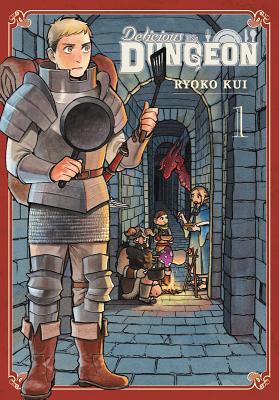
Here’s some concepts I’m stealing from Delicious in Dungeon for my ongoing megadungeon campaign. It’s not even the food aspect of it, don’t care much about that, but there’s plenty other things that are worth borrowing.
(Note that the manga go further than that (14 books) but from book 10 and on it diverges from my main interest/obsession, the dungeon, as the story devolves into a big crisis and final resolution for the last few books.)
In bold is stuff I want forefront in my Gunderholfen campaign.
Dungeons, Demons and Masters
There’s two kind of dungeons in Delicious in Dungeon. Natural dungeons are simply places where magic happens to be strongly concentrated. Unnatural/real dungeons are different and are basically prisons for demons (entities from another world), one demon per dungeon to be more precise. Dungeons of this latter type are huge, sprawling, expanding and sometime changing to fit the need of its Master.
Part demon’s accomplice, part roadblock to its liberty, the Master of the Dungeon is the one who controls the physical object that detains the demon, somewhere in the deeper levels of the dungeon. Probably already powerful, a Master gain extra powers once they take over a Dungeon, like the ability to create monsters, modify the dungeon, and have access to unique spells. This comes at a cost as the demon’s influence slowly erodes the Master’s grasp on reality and leads to madness down the line.
Demons have some limited abilities to interact with interlopers and can try to influence them in some way. Adventurers can also become unwittingly the demon’s liberators if they manage to kill the Master without further precautions.
Aside: a Player Character managing to become a Master most probably become an NPC and a villain for another campaign…
The Deeper you go, the more Magic/Mana there is
Mana is everywhere but there’s a lot more mana inside dungeons than outside. It has two main effects. The first is allowing the presence of monsters as they need ambient mana in order to exist at all, and larger amounts the more powerful they are. Thus, powerful monsters cannot normally venture on the upper levels without seriously comprimising their health. (if you ever needed an explanation for monster placement here you go).
The second effect is on magic-using. Spells are easier to cast and are more efficient inside the dungeon. (and to go further than the manga on this particular point>>) The deeper you go the truer it becomes. This also means that more powerful magic can only be cast on deeper levels (or a special place like a wizard’s tower perhaps) and isn’t purely in proportion to it’s caster’s might/high level. (If you follow my meaning, this implies a system that is probably NOT D&D).
The all-important, well-rounded Magic-User
Magic-users are absolutely essential to a party of adventurers to the point where not having one would be a serious issue. Potions, scrolls and other one-shot items are non-existent, you MUST rely on the magic-user for utility spells (water-walking comes to mind), protection spells, sheer firepower and most of all, healing (resurrection even). It’s a world without clerics where mages can cast fireballs AND heal (but some are better at one or the other). Protecting the party’s magic-user is not to be taken lightly. This implies that magic-users are polyvalent, have large ressources (are not depleted that quickly, have also an additional reserve with their mana-staff) but must manage them as there’s nothing else to fall back to.
Know your Monsters: Dungeon Ecology
Monsters, except the very weakest, should always pose a threat if you don’t know much about them. You have to have knowledge of their abilities, weaknesses, favored tactics, etc. if you wish to reliably be victorious in encounters with monsters. Theoritical knowledge (from a book say) is fine but isn’t always reliable. Hard gained practical knowledge is best of course but isn’t widely shared and often kept to one’s group to have an edge over others.
Adventurers Guilds
Adventurers work in guilds (the same as a party), with each members having signed contracts (with terms that could differ from one another). The guild’s leader owns the party’s equipment in its entirety (weapons and armors included). He’s the one who buys provisions and equipment for everybody each delve. The guild members can leave the guild if they wish so as long their contracts allows it.
Fatigue and Resting
The food aspect of Delicious in Dungeon (i.e eat properly in your dungeon-delving or suffer dire consequences) is interesting but hard to put in place in a ttrpg I think. A more general approach that includes stamina/fatigue that player characters have to take into account is something I wish to put more emphasis on (resting as something more that regaining hit points or abilities) in my campaign.
Conclusion
The fluff about the Dungeon/Master/Demon isn’t that important to be honest, though it fits with the module I’m actually running (Gunderholfen). What I find much more interesting is to play, to adapt (as the dungeon master) with:
how magic is applied in this setting, changed by how deep you are in the dungeon
player characters doing a rest as something more significant than in classical D&D
and also, and this gives me some work to do, how many monsters should be puzzles to solve for the players (they have to learn how to fight them efficiently).
Okay we’re at Book 9 now. Took me some time as my son had managed to lose the book inside his own room and couldn’t find it back even after I browbeat him into cleaning his mess. Kids… I mean, my son is awesome but tidiness is NOT is forte. Anyhow, I finally managed to find the book on the bottom of a drawer so here we are.
Right at the start we get an encounter with a black-armored, sword and whip wielding Dullahan (headless knight). It seems like it’s part spirit part physical. Its sword attack goes right through armor without damaging it. It’s also impervious to attacks, even magic ones! What’s one suppose to do? Laios, critically wounded, manages to make a deal with the Dullahan and it was pretty much the only reason why he didn’t die.
After that we have probably the most extreme example of dungeon ecology/monster biology to date when Laios’ Guild stumbles upon the reproducing ground of a swarm of Succubus [succubi]. True Succubus are demonic in nature but there’s another sort of creature that have been named after them: the Succubus Mosquito! Just like their namesake they can take the appearance of something of irresistible sex-appeal to their would-be victim. When they’re close enough they plunged their piercing, hollow tongue inside their victim to suck them dry. But wait there’s more, they then transform the stolen blood into a milk-like substance to nourish (via their anus, for good measure) their insect larvae that are kept in still water…
In the last third of the book we learn a lot about dungeons, why they exist and how they grow over time when it has found a « master ». Dungeons are basically prisons for demons (entities from another world), one demon per dungeon to be more precise. A demon/dungeon needs to interact with people to get stronger and thus does what it can to lure people to itself (riches and desire-fulfilling promises). The more powerful and complex the desires of someone are, the more strength the demon will gain when it will feed (literally) upon them. A person « eaten » in this manner will be either too weak to survive or become a shell of its former self.
So you see, Delicious in Dungeon has many typical fantasy fares, and not typical at all dungeon ecology and monster biology. It’s also sort of about food, nutrition and food taboos… But it could also have been called Dungeons & Demons!
There’s many unusual themes in Delicious in Dungeon even if we put aside the culinary one. There’s a strong sense of a biophysical verisimilitude applied to this D&D-like world, something that is definitely against the current zeitgeist both in gaming and in the real world. I personally find this refreshing.
the book start with Laios’s party members being subjected to the Changeling Mushrooms spores and thus all of them are transformed into another race/species
after the initial shock, the character are each able to see the benefits brought by their new body but soon enough what new limitations they now have
this come into effect with much clarity when the party gets into a fight against gargoyles, their usual effectiveness is completely gone
Laios, who’s a fighter type, enjoys the strength of his new dwarven body but finds that all this muscle density is consuming a lot more energy and it takes a real toll on his endurance (Dwarves need to eat more often)
Marcille the Half-Elf magic-user is impressed by her new heightened senses from her halfling body but finds out that she can’t cast strong spells without suffering from magic fatigue, halflings are just not suited for magic
Senshi the Dwarf, now a beautiful elf (always depicted with roses around him, it’s hilarious), doesn’t even try to fight as his weapons are now too heavy for him
As usual it’s more clever in the book than in my snippets but you get the idea I think. They eventually manage to cancel the effect of the changeling spores and get back to their own racial integrity
Laios’ Guild manages to open the magic-locked door and enter into a dwarven-made section full of pipes (steampunk technology). Soon after they get on an elevator and descends (it takes a while) to what should be 7th Level, an ancient, abandonned dwarven city.
Meanwhile, on the 1st Level, with the investigation of the Canaries, we see a first sign that a Dungeon, which is pretty much an actor of its own in this universe, thrives on disturbance. The more people try to meddle with the Dungeon the more it gains power until it can’t be managed anymore and it spills out on the countryside and does great damage.
Walking Mushrooms are pretty much the basic « starting » monster of the dungeon, numerous but almost inoffensive to anyone but the greenest of adventurers. But now we see that they can attain great size and can release spores with a mind-numbing effect.
In the 7th Level, Laios’ guild encounter a Bicorn. Unlike the virtuous-loving Licorn, the Bicorn is attracted to depravity. It also like to eat virtuous husbands.
First episode has aired on netflix – a faithful rendition of about half, maybe less, of the first book. I must say though that the voice acting in english was really bad, wooden, I switched to french and it was much better (that’s unusual). Anyway, I’m now at book 7 in this series where I try to highlight the many interesting concepts of Delicious in Dungeon.
we’re still on the 6th level and now Laios’ guild is back where it all started – inside the Red Dragon’s Lair in a vast cavern where we can see several tunnels débouching into the place.
we learn that this place was thought to be the deepest place of the dungeon but, not too long ago, a magic-locked door was discovered that may lead to deeper levels
we see ice golems and like any of their counterpart they have a crudely-carved « core » (very small) buried inside the matter that constitutes them without which they cease to function
we see some Barometz, inoffensive magic-loving monsters that are plants with sheep on top:
I mean, it’s pretty weird isn’t it? But wait until you learn that the unripe fruits of the Barometz have sheep foetus inside, all perfectly edible of course…
The challenge (and interesting idea) with the Barometz is that you may be pretty sure that predators are nearby, attracted by the easy preys
we’re introduced to a new faction with the arrival in town of the caravel ship the « Canari » (great fitting name) and its crew of elves that appear when dungeons are close to getting out of control.
Elves in this universe are definetely outlandish, non-human, the fact that they have much longer lives changes the way they think, it’s great.
In the second half of the book we have a lot of lore exposition, mostly through Yaado (the grandson of the cursed king) and a visit where the human – simple folks but immortals – inhabitants of the Golden Kingdom go about their lives, cohabiting with docile (magically pacified) monsters. There’s milk producing female minotaurs, that’s a thing yes.
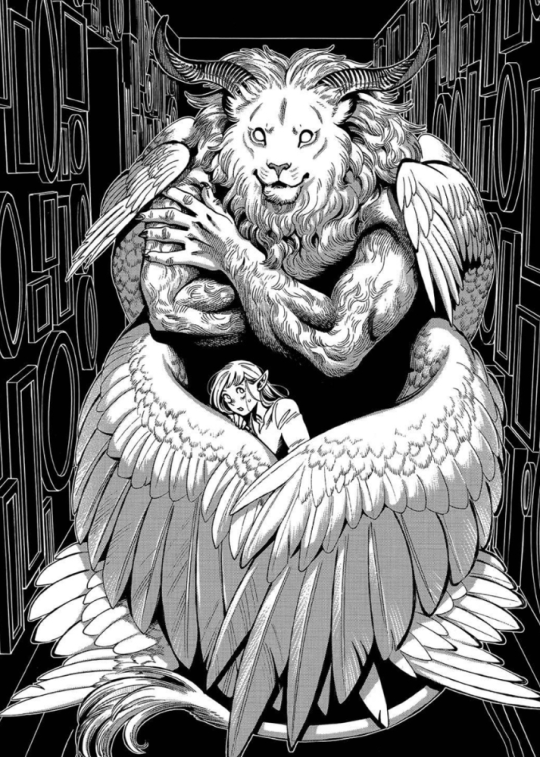
We learn that the titular god of the kingdom is the Winged Lion, it’s imprisoned by the Lunatic Magician at the deepest level of the dungeon. The Winged Lion sends forth prophecies so he can be freed. We’ve seen statues and fountains of the Winged Lion all along the previous books, nice.
The party is now inside a vast dwarven-built cistern with a very high ceiling supported by rows of columns covered by gold sheets. A perfect hunting ground for a griffon nesting high above.
We discover that a dwarven expedition found the dungeon from below, a few years before everyone else.
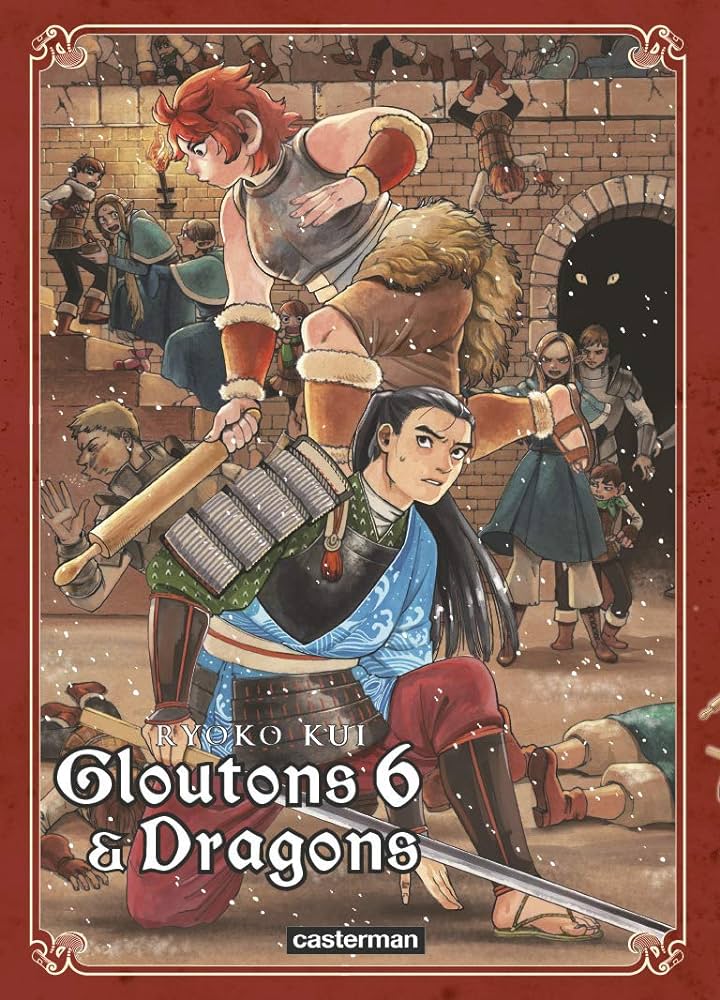
Book 5 has ended with the meeting of 3 adventuring guilds, mostly in a friendly manner. Now, taking a big chunk of book 6 is an EPIC fight with a special monster that takes on the whole gang of adventurers, killing 7 of them, incapacitating another, before getting away. Oh, and by the way the show on netflix starts tomorrow!
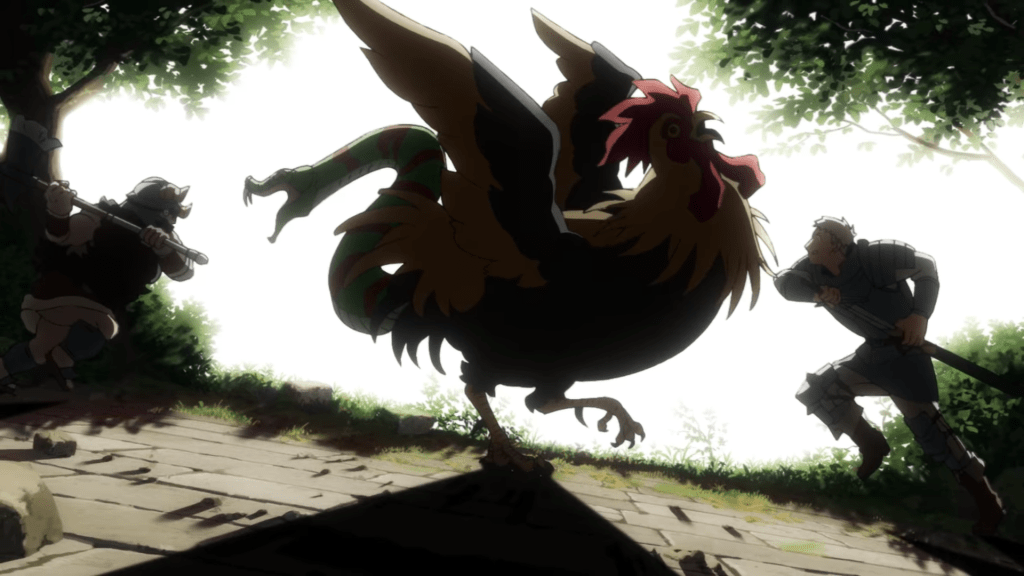
We can add harpies to the monster list of the 5th Level (the City). We learn that they’re mostly just like birds, nothing very special there. One funny bit is that harpies don’t hesitate to shit on corpses to discourage other meat eaters and keep it for themselves. Pretty gross.
After the aforementionned epic fight Laios’ guild get down through a set of large stairs to the 6th Level. 6th Level is made of the sum of the aqueducts, sewers and prison cells below the Castle.
6th Level is known to be uncomfortably warm but this time around its really cold, there’s even a snowstorm going on inside!
6th Level is also known for its many psychic monsters.
One is the Shapeshifter. A bit of a misnomer as its main gimmick is making illusory doubles of its preys to create confusion, maybe? It’s like a doppleganger situation but the whole thing is an elaborate illusion? Frankly it’s not really clear what’s the point of the illusions on a tactical level. On a narrative level that’s another thing entirely as the party has to identify who are the clones among them, knowing that the clones are not perfect replicas as the images are taken from each other’s faulty memories or bias perception of their companions. So, I would say, this time the monster doesn’t make much sense but the scene is absolutely great.
It’s pretty much the same pattern with the Nightmare monster. Manifesting in one’s sleep, the monster feeds on its victim’s fears, draining its vital energy slowly. It’s a bit underwhelming to learn that their real physical appearance is a clam-like pest that infests your pillow…
Anyway, great tome, great scenes, a bit less stellar on the monster ecology front. I do like the concept of a dungeon Level with psychic monsters as its main threat though.
There’s a lot of good stuff in book 5. The story definitely takes a darker turn just when we think that Laios has succeedeed in bringing his sister back from the dead. The comedy is still here but it’s obvious there’s some sort of bleaker plot down the line. Very clever in my opinion. And the dryad scene is awesome!
Laios’ guild is still in the 5th Level (the City) and its success in dealing with monsters has incurred the wrath of the master of the Dungeon, the Lunatic Magician. His magic intervention has the effect of shifting the layout of the Level every so often, confusing the adventurers into going in circles.
One fortunate thing though is that the Ghosts of the City are often helpful as contrary to those of the higher Levels they’re not insane. They show up when they wish so and the paths they follow are always safe.
There’s a great scene with the Corpse Retrievers, the same shady group that we’ve seen in a previous book, they use a powerful illusion so that adventuring guild members fight among themselves (they see each other as monsters). If you don’t find corpses you can help a little is what they say!
This other guild leader, Kabru, is like the antithesis of Laios, not that great against monsters but very shrewd and deadly against humanoids. He would probably be an assassin in AD&D.
We can add Sea Serpents to the Flooded Level, another Top of food chain monster.
We see yet another guild, this one with an oriental background. The leader, Toshiro, is a samurai-looking guy. Another member is a powerfully built female Oni warrior.
Meanwhile in 5th Level, with the Red Dragon gone, the local monsters are back. 5th Level is in fact reputed for its abundance of monsters.
A fight against Dryads in a kind of cemetary surrounded by trees and bushes. They’re dangerous but very fragile, looks like any hit would kill them, thus releasing their spores…
… and provoking an INTENSE allergic reaction. That’s where the fun begin, fighting the other dryads whilst you can’t see or breath properly…
Dryads are basically like flowers, ugh well, except that they reproduce by kissing each other… Of course they do.
We see Laios training in regenerative magic. That makes me think: I’ve mentionned that Delicious in Dungeon is D&D inspired but there’s some things that diverge obviously. One is that there don’t seem to be firm adventuring classes except maybe for the mages, I think the default system would be closer to something like GURPS where you invest your character points in whatever you want.
Speaking of diverging with D&D, the magic system is obviously not Vancian. It’s more like a magic/mana gauge that you can deplete.
There’s a fight against a Cocatrix, a bigger, meaner relative of the Basilisk. A bite of the serpent head can turn you into stone. Turning someone back to flesh is possible but not easy. You also have to take care of the body so it doesn’t break (i.e by falling over) before you find a cure.
Ghosts are often shown like they try to tell something but can’t. Some people are sensitive (?) enough to understand and talk to them.
There’s someting called Cleaners, inoffensive and amorphous organisms that repair damage caused to the dungeon.
There’s a lot less monster variety and monster ecology in action in book 4. The reason to this is that Laios’s guild is now at the 5th Level (the City) and will encounter its deadly new resident, the Red Dragon, who (we can safely guess) pretty much chased off everything else (except ghosts). Of course its also the kind of encounter that can take quite a few pages…
(As usual, I’m keeping the spoilers to a minimum)
The book start with a scene with the richly-attired governor of the island (from the village above the dungeon) and a couple of gnome magic-users that serves as his advisors. One thing to note is that the plundering of the dungeon has brought tremendous wealth to the village, probably more within the first few years of its discovery. Now that it doesn’t seem so treasure-filled what’s still of great value (to some people at least) is its secrets. The Biggie being the special magic that binds soul and body. The governor is thus encouraged to continue to pay adventurers (as loot isn’t so prevalent anymore) to get below and kill monsters so that others can do their research with less risk.
The City Level is still mostly in good state. Its 3-4 story high buildings are densely packed, in proper medieval-style, with many covered bridges crossing above the streets.
We already knew that the Red Dragon has displaced an Orc tribe, we now see dead wargs, incinerated by fire breath.
Dragons have only one weak spot, on the neck, just below the jaw. Their scaled skin is otherwise impervious to normal weapons (non-normal include those made in adamantium and mithril).
We see a demonstration of forbidden Ancient Magic. The Elf Marcille, its user, argues that it’s what we make of it that counts. Chilchuck the Halfling counters that it hasn’t been forbidden for nothing, he also says (not to her face) that he hopes that she isn’t a « dark elf », obviously not a racial thing in this context.
We see someone asking hospitality from a gentle-looking ghost of a young girl that agrees.
We learn that wargs are ferocious, that a pack can hunt much larger prey, that they’re very smart but also that they live with orcs of their own volition and not because they are trained by them.
We’re now at book 3, Laios’s guild is exploring 4th level, the Flooded Level, and get to an entrance for the 5th near the end of the book. We get another beautiful example of monster ecology on how food chain dynamics can affect a dungeon. Read on and you’ll see what I mean.
The book start strong as we see Corpse Retrievers in action. Corpse Retrievers specialize in finding dead adventurers, revive them with magic and charge them accordingly. Their work is obviously useful to adventurers but as their source of income depends on their eventual deaths, they’ll keep surviving tips for themselves…
The main monsters of the Flooded Level are the Bladefishes, Krakens, Tritons, Kelpies, Moray Eels, Mermaids, Slimes, Tentacles and Undines
One can counter a Mermaid’s song if they sing very loudly (and lousily?) themselves, that’s creepy and that’ll make them flee
A lot of Bladefishes means too few middle of food chain monsters, which means too many top of food chain monsters, which means at this Level: Krakens
Krakens are colossal and have giant 3′ long Parasites inside their flesh, don’t eat Giant Parasites, they have their own parasites and you’ll get gastro-intestinal troubles
We learn that giving back life to a corpse (resurrection if you will) work only inside the dungeon as it’s a feature of the magic curse of the Golden Kingdom: souls are chained to their bodies even in death, so in essence you just have to heal a body so it can function as the soul never departed
Undines are water spirits, they’re spheres of water that shoots deadly water jets. They’re made of magic, a magic-user can drink them (once they’re defeated) to get back depleted magic.
One way to the Fifth Level (it’s implied that there’s others) is going down through a non-flooded tower that barely jut out of the water
It’s infested with tentacles (Japanese love their tentacles, don’t they). Tentacles can strangle somebody and are poisonous. At least one variety hides inside traps mechanisms, good news is that it hinders the trap. Bad news it that an unsuspecting adventurer that tries to disarm a trap can get caught by the tentacle…
Giant Frogs are immune to the tentacles and live among them, a good example of monster commensalism




 Streets & Spores