Clark Ashton Smith – Averoigne: vol 4, excerpts

The fourth and final volume of the collection have three Averoigne stories within. Among them is The Beast of Averoigne, one of the best, and quite inspirational for my present endeavor. In fact it even directly serves as a backdrop for my Château des Fausseflammes/Castle Xyntillan campaign.

The Mandrakes

Now, in the old legend of Averoigne which I recount herewith, it is told that the impious and audacious wizard, fearing neither God nor devil nor witch-woman, dared to dig again in the earth of Sabine’s grave, removing many more of the white, female-shapen roots, which cried aloud in shrill complaint to the waning moon or turned like living limbs at his violence. And all those which he dug were formed alike, in the miniature image of the dead Sabine, from breasts to toes. And from them, it is said, he compounded other philtres, which he meant to sell in time when such should be requested.

As it happenned, however, these latter potions were never dispensed; and only a few of the first were sold, owing to the frightful and calamitous consequences that followed their use. For those to whom the potions had been administered privily, wheter men or women, were not moved by the genial fury of desire, as was the wonted result, but were driven by a darker rage, by a woeful and Satanic madness, irresistibly impelling them to harm or even slay the persons who had sought to attract their love.

The Beast of Averoigne

At first, it did not strike at living men, but assailed the helpless dead like some foul eater of carrion. Two freshly buried corpses were found lying in the cemetary at Ste. Zénobie, where the thing had dug them from their graves and had laid open their vertebrae. In each case, only a little of the marrow had been eaten; but as if in rage or disappointment, the cadavers had been torn into shreds from crown to heel, and the tatters were mixed inxtricably with the rags of their cerements. From this, it would seem that only the spinal marrow of creatures newly killed was pleasing to the monster.

Since then, the middle summer has gone by with nightly deeds of terror, beneath the blasting of the comet. Beasts, men, children, women, have been done to death by the monster, which, though seeming to haunt mainly the environs of the abbey, has ranged afiled even to the shores of the river Isoile and the gates of La Frénaie and Ximes. And some have beheld the monster at night, a black and slithering foulness clad in changeable luminescence; but no man has ever beheld it in the day.

« You, Messire le Chaudronnier, » said the marshal, « are reputed to know the arcanic arts of sorcery, and the spells that summon or dismiss evil demons and other spirits. Therefore, in dealing with this devil, it may be that you should succed whre all others have failed. Not willingly do we employ you in the matter, since it is not seemly for the church and the law to ally themselves with wizardry. But the need is desperate, lest the demon should take other victims. In return for your aid, we can promise you a goodly reward of gold and a guarantee of lifelong immunity from all inquisition and prosecution which your doings might otherwise invite. The Bishop of Ximes, and the Archbishop of Vyônes, are privy to this offer, which must be kept secret. »

Unquestionning, with ready weapons, the two men-atarms companioned me in that vigil. Well they knew the demonian terror which they might face before dawn; but there was no trace of trepidation in their bearing. And knowing much that they could not know, I drew the ring of Eibon from my finger, and made ready for that which the demon had directed me to do.

From the pieces of the lighly shattered gem, the disemprisoned demon rose in the form of a smoky fire, small as a candle-flame at first, and greatening like a conflagration of piled faggots. And, hissing softly with the voice of fire, and brightening to a wrathful. terrible gold, the demon leapt forward to do battle with the Beast, even as it had promised me, in return for its freedom after cycles of captivity.

The Disinternment of Venus

Prior to certain highly deplorable and scandalous happenings in the year 1550, the vegetable garden of Périgon was situated on the southeast side of the abbey. After these events, it was removed to the northwest side, where it has remained ever since; and the former garden-site was given to weeds and briars which, by strict order of the successive abbots, no one has ever tried to eradicate or curb.

Wild whispers were circulating among the monks; and it was said that several others besides the eight culprits had been drawn to touch the sorcerous marble in secret, and would succumb anon to the overpowering nympholepsy which they had incurred. It was said that the image was no mere lifeless lump of stone, but had sought to entice with wanton smiles and harlot gestures those who had labored in the garden after Paul, Pierre and Hughues.

Clark Ashton Smith – Averoigne: vol 3, excerpts

I can’t recommend highly enough this collection. Just look at those covers! Note the inclusion of CAS himself, from young to mature from book 1 to 4. Volume 3 has three Averoigne stories: The Holiness of Azédarac, The Makers of Gargoyles and the Colossus of Ylourgne. Those are less evocative than the previous ones in my opinion but in some ways they offer more background material for the Averoigne setting and, moreover, excellent gaming material.

The Holiness of Azédarac

  • […] I wisely thought to review my library; and I have found that the Book of Eibon, which contains the oldest incantations, and the secret, man-forgotten lore of Iog-Sotôt and Sodagui, is now missing.
  • In a chill flash of horror, his memory told him that the thin, pointed features behind the square beard were dubiously similar to those of Jehan Mauvaissoir, whom he had often seen in the household of Azédarac, and who, as he had reason to believe, was implicated in the Bishop’s sorceries.
  • « I am Moriamis, the enchantress, and the Druids fear my magic, which is more sovereign and more excellent than theirs, though I use it only for the welfare of men and not for their bale and bane. »
  • He [Azédarac] was the wisest and the mightiest of sorcerers, and the most secret withal ; for no one knew the time and the manner of his coming into Averoigne, or the fashion in which he had procured the immemorial Book of Eibon, whose runic writings were beyond the lore of all other wizards. He was a master of all enchantments and all demons, and likewise a compounder of mighty potions. Among these were certain philters, blended with potent spells and possessed of unique virtue, that would send the drinker backward or onward in time.

The Makers of Gargoyles

  • At that time, in the year of our Lord, 1138, Vyônes was the principal town of the province of Averoigne. On two sides the great, shadow-haunted forest, a place of equivocal legends, of loupsgarous and phantoms, approached to the very walls and flung its umbrage upon them at early forenoon and evening. On the other sides there lay cultivated fields, and gentle streams that meandered among willows or poplars, and roads that ran through an open plain to the high châteaux of nobles lords and to regions beyond Averoigne.
  • Of course, as in all medieval towns, there had been occasional instances of alleged sorcery or demoniacal possession; and, once or twice, the perilous temptations of succubi had made their inroads on the pious virtue of Vyônes. But this was nothing more than might be expected, in a world where the Devil and his works were always more or less rampant. No one could possibly have anticipated the reign of infernal horrors that was to make hideous the latter months of autumns, following the cathedral’s erection.
  • Armed with holy water and aspergillus, and accompanied by many of the towns-people carrying torches and staves and halberds, the priest was led by Maspier to the place of the horro; and there they had found the body of Mazzal, with fearfully mangled face, and the throat and bosom lined with bloody lacerations. The demoniac assailant had flown; and it was not seen or encountered again that night; but those who had beheld its work returned aghast to their homes, feeling that a creature of nethermost hell had come to visit the city, and perchance to abide therein.

The Colossus of Ylourgne

  • The thrice-infamous Nathaire, alchemist, astrologer and necromancer, with his ten devil-given pupils, had departed very suddenly and under circumstances of strict secrecy from the town of Vyônes. It was widely thought, among the people of that vicinage, that his departure had been prompted by a salutary fear of ecclessiastical thumbscrews and fagots. Other wizards, less notorious than he, had already gone to the stake during a year of unusual inquisitory zeal; and it was well-known that Nathaire had incurred the reprobation of the Church.
  • Among the people of the city, there was one man who took no part in the somber gossip and lurid speculation. This man was Gaspard du Nord, himself a student of the proscribed sciences, who had been numbered for a year among the pupils of Nathaire but had chosen to withdraw quietly from the master’s household after learning the enormities that would attend his further initiation. He had, however, taken with him much rare and peculiar knowledge, together with a certain insight into the baleful powers and night-dark motives of the necromancer.
  • Ylourgne, a great, craggy pile that had been built by a line of evil and marauding barons now extinct, was a place that even the goatherds preferred to shun. The wrathful specters of its bloody lords were said to move turbulently in its crumbling halls; and its châtelaines were the Undead. No one cared to dwell in the shadow of its cliff-founded walls; and the nearest abode of living men was a small Cistercian monastery, more than a mile away on the opposite slope of the valley.

Clark Ashton Smith – Averoigne: vol 2, excerpts

There’s only one Averoigne story in volume 2 but it’s a great one, very evocative:

(A Rendezvous in Averoigne)

« Somewhere in this wood, there was the ruinous and haunted Château des Fausseflammes; and , also, there was a double tomb within which the Sieur Hugh du Malinbois and his chatelaine, who were notorious for sorcery in their time, had lain unconsecrated for more than two hundred years. Of these, and their phantoms, there were grisly tales; and there were stories of loupgarous and goblins, of fays and devils and vampires that infested Averoigne.

[…]

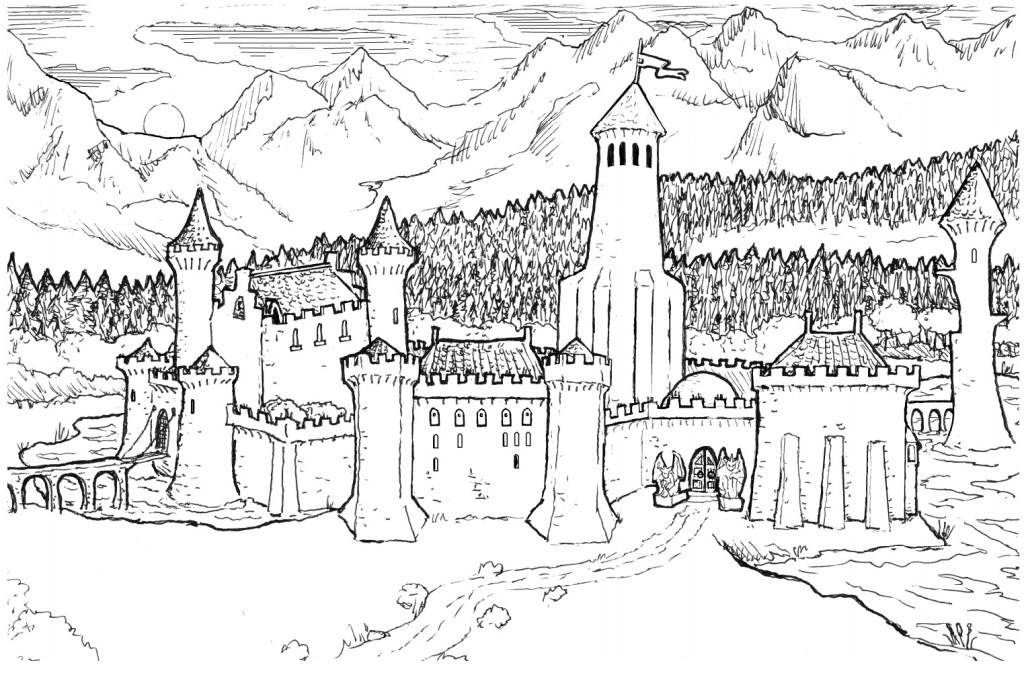
Gérard surveyed his environment with a cautious eye; and the more he looked the less he liked it; for some new and disagreeable detail was manifest at every glance. There were moving lights in the wood that vanished if he eyed them intently; there were drowned faces in the tarn that came and went like bubbles before he could discern their features. And, peering across the lake, he wondered why he had not seen the many-turreted castle of hoary stone whose neared walls were based in the dead waters. It was so grey and still and vasty, that it seemed to have stood for incomputable ages between the stagnant tarn and the equally stagnant heavens. it was ancienter than the world, it was older than the light; it was coeval with fear and darkness; and a horror dwelt upon it and crept unseen but palpable along its bastions. »

[…]

« Raoul », said the troubadour a little sternly,  » you must gather all your strength and come with me. Amid the gloomy walls that surrond us, the somber ancient halls, the high towers, and the heavy bastions, there is but one thing that veritably exists; and all the rest is a fabric of illusion. We must find the reality whereof I speak, and deal with it like true and valiant Christians. Come, we will now search the castle ere the lord and chatelaine shall awaken from their vampire lethargy. »

He led the way along the devious corridors with a swiftness that betokened much forethought. He had reconstructed in his mind the hoary pile of battlements and turrets as he had seen them the previous day, and he felt that the great donjon, being the center and stronghold of the edifice, might well be the place which he sought. With the sharpened staff in his hand, with Raoul lagging bloodlessly at his heels, he passed the doors of many secret rooms, the many windows that gave on the blindness of an inner court, and came at last to the lower story of the donjon-keep. »

Clark Ashton Smith – Averoigne: vol 1, excerpts

As I’ve stated many times already on this blog, I’m a big fan of CAS. I’ve put Castle Xyntillan (of the eponymous adventure module) into Averoigne, CAS’ fictional France setting. I’m already using some of its characters and places in our rpg game and I’m planning to add a few other things inspired by those stories too. Can’t say too much at the moment but here’s some excerpts to help vindicate my choice:

(The End of the Story)

« [Gérard de Venteillon] found his way to the ruins of the Château des Faussesflammes, which stands on a hill opposite the Benedictine abbey of Périgon.

Now these ruins (said the manuscript) are very old, and have long been avoided by the people of the district; for a legendry of immemorial evil clings about them, and it is said that they are the dwelling-place of foul spirits, the rendezvous of sorcerers and succubi. But Gérard, as if oblivious or fearless of their ill renown, plunged like one who is devil-driven into the shadow of the crumbling walls, and went, with the careful groping of a man who follows some given direction, to the northern end of the courtyard. There, directly between and below the two centermost windows, which, it may be, looked forth from the chamber of forgotten chatelaines, he pressed with his right foot on a flagstone differing from those about it in being of a triangular form. And the flagstone moved and tilted beneath his foot, revealing a flight of granite steps that went down into the earth. Then, lighting a taper he had brought with him, Gérard descended the steps, and the flagstone swung into place behind him.

On the morrow, his betrothed, Eleanor des Lys, and all her bridal train, waited vainly for him at the cathedral of Vyônes, the principal town of Averoigne, where the wedding has been set. And from that time his face was beheld by no man, and no vaguest rumor of Gérard de Venteillon or of the fate that befell him has ever passed among the living… »

(The Satyr)

« The couple [Olivier du Montoir and Comtesse Adèle] had wandered beyond the limits of their customary stroll, and were nearing a portion of the forest of Averoigne where the trees were older and taller than all others. Here, some of the huge oaks were said to date back to pagan days. Few people ever passed beneath them; and queer beliefs and legends had been attached to them by the peasantry for ages. Things had been seen within these precincts whose very existence was an affront to science and a blasphemy to religion; and evil influences were said to attend those who dared to intrude upon the sullen umbrage of the immemorial glades and thickets. The beliefs varied, and the legends were far from explicit; but all agreed that the wood was haunted by some entity inimical to man, some primordial spirit of ill that was ancienter than Christ or Satan. Panic, madness, demoniac possession, or baleful, unreasoning passions that led them to doom, were the lot of all who had trodden the demesnes of this entity. There were those who whispered what the spirit was, who told the incredible tales regarding its true nature, and described its true aspect; but such tales were not meet for the ear of devout Christians. »

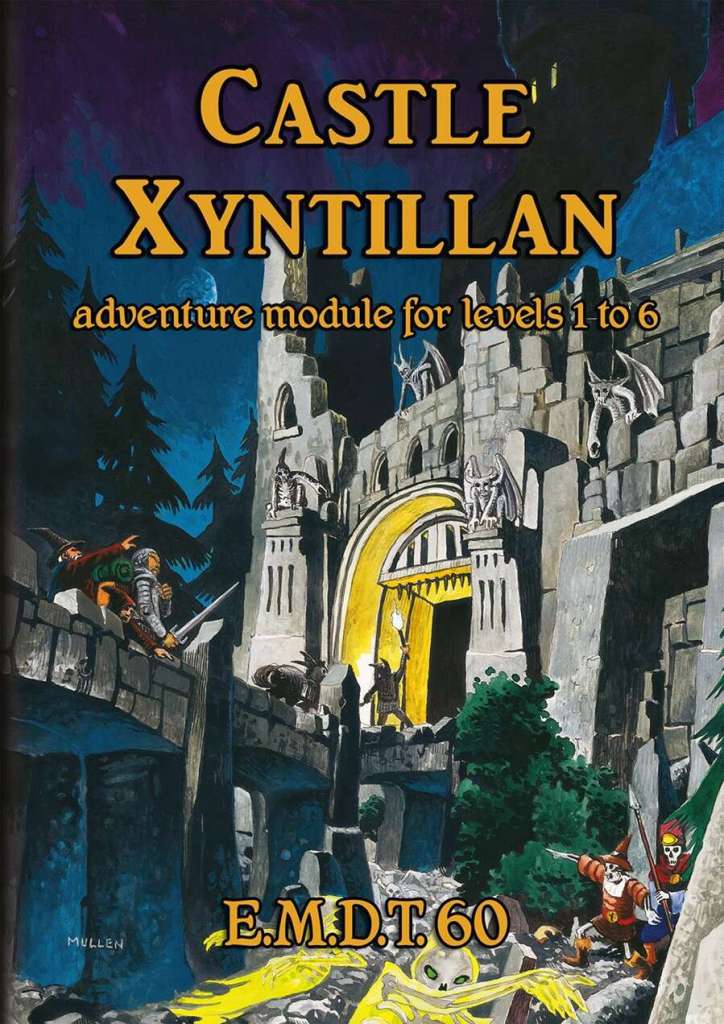
Castle Xyntillan

I took a day off last friday and decided it was time to try something new for our scheduled gaming session.

Some months ago I had bought Castle Xyntillan, directly from its designer in Hungary.

Now, Castle Xyntillan is an Indie/OSR megadungeon from game designer Gabor Lux, and is very much UNLIKE the D&D 5E books that I’ve purchased the past few years (albeit the last one I bought was like 3 years ago). Being nothing like a 5E book is in my present state of mind, a very good thing.

Its an adventure module set in haunted castle, not entirely serious but not a pure funhouse either. At the heart of the adventure is, of course, the impressive castle, but also its twisted and wicked inhabitants, the Malevol family members, truly a malevolent bunch!

As designed the module offers no clear end goal (indeed, goals should emerge from play) but it has TONS of delightful content to throw at the players. I think we could do easily 12-15 sessions just with the castle. Or dozens of session if I add side-adventures and whatnot.

I’ve decided to put Castle Xyntillan in author Clark Ashton Smith’s Averoigne, only the slightest of divergence from the default Valley of the 3 Rainbows setting anyway.

Set in a fictional medieval France. Averoigne is a forested and backwater region, beset by monsters, particularly witches, werewolves, vampires, and huh, beasts from beyond the veil…

I’m a big fan of CAS but I won’t be the first to use Averoigne. Tom Moldvay, in his 1981 module Castle Amber did just that.

The capital of the region is the gargoyles-infested city of Vyones. The other city is Ximes in which resides the Archbishop Azédarac, a dark sorcerer and demonologist.

(Aside: I’m pretty sure Gygax distorted the name Azédarac into Acererak, his infamous demi-lich of Tomb of Horrors fame)

There’s the cursed woods of Malinbois, the smaller town of Périgon with its monastery and then there’s the disquieting Château des Faussesflammes. Indeed, Castle Xyntillan will in fact be this very Château.

Now, I’m using the Worlds Without Number rpg system (which I might talk about in a future post). Learning how to play with both a new system and new style of play wasn’t effortless on my side or my players’, mistakes were made and a few tears were shed even, but our first session was certainly memorable and worthwhile.

Stay tuned, play report coming soon!

Session 41: Flower-Women

C’est le retour de Chris et Félix! Après un an d’absence en raison de toutes sortes de contraintes ça fait bien plaisir de les revoir et ils se joindront au groupe juste à temps pour le nouveau donjon! Mais pour le moment, une petite side-quest un peu loufoque question de se remettre dans l’ambiance.

Personnages Joueurs

  • (Félix) Flyzus, (level 8), Wood Elf Ranger (hunter), Outlander, n’a plus de famille ni de patrie, là pour l’aventure et se forger une nouvelle vie. Accompagné de son Dire Kakapo juvénile qu’il a sauvé.
  • (Chris) Pax Double-Poches, (level 6), Halfling Rogue (arcane trickster), Criminal, fuyant un passé criminel, à vu de ses yeux les trésors merveilleux qu’à rapporté le ranger Flyzus de sa dernìère expédition et s’est immiscé dans le groupe depuis
  • (Chris) Rufb (level 8), Half-Orc Barbarian (berserker), Mercenary Veteran; capturé par des pterafolks, seul survivant de sa bande de mercenaires, délivré par Flyzus au sommet du Firefinger

Maal Dweb approached the flower-women with a certain caution; for he knew that they were vampires. Their arms ended in long tendrils, pale as ivory, swifter and more supple than the coils of darting serpents, with which they were wont to secure the unwary victims drawn by their singing. Of course, knowing in his wisdom the inexorable laws of nature, he felt no disapproval of such vampirism; but, on the other hand, he did not care to be its object.

The Flower-Women by Clark Ashton Smith
Elles ont le regard un peu vide c’est vrai mais elles sentent tellement bon!

Depuis des mois qu’il les cherche

Le magicien Ronaro est revenu de la jungle en plus piteux état qu’à l’habitude. Ses habits sont en lambeaux et il a des bandages sanguinolents dont un autour du cou. Pax demande s’il peut offrir quelques soins et Ronaro n’a pas la force de refuser. Pax constate que la blessure au cou est en fait deux petits trous relativement profonds. Une morsure de vampire?! Pas tout à fait, une morsure de Femme-Fleur vampirique! Ces créatures sont très rares et Ronaro les a enfin trouvées, lui qui les cherchaient tout ce temps! Il en a besoin pour… Enfin son maître en a besoin pour se faire une potion de, hum, vitalité… (1)

Ronaro et son guide nain de la jungle ont trouvé une patch de Femmes-Fleurs à une demi-journée de marche dans la jungle. Le magicien utilise la faveur que les aventuriers lui doivent pour les envoyer là-bas, pour lui ramener une Femme-Fleur. Elle doit être en bon état!

Dangereuses mais Fragiles

Goï Gak, le Nain albinos, les guide donc jusqu’aux Femmes-Fleurs. Les PJs savent qu’elles ont un chant ensorcelant (2) et probablement du pollen aux effets néfastes aussi? Ils se mettent donc des bouchons dans les oreilles et les narines avant de procéder…

Pax s’avance précautionneusement en premier et constate qu’il y a 3 ou 4 Femmes-Fleurs mais elles sont espacées de 10-20 mètres entre elles. Pax décoche un carreau d’arbalète sur la plus proche, la blessant. Les Femme-Fleurs entament leurs chants de séduction mais les PJs, aidés de leurs bouchons, résistent à l’enchantement. Flyzus s’approche à son tour et se coordonne avec son Dire Kakapo (3) pour essayer d’enrouler la Femme-Fleur peu mobile d’une corde mais sa manœuvre n’est pas tout à fait réussie. Rufb accourt à la rescousse et tire un bon coup sur la corde et… coupe la Femme-Fleur en deux! (4)

Ils passent donc à la seconde…

Même tactique, un carreau d’arbalète de Pax la blesse, la corde par Flyzus et son animal de compagnie mais Rufb ne tirera pas sur la corde cette fois… La Femme-Fleur se débat, tente de saisir Flyzus de ses bras-tentacule mais sans succès. Elle tente de mordre Rudb qui s’approche mais celui-ci ne sans soucie pas et lui met un sac sur la tête et ensuite tous ensemble la déracine et partent avec.

Ils ramènent la Femme-Fleur à Ronaro, qui devra la ramener à Port Nyanzaru où présumément elle finira dans une potion pour son maître… (5)

Notes du DM:

  • potion de MANPOWER. Il doit satisfaire Poupette après tout!
  • comme dans la nouvelle de Clark Ashton Smith ci-dessus, qui m’a beaucoup inspiré
  • qu’il a dompté en downtime puisque plusieurs mois sont passés in-game
  • LE défi de ce combat était de ne pas détruire les adversaire comme à l’habitude haha!
  • Éthiquement discutable, pour le moins…

Demon of the Flower, Flower-Women Vampires and Pterodactyl Sorcerers

I’ve read some of Clark Ashton Smith recently to see if could steal some ideas for my D&D Ruins of Chult campaign. I don’t know if I’ll be using any of it but here’s some cool stuff nonetheless:

The Voorqual

The demon flower sprang from a bulb so encrusted with the growth of ages that it resembled a stone urn. Above this there rose the gnarled and mighty stalk that had displayed in earlier times the bifurcation of a mandrake, but whose halves had now grown together into a scaly, furrowed thing like the tail of some mythic sea-monster. The stalk was variegated with hues of greening bronze, of antique copper, with the livid blues and purples of fleshly corruption. It ended in a crown of stiff, blackish leaves, banded and spotted with poisonous, metallic white, and edged with sharp serrations as of savage weapons. From below the crown issued a long, sinuous arm, scaled like the main stem, and serpentining downward and outward to terminate in the huge upright bowl of a bizarre blossom — as if the arm, in sardonic fashion, should hold out a hellish beggar’s cup.

The Demon of the Flower by Clark Ashton Smith

Demon Flower post
Epic drawing from Raphael Ordonez

An immortal demon-possessed plant/flower, the Voorqual has its own priesthood tasked of bringing it human sacrifices. Killing a Voorqual is seemingly impossible, the only way is with a rare poison and even then, the demon-spirit inhabiting the plant can jump on another being that, in time, will be transformed in another Voorqual  (in the meanwhile a possessed human looks like a corrupted dryad, isn’t that cool?).

D&D use: A high level Boss fight. And the poison, necessary to have any kind of hope of defeating it, is a quest in itself, of course.

The Flower-Women

Maal Dweb approached the flower-women with a certain caution; for he knew that they were vampires. Their arms ended in long tendrils, pale as ivory, swifter and more supple than the coils of darting serpents, with which they were wont to secure the unwary victims drawn by their singing. Of course, knowing in his wisdom the inexorable laws of nature, he felt no disapproval of such vampirism; but, on the other hand, he did not care to be its object.

The Flower-Women by Clark Ashton Smith

avon_fr_no9

A strange mix of siren, plant and vampire, the Flower-Women, interestingly, are victims in the tale that presents them. Indeed, the pterodactylesque Ispazars capture and mash the poor bloodsucking Flower-Women to use as ingredients for their fell sorcery.

D&D use: They have a lurid song as the harpies but stronger (even the very powerful Maal Dweb has a tough time resisting it), they can grapple and they should have regenerate but they’re not very mobile and have the other usual plant vulnerabilities (fire at least, perhaps necrotic).

Pterodactyl Sorcerers

The depredators were certain reptilian beings, colossal in size and winged like pterodactyls, who came down from their new-built citadel among the mountains at the valley’s upper extreme. These beings, known as the Ispazars, seven in number, had become formidable sorcerers and had developed an intellection beyond that of their kind, together with many esoteric faculties. Preserving the cold and evilly cryptic nature of reptiles, they had made themselves the masters of an abhuman science.

The Flower-Women by Clark Ashton Smith

I wish WotC had used some of that for Tomb of Annihilation…

They came toward him among the crowded vessels, walking erect in the fashion of men on their short lizard legs, their ribbed and sabled wings retracted behind them, and their eyes glaring redly in the gloom. Two of them were armed with long, sinuous-bladed knives; and others were equipped with enormous adamantine pestles, to be employed, no doubt, in bruising the flesh of the floral vampire.

The Flower-Women by Clark Ashton Smith

D&D use: Yes! Some of the pterafolks of Chult will be admantine-pestles-brandishing magic-users…