A note on Parasites

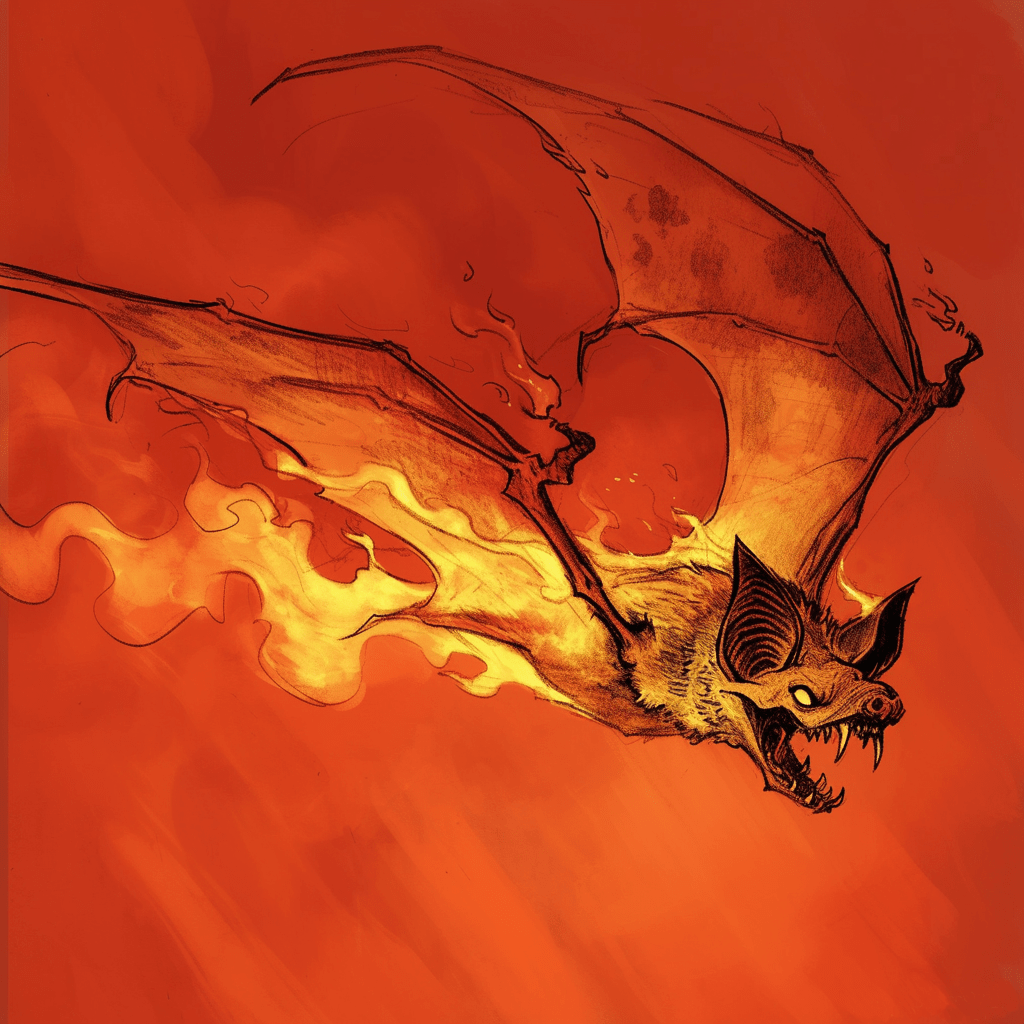
So that’s a bit random but I was thinking about resting/camping in D&D and then how STIRGES should preferably feed on sleeping targets and act more like their real-world counterpart, the vampire bat. And yeah, we might say I got down the rabbit hole…

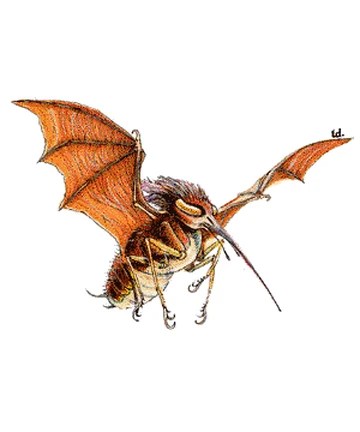
Am I a bat or am I a mosquito?

The sanguivore stirge should not be seen as predator but in fact as a parasite (it doesn’t wish to eat you, just to steal some of your blood, that’s parasitic in nature). Sometimes the boundary between the two gets blurry, for example many species of leeches in the real world are often both – stealing blood from animals and also swallowing micro-organisms.

I’ll not go into truly gruesome territory over here (there’s plenty of it when we talk about parasites) but suffice to say, I think including parasitic behavior within your fantasy ecology can definitely add some kind of unforgiving nature ambiance.

In my own game, in my Jungles of Chult campaign, I had giant parasitoid wasps (the mounts of wasp-riding goblins) that laid their eggs inside giant spiders and also fed on the spider-like sentient Araneas. The Araneas turned to the adventurers for help against this threat in exchange for precious spider silk vestments.

For you see, I’m a big fan of Gyagaxian Naturalism in my ttrpgs.

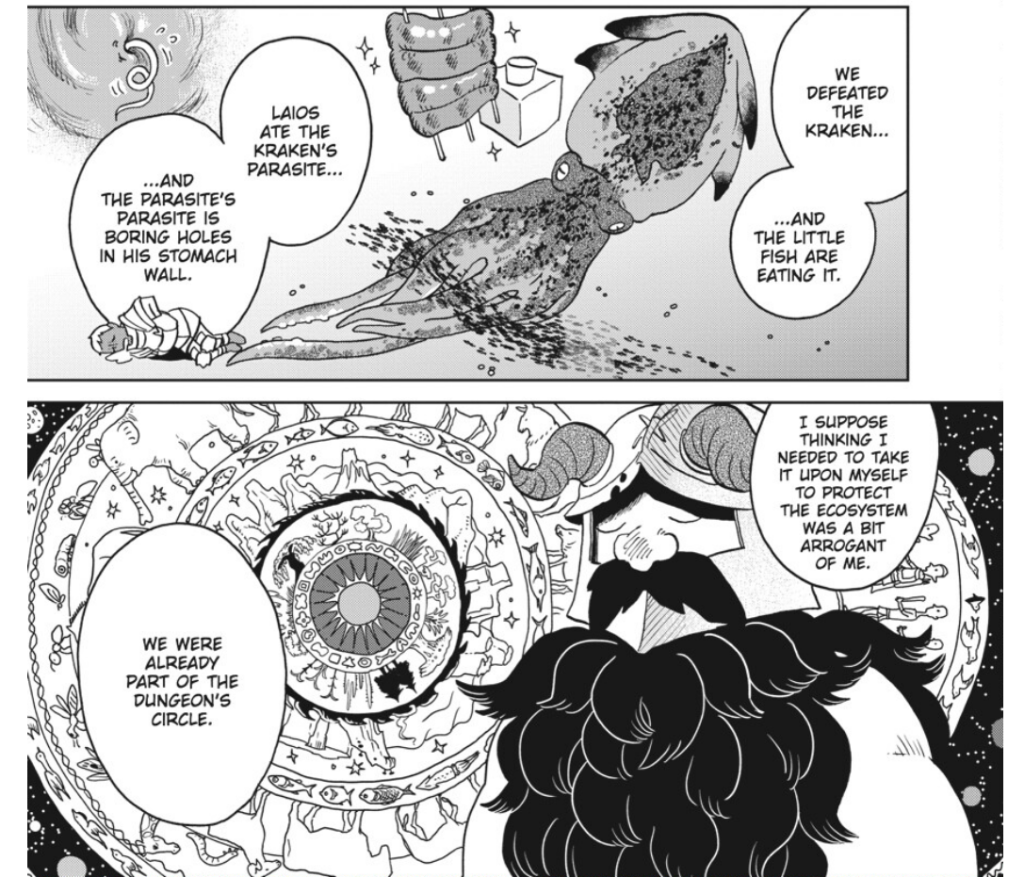
Ryoko Kui’s Dungeon Meshi.

And here’s an entertaining video from Unnatural History Channel, highly recommend this channel if you’re into that kind of stuff:

A note on Troglodytes

Been a while since I’ve done « A note on » post, but it’s been slow on the ttrpgaming front over here those last few weeks so I’ll put out this little filler.

Troglodytes in Heroes 3

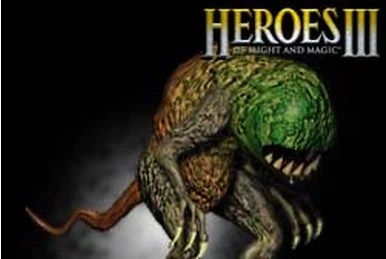
I’ve been playing the venerable computer game Heroes 3 with my sons for the last few weeks and we’re having great fun. My youngest is fond of the Dungeon faction, mainly for their strongest unit, the dragons unsurprisingly. Their weakest unit, the troglodyte, is MY favorite though. I love their design!

They don’t have eyes!
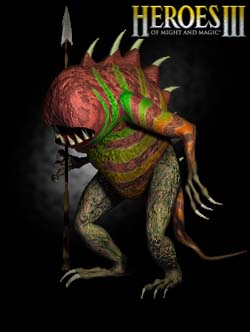
or the « improved » stronger version

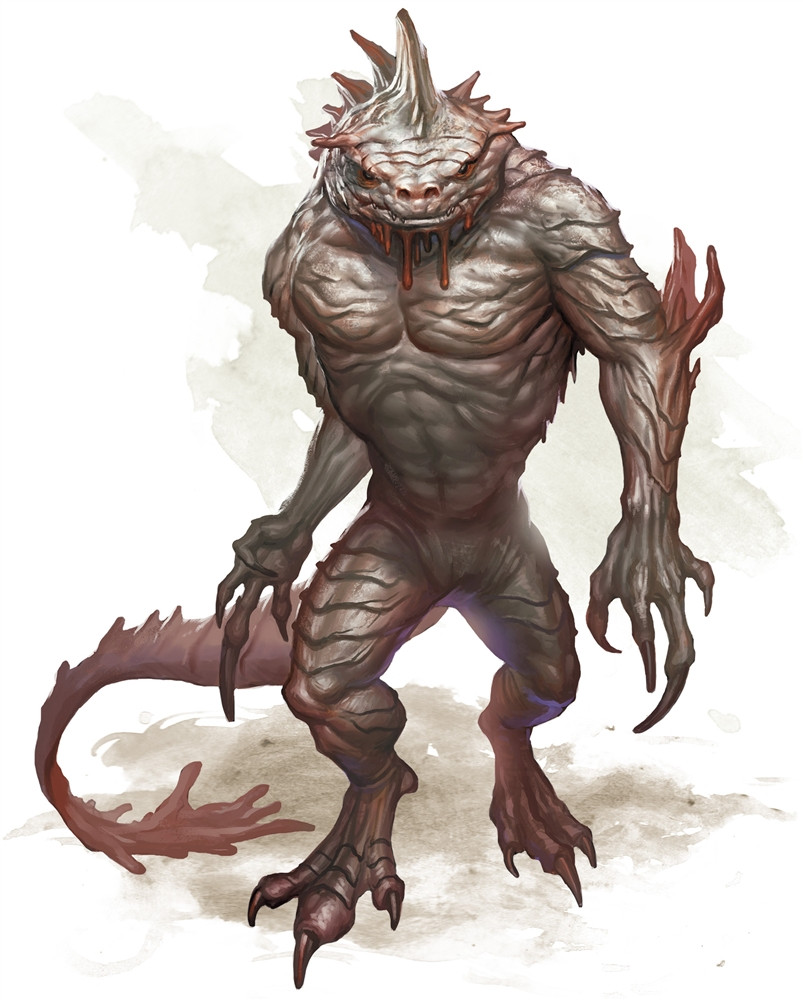
Contrast it with the current D&D version:

Not bad but it looks like some kind of ugly lizardman, nothing special here.

The one thing that differientate troglodytes from other monsters in D&D is their horrible stench. It’s okay, I have nothing against it but I think I can offer alternative features that are more interesting.

Now, troglodytes, as befit the name should be a mostly subterranean species. Making do without eyes could actually make a lot of sense (pun intended).

damn, the stuff we can find on the internet

New features for D&D

Anyway, yeah, I think eyeless troglodytes should have echolocation like dolphins or bats for that matter. The adventurers would hear the eery screams of the troglodytes coming for them, wouldn’t it be scary/cool? That could be a fluff thing or it could also means mechanically that Trologodytes are simply immune to anything that need eyesight to be affected (i.e illusions, or blindness obviously) AND would be vulnerable to silence effects (would be effectively « blinded »).

Now, a more audacious feature I would give troglodytes is darkvision camouflage. As in modern D&D something like three quarters of people have darkvision for some reason, what about the one species that would have evolved to mess with this sense? Be it low body temperature à la Predator, or some special skin pattern, the Troglodytes are basically invisible to darkvision users.

You hear the screams of those awful troglodytes adventurer? Hope you didn’t only banked on your darkvision and brought ye ole torch!

Delicious in Dungeon: the Golden Kingdom megadungeon, Book 9

Okay we’re at Book 9 now. Took me some time as my son had managed to lose the book inside his own room and couldn’t find it back even after I browbeat him into cleaning his mess. Kids… I mean, my son is awesome but tidiness is NOT is forte. Anyhow, I finally managed to find the book on the bottom of a drawer so here we are.

  • Right at the start we get an encounter with a black-armored, sword and whip wielding Dullahan (headless knight). It seems like it’s part spirit part physical. Its sword attack goes right through armor without damaging it. It’s also impervious to attacks, even magic ones! What’s one suppose to do? Laios, critically wounded, manages to make a deal with the Dullahan and it was pretty much the only reason why he didn’t die.
  • After that we have probably the most extreme example of dungeon ecology/monster biology to date when Laios’ Guild stumbles upon the reproducing ground of a swarm of Succubus [succubi]. True Succubus are demonic in nature but there’s another sort of creature that have been named after them: the Succubus Mosquito! Just like their namesake they can take the appearance of something of irresistible sex-appeal to their would-be victim. When they’re close enough they plunged their piercing, hollow tongue inside their victim to suck them dry. But wait there’s more, they then transform the stolen blood into a milk-like substance to nourish (via their anus, for good measure) their insect larvae that are kept in still water…
  • In the last third of the book we learn a lot about dungeons, why they exist and how they grow over time when it has found a « master ». Dungeons are basically prisons for demons (entities from another world), one demon per dungeon to be more precise. A demon/dungeon needs to interact with people to get stronger and thus does what it can to lure people to itself (riches and desire-fulfilling promises). The more powerful and complex the desires of someone are, the more strength the demon will gain when it will feed (literally) upon them. A person « eaten » in this manner will be either too weak to survive or become a shell of its former self.

So you see, Delicious in Dungeon has many typical fantasy fares, and not typical at all dungeon ecology and monster biology. It’s also sort of about food, nutrition and food taboos… But it could also have been called Dungeons & Demons!

Delicious in Dungeon: the Golden Kingdom megadungeon, Book 7

First episode has aired on netflix – a faithful rendition of about half, maybe less, of the first book. I must say though that the voice acting in english was really bad, wooden, I switched to french and it was much better (that’s unusual). Anyway, I’m now at book 7 in this series where I try to highlight the many interesting concepts of Delicious in Dungeon.

  • we’re still on the 6th level and now Laios’ guild is back where it all started – inside the Red Dragon’s Lair in a vast cavern where we can see several tunnels débouching into the place.
  • we learn that this place was thought to be the deepest place of the dungeon but, not too long ago, a magic-locked door was discovered that may lead to deeper levels
  • we see ice golems and like any of their counterpart they have a crudely-carved « core » (very small) buried inside the matter that constitutes them without which they cease to function
  • we see some Barometz, inoffensive magic-loving monsters that are plants with sheep on top:
  • I mean, it’s pretty weird isn’t it? But wait until you learn that the unripe fruits of the Barometz have sheep foetus inside, all perfectly edible of course…
  • The challenge (and interesting idea) with the Barometz is that you may be pretty sure that predators are nearby, attracted by the easy preys
  • we’re introduced to a new faction with the arrival in town of the caravel ship the « Canari » (great fitting name) and its crew of elves that appear when dungeons are close to getting out of control.
  • Elves in this universe are definetely outlandish, non-human, the fact that they have much longer lives changes the way they think, it’s great.
  • In the second half of the book we have a lot of lore exposition, mostly through Yaado (the grandson of the cursed king) and a visit where the human – simple folks but immortals – inhabitants of the Golden Kingdom go about their lives, cohabiting with docile (magically pacified) monsters. There’s milk producing female minotaurs, that’s a thing yes.
  • We learn that the titular god of the kingdom is the Winged Lion, it’s imprisoned by the Lunatic Magician at the deepest level of the dungeon. The Winged Lion sends forth prophecies so he can be freed. We’ve seen statues and fountains of the Winged Lion all along the previous books, nice.
  • The party is now inside a vast dwarven-built cistern with a very high ceiling supported by rows of columns covered by gold sheets. A perfect hunting ground for a griffon nesting high above.
  • We discover that a dwarven expedition found the dungeon from below, a few years before everyone else.

Book 8 Here

Delicious in Dungeon: the Golden Kingdom megadungeon, Book 6

Book 5 has ended with the meeting of 3 adventuring guilds, mostly in a friendly manner. Now, taking a big chunk of book 6 is an EPIC fight with a special monster that takes on the whole gang of adventurers, killing 7 of them, incapacitating another, before getting away. Oh, and by the way the show on netflix starts tomorrow!

  • We can add harpies to the monster list of the 5th Level (the City). We learn that they’re mostly just like birds, nothing very special there. One funny bit is that harpies don’t hesitate to shit on corpses to discourage other meat eaters and keep it for themselves. Pretty gross.
  • After the aforementionned epic fight Laios’ guild get down through a set of large stairs to the 6th Level. 6th Level is made of the sum of the aqueducts, sewers and prison cells below the Castle.
  • 6th Level is known to be uncomfortably warm but this time around its really cold, there’s even a snowstorm going on inside!
  • 6th Level is also known for its many psychic monsters.
  • One is the Shapeshifter. A bit of a misnomer as its main gimmick is making illusory doubles of its preys to create confusion, maybe? It’s like a doppleganger situation but the whole thing is an elaborate illusion? Frankly it’s not really clear what’s the point of the illusions on a tactical level. On a narrative level that’s another thing entirely as the party has to identify who are the clones among them, knowing that the clones are not perfect replicas as the images are taken from each other’s faulty memories or bias perception of their companions. So, I would say, this time the monster doesn’t make much sense but the scene is absolutely great.
  • It’s pretty much the same pattern with the Nightmare monster. Manifesting in one’s sleep, the monster feeds on its victim’s fears, draining its vital energy slowly. It’s a bit underwhelming to learn that their real physical appearance is a clam-like pest that infests your pillow…

Anyway, great tome, great scenes, a bit less stellar on the monster ecology front. I do like the concept of a dungeon Level with psychic monsters as its main threat though.

Book 7 Here

Delicious in Dungeon: the Golden Kingdom megadungeon, Book 5

There’s a lot of good stuff in book 5. The story definitely takes a darker turn just when we think that Laios has succeedeed in bringing his sister back from the dead. The comedy is still here but it’s obvious there’s some sort of bleaker plot down the line. Very clever in my opinion. And the dryad scene is awesome!

  • Laios’ guild is still in the 5th Level (the City) and its success in dealing with monsters has incurred the wrath of the master of the Dungeon, the Lunatic Magician. His magic intervention has the effect of shifting the layout of the Level every so often, confusing the adventurers into going in circles.
  • One fortunate thing though is that the Ghosts of the City are often helpful as contrary to those of the higher Levels they’re not insane. They show up when they wish so and the paths they follow are always safe.
  • There’s a great scene with the Corpse Retrievers, the same shady group that we’ve seen in a previous book, they use a powerful illusion so that adventuring guild members fight among themselves (they see each other as monsters). If you don’t find corpses you can help a little is what they say!
  • This other guild leader, Kabru, is like the antithesis of Laios, not that great against monsters but very shrewd and deadly against humanoids. He would probably be an assassin in AD&D.
  • We can add Sea Serpents to the Flooded Level, another Top of food chain monster.
  • We see yet another guild, this one with an oriental background. The leader, Toshiro, is a samurai-looking guy. Another member is a powerfully built female Oni warrior.
  • Meanwhile in 5th Level, with the Red Dragon gone, the local monsters are back. 5th Level is in fact reputed for its abundance of monsters.
  • A fight against Dryads in a kind of cemetary surrounded by trees and bushes. They’re dangerous but very fragile, looks like any hit would kill them, thus releasing their spores…
  • … and provoking an INTENSE allergic reaction. That’s where the fun begin, fighting the other dryads whilst you can’t see or breath properly…
  • Dryads are basically like flowers, ugh well, except that they reproduce by kissing each other… Of course they do.
  • We see Laios training in regenerative magic. That makes me think: I’ve mentionned that Delicious in Dungeon is D&D inspired but there’s some things that diverge obviously. One is that there don’t seem to be firm adventuring classes except maybe for the mages, I think the default system would be closer to something like GURPS where you invest your character points in whatever you want.
  • Speaking of diverging with D&D, the magic system is obviously not Vancian. It’s more like a magic/mana gauge that you can deplete.
  • There’s a fight against a Cocatrix, a bigger, meaner relative of the Basilisk. A bite of the serpent head can turn you into stone. Turning someone back to flesh is possible but not easy. You also have to take care of the body so it doesn’t break (i.e by falling over) before you find a cure.
  • Ghosts are often shown like they try to tell something but can’t. Some people are sensitive (?) enough to understand and talk to them.
  • There’s someting called Cleaners, inoffensive and amorphous organisms that repair damage caused to the dungeon.

Book 6 Here

Delicious in Dungeon: the Golden Kingdom megadungeon, Book 4

There’s a lot less monster variety and monster ecology in action in book 4. The reason to this is that Laios’s guild is now at the 5th Level (the City) and will encounter its deadly new resident, the Red Dragon, who (we can safely guess) pretty much chased off everything else (except ghosts). Of course its also the kind of encounter that can take quite a few pages…

(As usual, I’m keeping the spoilers to a minimum)

  • The book start with a scene with the richly-attired governor of the island (from the village above the dungeon) and a couple of gnome magic-users that serves as his advisors. One thing to note is that the plundering of the dungeon has brought tremendous wealth to the village, probably more within the first few years of its discovery. Now that it doesn’t seem so treasure-filled what’s still of great value (to some people at least) is its secrets. The Biggie being the special magic that binds soul and body. The governor is thus encouraged to continue to pay adventurers (as loot isn’t so prevalent anymore) to get below and kill monsters so that others can do their research with less risk.
  • The City Level is still mostly in good state. Its 3-4 story high buildings are densely packed, in proper medieval-style, with many covered bridges crossing above the streets.
  • We already knew that the Red Dragon has displaced an Orc tribe, we now see dead wargs, incinerated by fire breath.
  • Dragons have only one weak spot, on the neck, just below the jaw. Their scaled skin is otherwise impervious to normal weapons (non-normal include those made in adamantium and mithril).
  • We see a demonstration of forbidden Ancient Magic. The Elf Marcille, its user, argues that it’s what we make of it that counts. Chilchuck the Halfling counters that it hasn’t been forbidden for nothing, he also says (not to her face) that he hopes that she isn’t a « dark elf », obviously not a racial thing in this context.
  • We see someone asking hospitality from a gentle-looking ghost of a young girl that agrees.
  • We learn that wargs are ferocious, that a pack can hunt much larger prey, that they’re very smart but also that they live with orcs of their own volition and not because they are trained by them.

Book 5 Here

Delicious in Dungeon: the Golden Kingdom megadungeon, Book 2

In Book 2 we see Laios’ guild going through the Golden Kingdom’s third level (the Crypt being the 1st and the Forest Top the 2nd) and reaching the 4th near the end. The 3rd level is more of a classical dungeon setting as we’re now inside the upper part of the castle and what we see is a lot of bricks: corridors, great halls, and at one point, a vast atrium surrounded by balconies.

  • The main denizens of the level are undead (skeletons, ghouls and ghosts) and golems (only 3 remains but there were more before) and a few more surprises too. We learn that the presence of the golems is the main reason why there’s not much monsters invading from below. I’m guessing that the golems don’t attack the undead.
  • Sounds are amplified a lot, echoing along the stone corridors and one attentive listener can identify what’s nearby.
  • There’s a few fountains with running water but not much food to be collected from monsters on this level for obvious reasons.
  • There’s places that serves as a kind of disreputable taverns where one can meet adventurers and criminals in hiding.
  • In the book we see Orcs raiding the area but they usually stay on the lower levels. They’ve been forced out of their village by a rampaging Red Dragon. Orcs weren’t part of the Golden Kingdom, but they were the first to explore the lower levels as they were fleeing the surface after being attacked by Elves and Humans.
  • Orc toddlers are extra cute, of course they are.
  • There’s a thing that’s called a Treasure Insect that looks like a coin or a gem or even a pearl necklace (the centipede version).
  • There’s Living Paintings, if you get near one you get sucked in into a phantasmal world, sort of an extension of the scene that was depicted on the painting where you can get hurt, and probably die too. You’ll need external help to get out, you can’t bring back anything that you found inside but it can be an invaluable source of information/lore as you can see past events and talk to people long lost.
  • Mimics are very much like giant hermit crabs, they go from small to bigger containers as they grow in size. We learn (here’s a pretty potent example of applied monster ecology) that Treasure Insects are parasites of Mimics: they lay their eggs inside a Mimic so that their larvae feed on it, they can then count on greedy adventurers to open the chest later on and free the new generation!
  • The 3rd level is in fact many floors high, at the bottom you reach the 4th, the flooded level. It seems like the whole base of the castle is underwater.

Book 3 Here

Delicious in Dungeon: the Golden Kingdom Megadungeon

I’ve been quite fascinated by the concept of megadungeons for the last two years or so. I’m actually running a campaign inside Castle Xyntillan where I can see for myself how it’s done, we’re seven sessions in and it’s been a blast! I’ve listened attentively (twice!) to Mazirian’s Garden podcast episodes of Into the Megadungeon, on how to run a megadungeon for 100 + sessions (!), trying to absorb everything I hear.

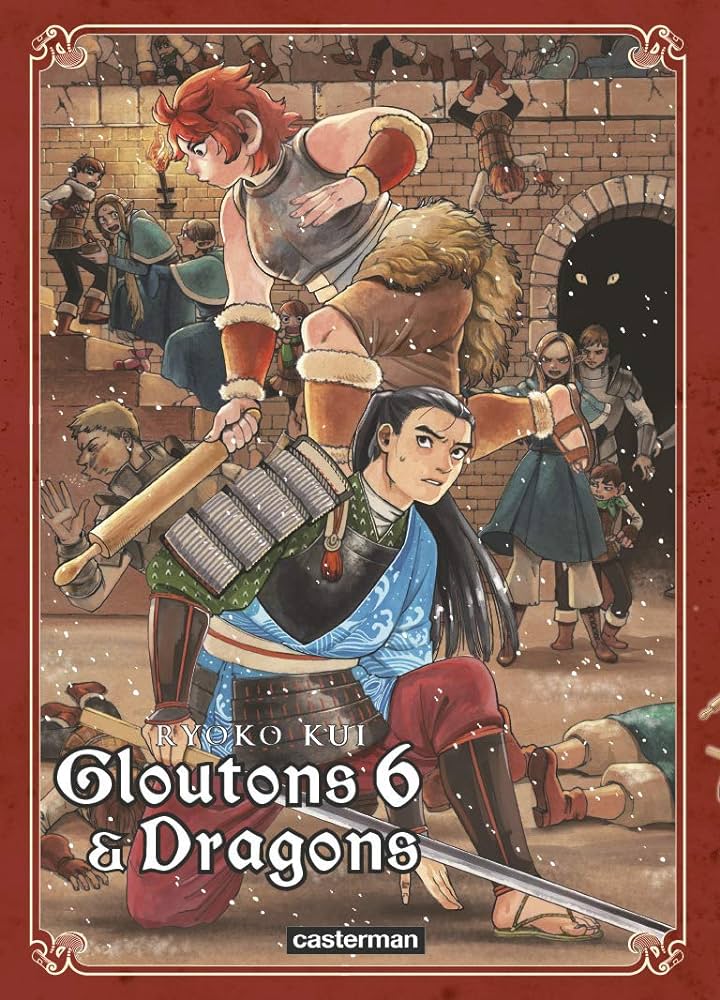
Another media that hooked me to megadungeons is the Delicious in Dungeon (Danjon Meshi), a D&D inspired manga by Ryoko Kui. That’s what I want to talk about today.

the french translation I’m reading with my kids

I don’t quite know how popular it is but it must be doing good enough as Netflix is launching a series starting soon, on January. So, you see, I’m actually doing a hype job, would you believe it! But you know what, I think it deserves the attention as I’m sure it offers a thing or two that even the most jaded, old-school gray-bearded dungeon master can borrow from…

In short:

  • a vast, unique megadungeon: a cursed kingdom that as been magically transported underground a 1000+ years ago, castle, village, fields, inhabitants and even sunlight
  • Monster ecology cranked to 11; reproducing habits, anatomy and of course, how to cook them
  • Related: Monsters as Puzzles, even weak monsters seem to be dangerous in this world, to fight them efficiently you must KNOW them, their tactics and weak spots
  • The logistic of food in dungeon-crawling way beyond simply bringing rations; have you eaten a balanced diet the last few days because if not, you won’t be at your best (and will probably die)!
  • a well-thought-out dungeon-centered economy: adventuring guilds, the town’s prosperity linked with the dungeon delves, etc.

Now here’s what I’ll do on my blog, I won’t talk much about the storyline I think, but I will highlight the stuff we learn about the Golden Kingdom, the dungeon lore if you will, from book to book. More specifically what we would need to know to run it as a ttrpg or, as usual, what’s worth stealing from.

Book 1

In order of the book:

  • The dungeon was discovered when a wall inside the village’s crypt (which seems surprisingly extensive) shattered. Beyond the wall, the inspecting villagers found a man that presented himself as the king of the Golden Kingdom that disappeared more than a millenium ago. He mentions a Mad Sorcerer that took control of the Golden Kingdom and he (the king) offers all his wealth to whom could defeat him and then his body turns to dust. (Don’t worry, it’s not simply a « wizard did this » dungeon…).
  • Adventurers work in guilds, with each members having signed contracts. The guild’s leader owns the party’s equipment in its entirety (weapons and armors included). He’s the one who buys provisions and equipment for everybody each delve. The guild members can resign and leave the guild if they wish so.
  • The 1st level of the dungeon is the Crypt. There’s no undead over there as one might have thought, it’s not a dangerous place per se as technically it’s not part of the Golden Kingdom but just happens to be the fortuitous entrance to the dungeon. But weak monsters do seep in, in this book we see: the Ambulatory Mushrooms (that come in many varieties, the Japanese know their mushrooms 😀 ), Scorpions (foot-long) that hides in cracks of the walls and Slimes (watch the ceiling).
beware the fearsome Ambulatory Mushroom!
  • The Crypt isn’t gloomy at all, it’s bursting with activity and noise. Merchants have put their wares among the alcoves of the dead and do their sales over sarcophagi. A bit sacrilegous but hey, there’s money to be made! Many adventuring guilds prepare for their expeditions or rest after they’ve returned from one. There’s a room with a fountain that is called Rookies’ Plaza where beginners gather.
  • We learn indirectly (there’s a hint of something else I’ll talk about when I get there), when the dwarf Senshi joins the party, that the dungeon has been open for a few years, certainly less than ten.
  • From the Crypt one can go down to the 2nd level, the Forest. The underground Castle’s numerous towers stand among incredibly tall trees.
  • A vast network of suspended bridges have been built, criss crossing the entire level, linking trees and towers together. That’s one way to descend to the lower levels, progressively by the bridges, it’s truly a vertical level.
  • The monsters are already a lot more dangerous (we see another adventuring party being tpked), there’s Sylvan Goblins, a variety of Carnivorous Plants, Basilisks and also, Imperial Bats (human-sized). Tree cavities and towers’ interiors provide ample hiding places for both adventurers and monsters.
  • There’s at least one shortcut that is indoor leading to the 3rd level (thus evading the scary Imperial Bats) that can be accessed in one of the larger tower but one need to find several secret doors and evade a series of traps.
  • Inside the towers (and castle) one can also encounter Living Armors. And by the way Living Armors are edible, of course they are! Or at least, the hive-minded molluscs that live inside the plates are…

That’s it for book 1, there’s 12 to date, stay tuned!

Book 2 Here

A Hag I can get behind, ugh!

I’ve commented on Talaraska’s blog (check it out, it has great content!) that I’m not a big fan of hags in D&D. I’ve suggested that he takes an interesting unique monster that he’d created as a main villain instead of his pick of a green hag. I’m sorry, I know, I can be annoying that way.

But why the hate on hags?

It’s got to do with thematics… huh, I think? Part of it is their « just another monster » treatment, just like there’s medusas in the monster manual instead of you know, the Medusa and her sisters Euryale and Shteno, the three gorgons of greek mythology. But also, and more annoying to me, is… what the heck is a hag?!

The Merriam-Webster dictionnary’s definition:

1an ugly, slatternly, or evil-looking old woman

archaic 2:

a: a female demon

b: an evil or frightening spirit hobgoblin

3: Witch

Now, in D&D hags are definitely ugly, have witch-related powers but are certainly not mortal, human-like witches, they’re creatures. If you take the 5e lore (the pain!) their origins lie in the Fey Wyld, a different plane of existence. So if we go with this, a hag is not exactly an « evil spirit » but not that far either. Of course, saying that a creature exists because it comes from somewhere else is the absolute laziest approach possible to lore in my not so humble opinion but hey, to each its own I guess.

Here’s a matter of personal taste but I myself prefer something more in the vein of « Fantasy Ecology » or Gygaxian Naturalism » if you like.

So in an effort of not being entirely negative I’ve searched far and wide (not) for an example of a hag that I actually do like and I’ve come up with the one in the Darkest Dungeon videogame (the original one, I’m always late to the party).

Here’s her bio from the game as explained by the Narrator/Ancestor:

I had collected many rare and elusive volumes on ancient herbal properties and was set to enjoy several weeks immersed in comfortable study. My work was interrupted, however, by a singularly striking young woman who insisted on repeated calls to the house.

Her knowledge of horticulturalism and its role in various arcane practices impressed me greatly. My licentious impulse gave way to a genuine professional respect, and together, we began to plant, harvest, and brew. As time wore on, her wild policy of self-experimentation grew intolerable.

She quaffed all manner of strange fungi, herbs, and concoctions, intent on gaining some insight into the horror we both knew to be growing beneath us. The change in her was appalling, and no longer able to stomach it, I sent her to live in the weald, where her wildness would be welcomed.
(Ah, the Ancestor, what a colossal jerk)

I think her backstory is great. Okay to be honest I’m sold on her mainly because I find her fight actions immensely funny. Here’s how it goes, as a Boss she has four:

Into the Pot! sends one member of the party into her cauldron to be boiled. That’s her main threat.

(pro tip: it’s not worth it to lose actions on the cauldron but be prepared to heal the boiled character when he gets out of it at 0 hp)

Meat Tenderizer, which she does with an actual meat hammer, a simple damage attack on everybody.

Season to Perfection (my favorite), where she throws seasoning at the party which debuffs and also (of course) causes stress. Because, y’know, receiving salt&pepper on you so you’ll taste better while you fight can be a bit alarming.

Taste the Stew, where she tastes the content of her cauldron, that is, one of your guys being turned into a stew before your very eyes… It heals the Hag a little and causes more stress to your team for good measure.

Wicked!

That’s it, a hag after my own heart!