A note on Cloakers

I forgot to mention one amusing encounter with a cloaker in a recent play report. I could simply edit the post and add a paragraph but I’ve figured that I could do one of my « A note on … » article as I think it’s quirky enough.

So basically a cloaker in D&D is a manta-like intelligent predator that, as the name implies, ressemble a black cloak or a coat when it’s immobile.

The funny gimmick (for a DM anyway) is the mode of attack of this ambush monster: once a cloaker has chosen a victim it will silently glide from behind or jump unto an unsuspecting passerby that thought it just a piece of clothe or use its mind-affecting « moan » power but either way it will engulf its prey to bite it or perhaps just let it suffocate to death. Outside help is complicated by the fact that hitting the Cloaker much likely hits the engulfed victim too!

Aside: The always useful The Monsters Know What They’re Doing’s article (here) on the cloaker tactics mentions how the « suffocate » mechanic should be applied efficiently in 5E.

The first appearance of the Cloaker goes back to the 1981 Secret of the Slavers Stockade, a 40p dungeon-crawling adventure, the second part out of four of the slavers series. In it, the bad guys had some kind of understanding with this strange creature that came from far underground and it acted as a guard of sort for the slaves. Already at its origins it has all kind of funky powers to keep the players guessing!

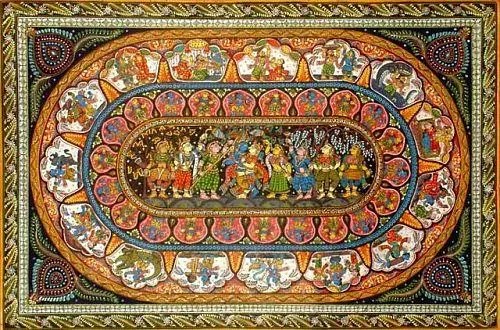
Now, my version of a cloaker that I’ve put in my game does not have the appearance of a black cloak but instead looked like an authentic ancient tapestry, with some kind of complicated art on it, hanging on a wall inside the Tomb of Iyayo.

Looks like a big mouth doesnt’ it?

The emphasis I’m doing in this case is more on the MIMIC nature of the cloaker than being an exotic manta-like underground predator that happens to look like a cloak. Tapestries, rugs, and such will always be potential cloakers in my dungeons from now on. The neat thing I think is that my players, with the past few dungeons, are used to find clues on such accessories and so the dilemna will be: will you get close to this ancient looking tapestry that may give you an important clue knowing that it may well be a cloaker? ‘Cause that’s one of the best part of D&D, the « will you mess with this »? that you throw at the players constantly!

The 7th Voyage of Sinbad – duel épique

Nous poursuivons avec les animations de Harryhausen – dans le désordre – avec Sinbad (1958). Et puis… C’est pas un grand film, disons-le… Avec probablement le pire accent  (du magicien Sokurah) arabe (?) fake de l’histoire du cinéma! Ish… Mais tout de même, c’est du bon divertissement, les enfants ont aimé, et que dire d’un duel épique d’un dragon contre un cyclope?!

A note on Myconids

27. sovereign basidia (2015) - out of the abyss

I don’t think I’ve ever used myconids, but that’s something I want to remediate soon enough. However, if I were to stick to D&D canon lore (which I won’t), myconids are supposed to be found exclusively in the underdark, the subterranean world home to the iconic drow. This was set in stone, so to speak, by Gary Gigax’s D1-2 Descent into the Depths of the Earth (1e), which of course, borrowed heavily on established hollow earth fiction (Jules Verne’s Voyage au centre de la Terre). More to the point, Gigax also borrowed the myconids, which were created in the earlier module  A4 In the Dungeons of the Slave Lords, which was an subteranean adventure (mostly) but in no way deep in the bowels of the earth-subteranean.

shrooms

They belong on the surface!

Leaving the myconids out of most of the more typical (surface) encounters is both sad and needless, in my opinion. Put in any setting, the potential is just mind-blowing…

mike-burns-deathbloomthallid-full-flat-c
Deathbloom Thallid (MtG), perfect for a Chult campaign conversion

thallid_mikeburns

sporecap_spider

Demon of the Flower, Flower-Women Vampires and Pterodactyl Sorcerers

I’ve read some of Clark Ashton Smith recently to see if could steal some ideas for my D&D Ruins of Chult campaign. I don’t know if I’ll be using any of it but here’s some cool stuff nonetheless:

The Voorqual

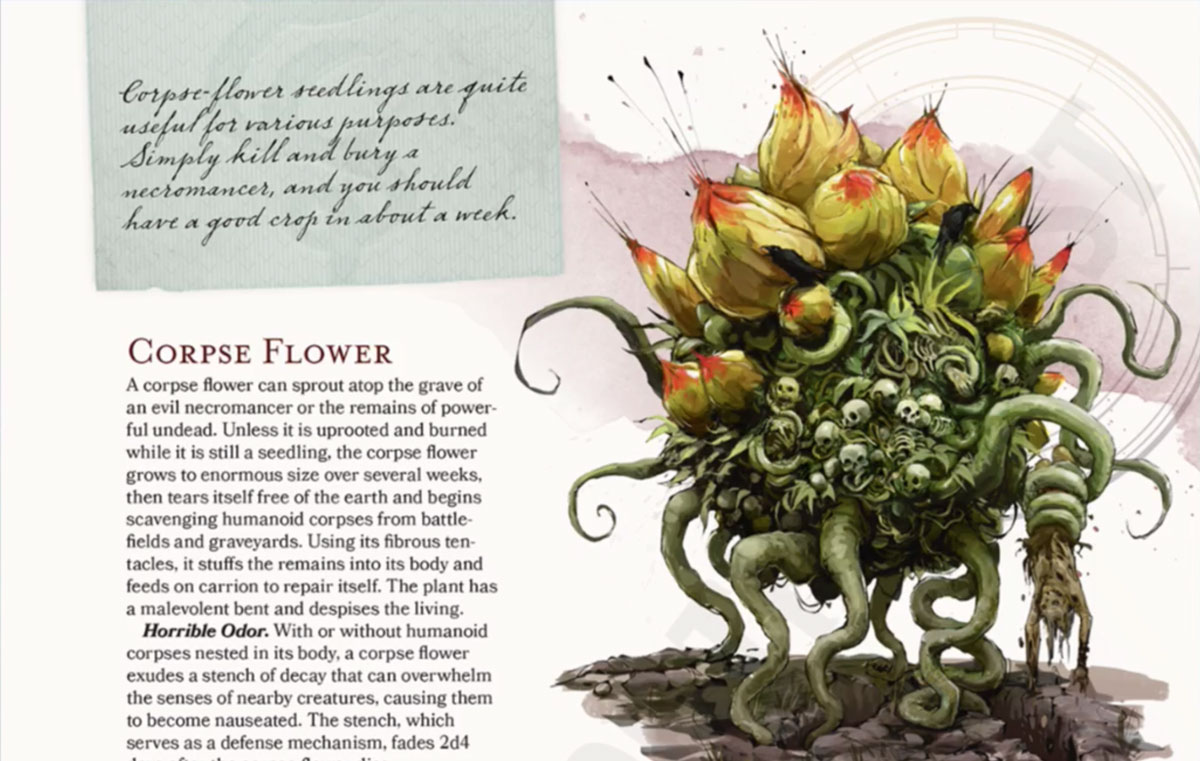
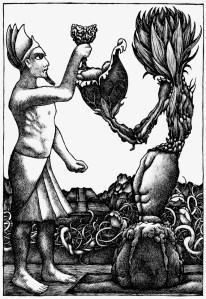
The demon flower sprang from a bulb so encrusted with the growth of ages that it resembled a stone urn. Above this there rose the gnarled and mighty stalk that had displayed in earlier times the bifurcation of a mandrake, but whose halves had now grown together into a scaly, furrowed thing like the tail of some mythic sea-monster. The stalk was variegated with hues of greening bronze, of antique copper, with the livid blues and purples of fleshly corruption. It ended in a crown of stiff, blackish leaves, banded and spotted with poisonous, metallic white, and edged with sharp serrations as of savage weapons. From below the crown issued a long, sinuous arm, scaled like the main stem, and serpentining downward and outward to terminate in the huge upright bowl of a bizarre blossom — as if the arm, in sardonic fashion, should hold out a hellish beggar’s cup.

The Demon of the Flower by Clark Ashton Smith

Demon Flower post
Epic drawing from Raphael Ordonez

An immortal demon-possessed plant/flower, the Voorqual has its own priesthood tasked of bringing it human sacrifices. Killing a Voorqual is seemingly impossible, the only way is with a rare poison and even then, the demon-spirit inhabiting the plant can jump on another being that, in time, will be transformed in another Voorqual  (in the meanwhile a possessed human looks like a corrupted dryad, isn’t that cool?).

D&D use: A high level Boss fight. And the poison, necessary to have any kind of hope of defeating it, is a quest in itself, of course.

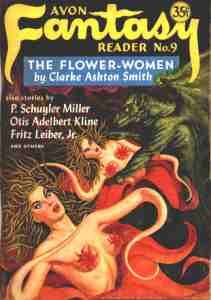
The Flower-Women

Maal Dweb approached the flower-women with a certain caution; for he knew that they were vampires. Their arms ended in long tendrils, pale as ivory, swifter and more supple than the coils of darting serpents, with which they were wont to secure the unwary victims drawn by their singing. Of course, knowing in his wisdom the inexorable laws of nature, he felt no disapproval of such vampirism; but, on the other hand, he did not care to be its object.

The Flower-Women by Clark Ashton Smith

avon_fr_no9

A strange mix of siren, plant and vampire, the Flower-Women, interestingly, are victims in the tale that presents them. Indeed, the pterodactylesque Ispazars capture and mash the poor bloodsucking Flower-Women to use as ingredients for their fell sorcery.

D&D use: They have a lurid song as the harpies but stronger (even the very powerful Maal Dweb has a tough time resisting it), they can grapple and they should have regenerate but they’re not very mobile and have the other usual plant vulnerabilities (fire at least, perhaps necrotic).

Pterodactyl Sorcerers

The depredators were certain reptilian beings, colossal in size and winged like pterodactyls, who came down from their new-built citadel among the mountains at the valley’s upper extreme. These beings, known as the Ispazars, seven in number, had become formidable sorcerers and had developed an intellection beyond that of their kind, together with many esoteric faculties. Preserving the cold and evilly cryptic nature of reptiles, they had made themselves the masters of an abhuman science.

The Flower-Women by Clark Ashton Smith

I wish WotC had used some of that for Tomb of Annihilation…

They came toward him among the crowded vessels, walking erect in the fashion of men on their short lizard legs, their ribbed and sabled wings retracted behind them, and their eyes glaring redly in the gloom. Two of them were armed with long, sinuous-bladed knives; and others were equipped with enormous adamantine pestles, to be employed, no doubt, in bruising the flesh of the floral vampire.

The Flower-Women by Clark Ashton Smith

D&D use: Yes! Some of the pterafolks of Chult will be admantine-pestles-brandishing magic-users…


District Invasion

As if the numerous troublesome gangs weren’t enough, outside parties often invite themselves to the woe of the inhabitants.

Gargoyles from the Folly

d482303b855934608b9f92f0ab760444

There’s many clutches of gargoyles living among the Folly’s dizzying heights. They’re very territorial and constantly at each other’s throats. They mostly keep to their high above ground perches but recently, the Covellites gargoyles, under pressure by an alliance of Realgars and Pyrites, have started making forays into the Harlequin.

Thrill-seeking Enclave Elves

bcefe0d392501ce8e5baf5cb8bf80ad2

Boredom can be a powerful driving force, suffer a couple of centuries of it and I’m sure you’ll agree. A manifestation of this is expressed by those elven interlopers going for a stroll in the « bad neighborhood ». Most of the time, such a group is escorted by hired arms and the elves themselves are comically clad with antique (and mostly useless) armors.  Less often, these Enclave Elves want to really test themselves and get some action. Some are actually quite good at it.

Kwaggers from… the Kwag

cd54fa2b192a38a7ce82016ff6b769bb

Be they of any races, kwaggers are kwaggers. Crazy, violent slum people who don’t even seem to want to better their lives. But then, the Kwag is literally a nexus of bad energy. Folks who live there don’t stay sane very long. Sometimes things spill out, a gate gets destroyed or a levy-bridge breaks, slamming down, and the Kwaggers swarm over, howling and clawing like madmen.